



While windy locations naturally make ideal spots for offshore wind farms, they bring challenges when it comes to assembling wind turbines, particularly in ports.
Most wind turbines have fixed foundations and are assembled at sea using powerful installation vessels that are specially designed to withstand strong winds. Floating wind turbines can be installed in deeper waters and deliver much higher power yields.
However, the movement of their foundations means they must be assembled in the calmer waters of ports, with their towers, nacelles, and blades constructed on their buoyant bases before being floated out as complete units. As years pass, the size of these turbines is steadily growing which means that some of the world’s largest cranes are now needed to assemble them at port.
The Eoliennes flottantes du Golfe du Lion (EFGL) wind farm is a joint venture between Ocean Winds and Banque des Territoires. With this project, floating wind technology will reach its third generation and mature towards mass deployment. Mammoet was approached by Euroports to support with the marshalling and assembly of the components that make up the three turbines at Port-la-Nouvelle in France. Engineers managed the entire operation in turbulent weather conditions as the project is located in one of the windiest areas in France, where speeds can reach 10 metres per second.
Foundations for success
Mammoet was brought in at the planning stage of the project to advise on what crane would be best suited for the job and how to ensure a smooth transition from component delivery to construction.
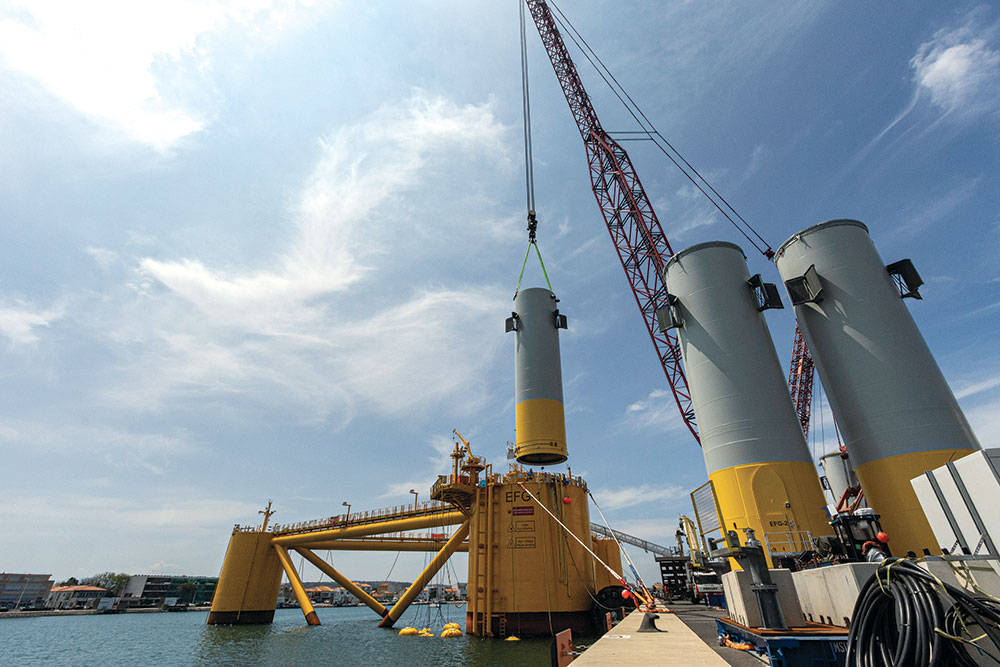
Its approach was to ensure that all the components for all three floating wind turbines were delivered to the port well in advance of assembly, to de-risk subsequent stages given the high probability of wind delays. A large crawler crane, the CC8800-1, was chosen as the main crane for the heavy lifts. It was supported by two 200 ton mobile cranes for tailing operations.
“With jobs like this, you must use a powerful crane with a big outreach capacity, because the foundations are moored next to the quayside,” explains Yan Billard, managing director of Mammoet France. “We used a CC8800, which has a 1600 ton capacity, fitted with a boom booster to create a 144 metre main boom. The booster is a special section that increases the capacity of the crane to enable higher lifting within a small radius”.
To ensure that the quay could take the full weight of the CC8800 during lifts, an area measuring 40 square metres was created that could sustain a ground-bearing pressure of 30 tons per square metre. The ground was reinforced with two layers of wooden mats, laid over gravel to ensure a flat foundation. 24 lines of Mammoet self-propelled modular transporters (SPMTs) were used to transport the components inside the port, driving them from the quayside to a laydown area before returning them for assembly. The three floating foundations were fabricated in For-sur-Mer and took a day of towing to reach Port-la-Nouvelle.
Managing the unmanageable
Once all the components were in their storage areas and the floating foundations temporarily moored near the entrance of the port, the project moved to the assembly phase.
Mammoet’s scope was to bring each component, in the right order, underneath the hook of the crawler using SPMTs. The CC8800 would then lift them into position so they could be bolted together.
The operation began with the three tower sections, followed by the nacelle, and then finally, the three blades. The heaviest item was the 380 ton nacelle.
Due to the electrical components inside, the bottom tower sections were stored beside the CC8800 in a vertical position. The other two sections were tailed into an upright position using the mobile cranes and the crawler.
“The wind presented the biggest challenge when it came to the lifts,” adds Billard. “When it exceeded speeds of 10 metres per second, lifting had to pause. It is a very windy area, and we were aware of this, but knew this was something we would have to manage effectively. Safety is always the top priority”.
Once all the components were connected, the turbine was moved by tugs to a different section of the quay for final assembly work to take place before the final load-out. Mammoet’s considerable experience in planning and supporting successful offshore wind projects makes it a perfect partner for de-risking projects in challenging environments.
For more information contact Mammoet Global,






© Technews Publishing (Pty) Ltd | All Rights Reserved
 printer friendly version