



Brent crude prices have moved sharply since March 2026, rising from $92 to over $113 per barrel in a single week. The International Energy Agency’s March 2026 Oil Market Report calls this the largest supply disruption in the history of the global oil market, with nearly 20 million barrels per day of crude and product exports affected by conflict in the Middle East and disruptions to the Strait of Hormuz.
For mining operations across Africa, shifts like these carry practical implications for operating costs. Energy is closely tied to almost every stage of the mining value chain, from crushing and milling to ventilation, dewatering and processing. For off-grid operations, where on-site diesel generation keeps production running, oil price volatility hits production costs directly. Delivered fuel prices at remote mine sites across Africa already exceed international benchmarks once you factor in transport, security and handling. When global crude surges 40% in a matter of weeks, as it has this quarter, the financial exposure compounds quickly.
This is not a new challenge, but the pace and scale of disruptions are accelerating. Energy strategy is becoming an increasingly important part of mining resilience and long-term planning.
The risk of a single-fuel strategy
Thermal generation continues to play an important role in many remote mining power strategies. Diesel and gas-powered generators deliver the firm, dispatchable capacity you need to keep operations running around the clock. In many cases, thermal generation remains a practical requirement for maintaining reliable baseload capacity.
The issue is not thermal power, but over-reliance on a single fuel source can increase exposure to cost and supply volatility outside your operational control. When every kilowatt-hour depends on diesel alone, you are not just running a mine, you are running a fuel logistics operation, exposed to currency swings, transport bottlenecks, and geopolitical shocks that have nothing to do with your orebody or your team’s capability. For a mine consuming millions of litres annually, swings in the fuel price can add millions of dollars to your cost base with a zero increase in output. That is not energy security.
Hybrid power enables cost predictability through diversification
One practical response to fuel volatility is to complement thermal generation with additional energy sources. It is to reduce the share of your energy mix that is exposed to volatile commodity prices.
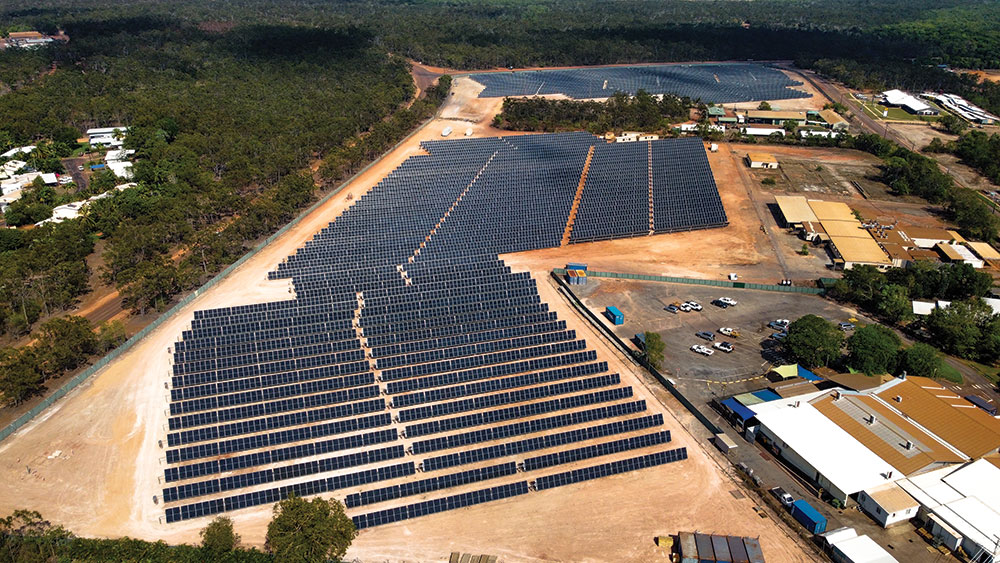
Hybrid power solutions are designed to support a more balanced and diversified energy mix. Solar photovoltaic arrays, battery energy storage and flexible thermal generation work together under advanced control to give you a more balanced, more predictable energy mix. Solar delivers low-cost energy during daylight hours at a fixed cost. Batteries smooth your load profile and capture excess renewable generation. Thermal assets provide firm backup and peak capacity, running more efficiently because they are no longer carrying the full baseload alone.
The economics speak for themselves. Past regional data shows solar-plus-storage can deliver electricity at USD $0,06 to 0,20 per kilowatt-hour, compared with $0,15 to over 0,50 per kilowatt-hour for diesel in off-grid contexts. Across multiple projects in Africa, well-designed hybrid power solutions have displaced up to 40% of diesel consumption while maintaining round-the-clock reliability. The Middle East and Africa microgrid market, valued at over $10 billion today, is projected to exceed $21 billion by 2030. Mining is a leading driver of that growth.
These outcomes are increasingly being demonstrated across operating sites in demanding environments, proven in some of the continent’s most demanding environments.
Beyond cost and the strategic case for acting now
Energy security in mining increasingly extends beyond fuel pricing considerations alone; it comes down to several factors that are becoming increasingly relevant for executive and board-level consideration.
Operational resilience is improved by hybrid power solutions as they build redundancy into your energy supply. If one source is disrupted, others compensate. Advanced controllers manage load balancing in real time, and well-designed solutions routinely deliver uptime above 99,9%. For a mine where every hour of downtime means lost production, that resilience matters.
Utilising solar energy enhances financial predictability, as its zero fuel costs post-installation serve as an effective hedge against volatility in fossil fuel prices. This approach offers your finance team a more consistent cost foundation for strategic long-term planning.Mines with lower, more predictable energy costs also unlock better access to sustainability-linked finance and stronger terms from offtake partners.
Licence to operate remains key. Institutional investors, international lenders and major commodity buyers now factor Scope 1 emissions and renewable energy adoption into their due diligence. A mid-sized mine transitioning to hybrid power can cut CO2 emissions by 50 000 to 100 000 tons annually. That is not just an environmental metric; it is a commercial advantage that strengthens your position across the value chain.
What holds mines back, and how to move past it
If the case is this strong, why has adoption not been faster? While adoption challenges exist, a growing range of solutions is helping address them.
Capital allocation is the most common constraint. You rightly prioritise investment in core operations such expanding the pit, upgrading processing and extending mine life. Large upfront capital spent on energy infrastructure competes with these priorities.
Alternative commercial models, including OPEX-led structures, can help reduce upfront capital requirements. Power purchase agreements and OPEX-led structures give you access to hybrid power solutions with minimal upfront investment. You pay for power on a per-kilowatt-hour basis, typically lower than your existing diesel cost, from day one.
Operational complexity is another concern. You are experts in extracting and processing minerals, not in managing integrated energy solutions that combine solar, storage and thermal generation. This is where working with an experienced energy partner can add value. The right energy partner brings lifecycle management such as operations, maintenance, remote monitoring, fuel mix optimisation, and the ability to scale your energy solution as production evolves.
Regulatory environments across African jurisdictions vary, and navigating permitting, environmental compliance and grid interconnection requires local knowledge and established on-the-ground relationships.
A practical path forward
The current oil price environment has made the cost of inaction hard to miss. Decisions around hybrid power are often informed by long-term trends rather than short-term price movements. They should be driven by a clear view of where the world is heading.
Africa holds over 40% of global reserves of cobalt, manganese and platinum, as well as growing deposits of lithium, graphite and rare earths. Demand for these minerals will intensify as the global energy transition accelerates. The mines that extract them will operate for decades, and your energy strategy should reflect that time horizon.
At Aggreko, we have spent decades powering mining operations in some of Africa’s most remote and challenging locations. We understand that reliability is non-negotiable, that every site has its own constraints, and that the shift from diesel-only to hybrid power must be practical, staged and proven at every step. We design, deploy and optimise modular hybrid power solutions that pair thermal and renewable assets in configurations you can scale over time, backed by flexible commercial structures and operational support across the continent.
Increasingly, the discussion is shifting from whether hybrid power can work to how to implement it effectively, with projects already demonstrating the viability of hybrid approaches. The question is: how quickly you can move to protect your operations from the next disruption, the next cost surge, or the next shift in investor expectations? Mines exploring hybrid approaches today may be better positioned for long-term cost stability and resilience.
For more information contact Ruth Mweu, Aggreko,






© Technews Publishing (Pty) Ltd | All Rights Reserved
 printer friendly version