



As with many things, the answer to this question is not a simple yes or no. The average person when confronted with the question of handling hydrogen gas immediately makes an association with two rather dramatic past events. The first was the appalling fate of the Hindenburg airship and its unfortunate passengers. This incident in 1937 brought to an end the short life of airships as serious passenger transport vehicles. The second is, of course, the dreaded atomic bomb, used to destroy the Japanese cities of Hiroshima and Nagasaki.
Before looking at the safe storage and usage of hydrogen in industry, let us look briefly at the fundamental risks that hydrogen technology involves. First of all, we can discard the hydrogen bomb concern. Splitting an atom of hydrogen to create a nuclear explosion is technically challenging and requires very sophisticated engineering. There is no possibility that hydrogen generated and stored in normal processes can in any conceivable way cause an atomic explosion.
However, as the Hindenburg incident demonstrated, hydrogen can burn and it burns easily; the energy required for ignition is extremely low. What then is the explosion risk? The primary risk of explosion occurs when a mixture of hydrogen and oxygen are trapped in an enclosed space – such as a pressure vessel. When pressure vessels are filled with hydrogen, the gas is monitored to ensure that no oxygen is present. If a pressure vessel is ruptured, the escaping gas may burn, but as long as it is allowed to disperse feely – it will not explode.
How does one mitigate the risks?
Firstly, in any environment where hydrogen may be used, stored, or generated, the first line of defence is to ensure that suitable ventilation is provided. This is simpler than it sounds. Hydrogen is the lightest element in the universe, and if it leaks, it disperses rapidly upwards as long as it is not trapped in spaces from which it cannot escape. Also, being such a small molecule, hydrogen can escape through extremely small holes. That said, if hydrogen is leaking, it is not easy to detect. Hydrogen is colourless and odourless. So, without reliable suitably designed instruments, it is difficult to tell if a dangerous situation is developing.
To summarise: one can generate and handle hydrogen without fear of fire or explosion provided some basic rules are followed:
1. Never allow a situation to develop where hydrogen can be trapped and mix with oxygen.
2. Install suitable hydrogen detection/monitoring equipment that will respond should a dangerous situation occur.
Instruments for the measurement and detection of hydrogen
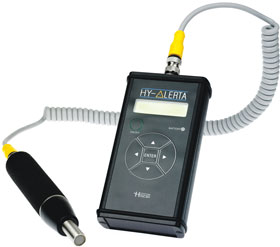
RTS Africa Technologies and H2scan of California are specialists in the manufacture and application of instruments for measurement and detection of hydrogen in a variety of industrial and scientific environments. A typical application is battery rooms. When batteries are charged, hydrogen gas is generated. Battery rooms, by their nature, are frequently enclosed environments with inadequate ventilation. All battery storage facilities should be equipped with H2scan HY-Alerta Gen 5 space monitors. These instruments can detect hydrogen in air down to a fraction of 1%, and can be connected to alarms, additional ventilations fans, or whatever safety plan is implemented. This enables automatic and human response action to be taken, long before a dangerous hydrogen rich atmosphere is created. The new HY-Alerta is based on H2scan’s recently announced Gen 5 system for distribution transformer monitoring, a first of its kind with a small-size, application specific integrated circuit (ASIC) hydrogen safety sensor that includes high accuracy, high-end features, and low cost in a compact instrument.
Another source of risk are hydrogen supply pipelines. Any air/oxygen entrained in hydrogen supply lines, whether due to leaks, process errors, or a variety of other possible reasons, can cause serious explosions. This is because, as mentioned above, a mixture of hydrogen and oxygen in a confined space such as a pipeline or pressure vessel creates a serious risk of explosion. Here H2scans HI-Optima online hydrogen gas analyser is a safety device that is essential in any environment where hydrogen is transported.
H2scan also manufacture analysers that can be used in processes such as oil refineries to monitor the hydrogen content in gas lines, and of course, any possible hydrogen leaks that may represent a risk to plant or personnel.
H2scan instruments also provide valuable safety devices in applications such as steel annealing plants, where an atmosphere consisting of a mixture of hydrogen and nitrogen is used to prevent oxidation of the hot steel plate during the annealing process.






© Technews Publishing (Pty) Ltd | All Rights Reserved
 printer friendly version