



Some questions never go out of date, and in our industry, a few have been asked for decades. At SA Gauge, we hear them every week: Which range should I choose? Do I need a liquid-filled gauge? How often should I calibrate? The technology behind pressure and temperature gauges has evolved, but the core principles remain the same. Whether you’re specifying instruments for a new installation or replacing older units, understanding the basics helps you choose wisely, avoid costly errors, and get the best performance from every gauge.
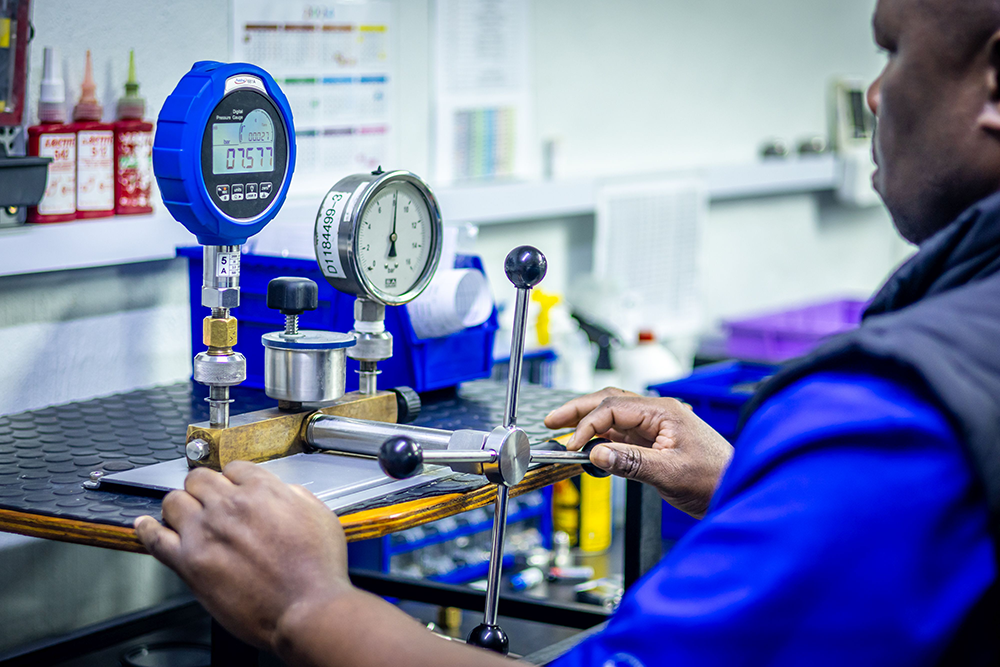
Here are the ten questions we hear most often, and the practical answers that can save time, money and frustration.
1. What range should I choose?
A gauge performs best and lasts longest when it operates in the middle third of its scale. If your gauge spends most of its life near the top of the dial, the mechanism wears faster and accuracy can drift. For pressure, select a gauge with a maximum range 25 to 50% higher than your normal operating pressure.
For temperature, pick a range that comfortably spans your expected minimum and maximum readings. This gives you a safety margin and ensures your gauge isn’t working at its limit.
2. Which gauge type is right for my application?
It depends on what you’re measuring and how you’ll use the reading. Pressure gauges come in three main types:
• Gauge pressure measures relative to atmospheric pressure.
• Absolute pressure measures from a vacuum and is used in sealed or controlled environments.
• Differential pressure measures the difference between two points, and is often used across filters or pumps.
Temperature gauges include:
• Bimetal thermometers for general industrial use.
• Gas-actuated thermometers for higher temperatures or remote installations.
• Liquid-in-glass or expansion types for stable, low-vibration applications.
Choosing the right type ensures accurate, reliable readings and longer service life.
3. How accurate should my gauge be?
Gauges are rated by accuracy class, often 1,0%, 1,6% or 2,5% of full scale.
• For process control or calibration, choose higher accuracy, 1% or better.
• For general plant monitoring, 1,6 to 2,5% is usually sufficient.
Specifying greater accuracy than you need adds cost without real benefit, but too little accuracy can lead to poor decisions based on misleading readings. It’s about matching precision to purpose.
4. Which connection and material should I use?
Always check thread type and size, usually BSP or NPT in ¼” or ½”. The process connection must fit properly and seal securely to avoid leaks or vibration damage. Equally important is the material of the wetted parts that come into contact with the process fluid.
• Brass works well for air, water and non-corrosive fluids.
• Stainless steel is better for corrosive media, high humidity or outdoor use.
A mismatch in materials can lead to corrosion, leaks and early failure; a simple detail that makes a big difference.
5. Should I use a liquid-filled or dry gauge?
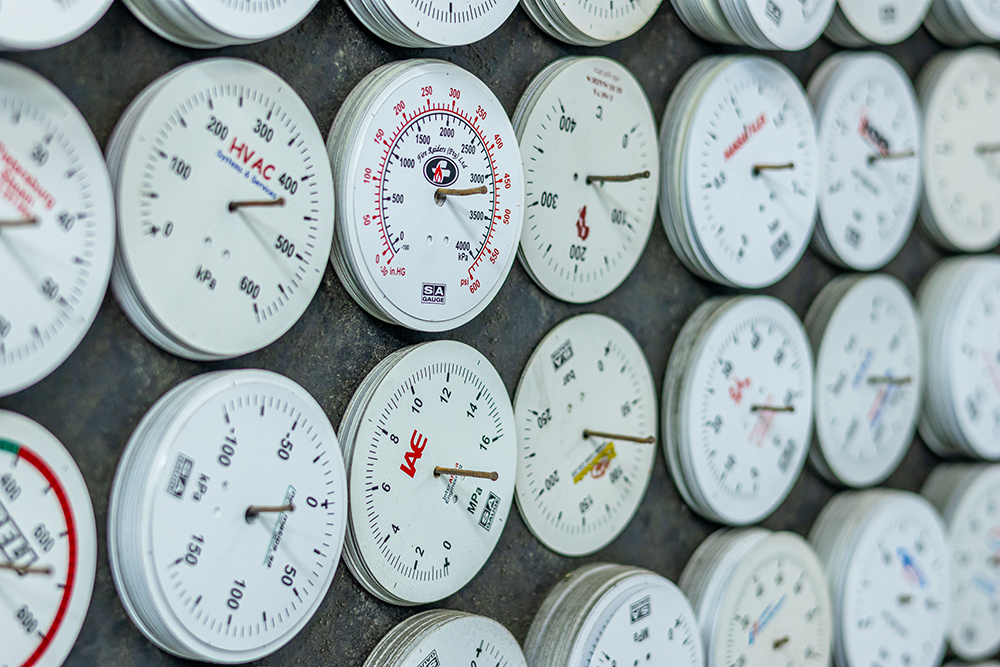
A liquid-filled gauge (usually glycerine-filled) cushions the internal mechanism against vibration and moisture. It’s ideal for pumps, compressors and outdoor environments. A dry gauge suits clean, stable applications and costs a little less.
If your process involves vibration or temperature swings, liquid filling is worth it for longer service life and steadier readings.
6. Do I need accessories like a snubber or thermowell?
Often, yes. Accessories protect gauges from the very conditions that shorten their life. For pressure gauges, a snubber dampens pulsation and sudden pressure spikes. For temperature gauges, a thermowell shields the sensor from corrosive or fast-moving fluids and allows replacement without draining the system. Adding these small, inexpensive components can double the life of your instruments.
7. What dial size and mounting style should I choose?
Readability matters as much as accuracy. For close-range or panel use, 63 mm dials are common. For field use or where visibility from a distance is important, go for 100 mm or 160 mm dials. Mounting styles can be bottom entry, back entry or panel mount, and depend on where the operator needs to read the gauge. Always position instruments for a clear, safe line of sight.
8. How do ambient conditions affect performance?
Environmental factors can influence accuracy and lifespan just as much as process conditions. High temperatures can soften seals or distort the Bourdon tube; cold can stiffen internal components; humidity can fog the dial or corrode the case. If gauges are exposed to the elements, consider liquid filling, protective housings or relocation to a less exposed spot. For extreme vibration or heat, use damping accessories or stainless steel construction.
9. How often should gauges be calibrated or replaced?
A gauge’s accuracy naturally changes over time due to mechanical wear and pressure cycling. For most industrial applications, calibration should be checked at least once a year, and more often in critical or high-use areas. Replace gauges showing:
• A pointer that doesn’t return to zero.
• Erratic or sluggish movement.
• Cracked lenses or corrosion inside the case.
Regular calibration ensures reliability and compliance, especially for processes where accuracy affects safety or product quality.
10. Where can I find local expertise and support?
Even the best instruments need correct specification, installation and maintenance. Working with a local supplier, like SA Gauge, ensures quick access to stock, calibration and application advice specific to South African conditions.
From standard pressure and temperature gauges to custom assemblies and accessories, local expertise saves time, reduces downtime and gives peace of mind that you’re fitting the right instrument for the job.
Conclusion
Pressure and temperature gauges might seem simple, but they remain at the heart of safe, reliable process control. Getting the basics right − range, type, material, accuracy and calibration − makes all the difference between consistent performance and costly downtime. At SA Gauge, we see these same questions every day, and we never tire of answering them because every correct specification is another system running safely and smoothly. Simple tools, when chosen well, still do the most important work.
| Tel: | +27 31 579 2216 |
| Email: | [email protected] |
| www: | www.sagauge.com |
| Articles: | More information and articles about SA Gauge |






© Technews Publishing (Pty) Ltd | All Rights Reserved
 printer friendly version