What generally happens is that shop floor staff complain about low compressed air pressure. This leads to operators increasing the air compressor’s discharge pressure, which in turn means that for every 1 bar increase in pressure, you are paying an extra 7% on your power bill. The increase in pressure will also increase the discharge temperature and the wear and tear on the compressor, and may also affect the air/oil reclaimer life span.
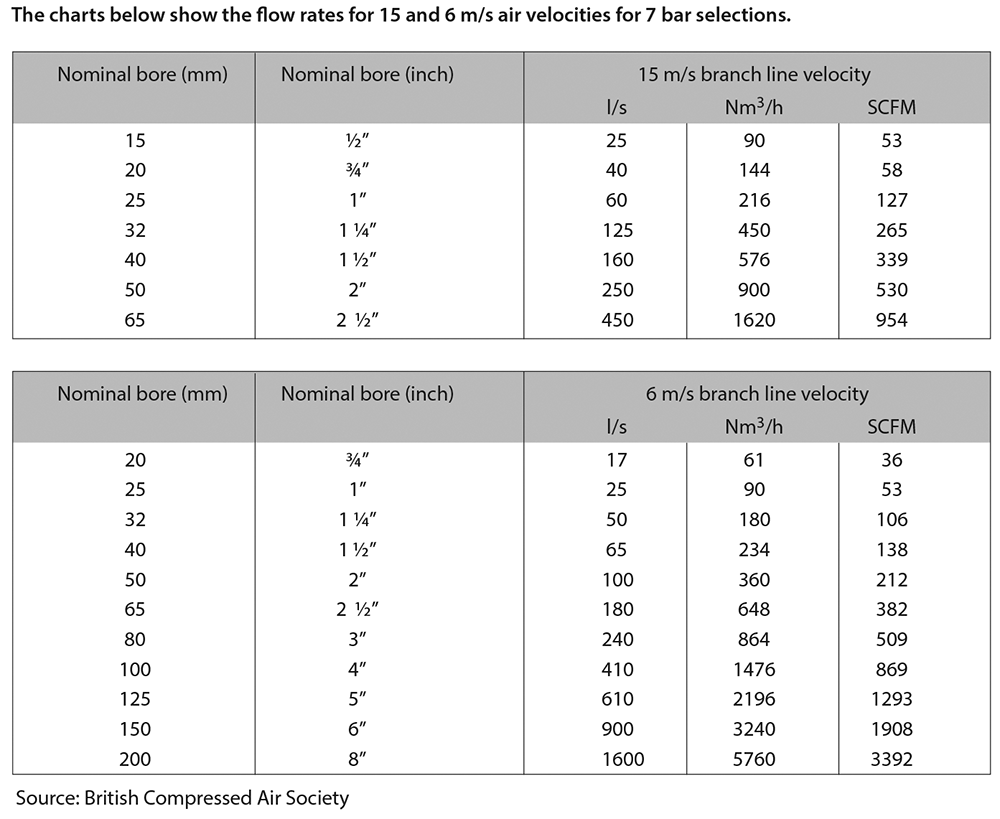
This is when bigger is better. Do not use 15 m/s as a guide for main line sizing. Use the 6 m/s selection guide. These guides are for bar applications, which will change if the pressure is lower or higher. Slower air velocities equate to lower pressure drops. This means better compressor performance and less power wasted. Use the higher speed chart for very short air take-off points only, nothing else.
The charts do not show the pressure drops for valves, bends, tee pieces or flex hoses. These charts are merely a guide – treat them cautiously. The manufacturers of compressors often set a bad example for pipe sizing. We frequently see very small undersized outlets on air compressor packages. This suits the manufacturer as the piping is cheaper and easier to fit into tightly engineered compressor packages.
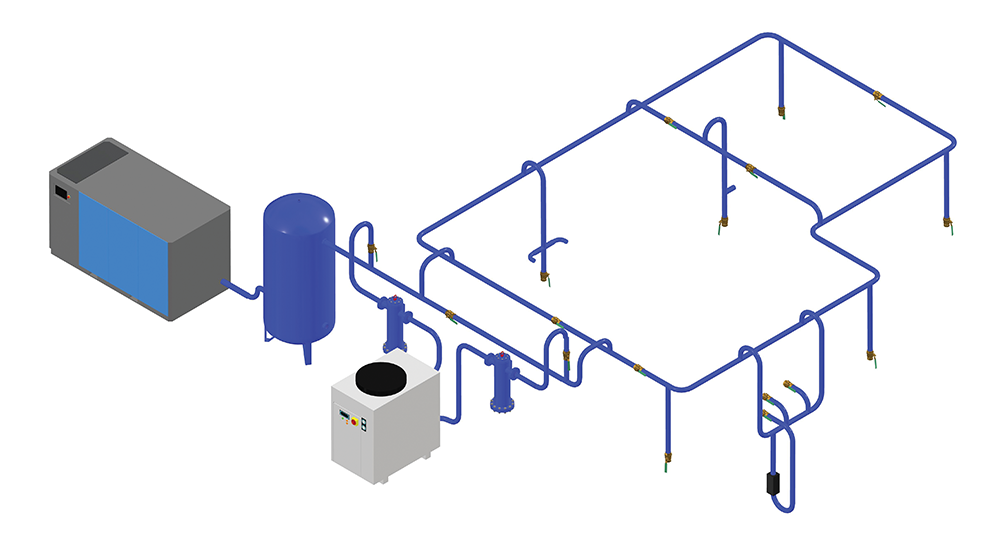
Check the charts above and oversize the piping accordingly, especially in the compressor room. Low speed equates to less back pressure. High velocities and bad pipe design lead to compressors bouncing from load to unload. This is not good for the controls, the filtration system, the air dryer or the compressor system itself.
Use a correctly sized air receiver to act as a buffer between the compressor and its ancillaries, such as dryer and filters. This will reduce your load and offload cycles and improve compressed air quality. High velocities and pressure drops in the compressor room frequently lead to the air compressor fighting for lead position or control. If possible, install a compressor controller where you determine the lead and lag air compressor as it will generally save you a small fortune on energy costs, compressor repairs and maintenance. Lower air speeds also improve compressed air filtration and reduce pressure drops across the filter bank.
Call us for a copy of ‘Compressed Air Piping Design Hints’.
Precision and durability in metal manufacturing and injection moulding Parker Hannifin - Sales Company South Africa
Pneumatics & Hydraulics
From 800 bar hydraulic circuits in metal presses to low-pressure cooling systems in injection moulding machines, Parker Hannifin’s fluid connector systems are engineered for the contrasting demands of high-pressure sealing, thermal resistance and rapid serviceability.
Read more...Turning compressed air into a strategic energy advantage
Pneumatics & Hydraulics
Compressed air accounts for up to 80% of a system’s lifecycle costs, yet often remains overlooked in energy strategies. CompAir’s Energy Check provides a data-driven analysis of the complete compressed air network to identify energy savings of 20 to 30% or more.
Read more...Air compressor secures premium meat company’s legacy
Pneumatics & Hydraulics
A tailored ELGi compressed air solution from Integrated Air Solutions is helping Tulisa Meat Market protect six decades of quality and consistency in its premium meat production.
Read more...Identifying signs of hydraulic cylinder wear and tear CT Hydraulics (Nqoba)
Pneumatics & Hydraulics
Recognising the early warning signs of hydraulic cylinder degradation is crucial for preventing costly downtime, ensuring operator safety and maximising the lifespan of your hydraulic systems.
Read more...Integrated Air Solutions opens Pinetown branch
Pneumatics & Hydraulics
Integrated Air Solutions has opened a branch in Pinetown, bringing world-class diesel and electric air compressor services closer to customers in KwaZulu-Natal.
Read more...Cartridge-style flowmeter Axiom Hydraulics
Pneumatics & Hydraulics
Sun’s new cartridge-style flowmeter QMEH delivers precise, real-time flow measurements for demanding hydraulic applications. Using a custom-built, state-of-the-art sensor, the QMEH accurately detects flow and converts the electrical signal into a proportional flow rate.
Read more...Robust sensors for pneumatic applications ifm - South Africa
Pneumatics & Hydraulics
The pressure sensors from ifm have a G1/8 process connection, combined with a welded thin-film measuring cell. While offering an unbeatable price/performance ratio, this technology provides for high measuring accuracy in a very compact and robust housing.
While every effort has been made to ensure the accuracy of the information contained herein, the publisher and its agents cannot be held responsible for any errors contained, or any loss incurred as a result. Articles published do not necessarily reflect the views of the publishers. The editor reserves the right to alter or cut copy. Articles submitted are deemed to have been cleared for publication. Advertisements and company contact details are published as provided by the advertiser. Technews Publishing (Pty) Ltd cannot be held responsible for the accuracy or veracity of supplied material.










 printer friendly version