


IT in Manufacturing


Track busway for scalable data centre power delivery

October 2025 IT in Manufacturing

The latest generation Legrand Data Centre Track Busway technology addresses the operational pressures facing today’s high-density, AI-intensive computing environments and is being well received by data centre facilities around the world.

The Legrand Track Busway system, engineered for reliability, safety and long-term efficiency, introduces modular, monitored power distribution infrastructure that supports scalable, fault-resilient data centre operations. The advanced track busway system supports current ratings from 160 A to 800 A and integrates key safety and monitoring technologies while simplifying installation and maintenance.
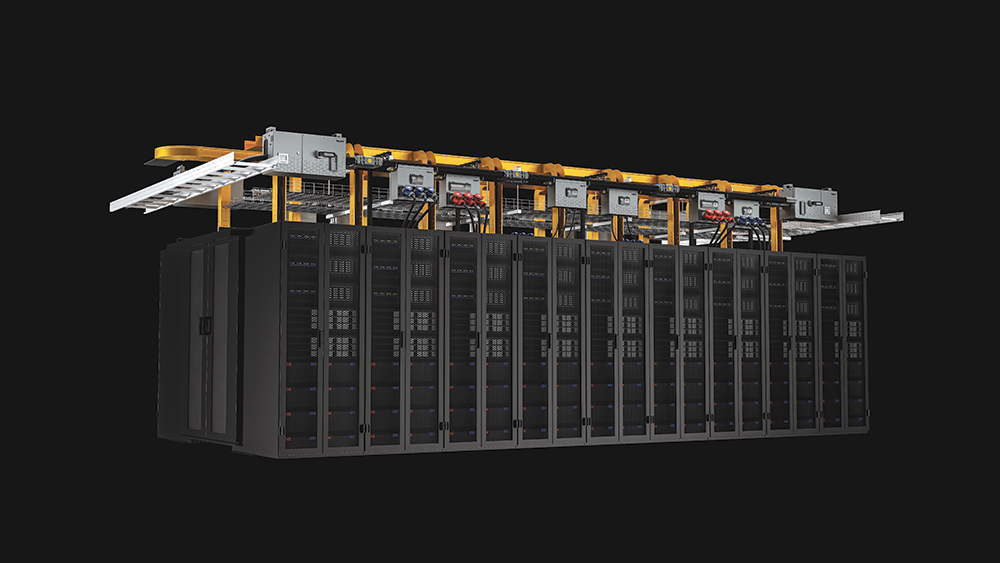
Legrand’s latest solution offers data centre operators who face the growing energy demands of AI-generated content and high-throughput networking a streamlined, intelligent approach to delivering uninterrupted power within compact, dynamic rack environments.

Notable features of the Legrand Track Busway compared to conventional busway systems include the combination of premium safety features, rapid tool-free installation, integrated intelligent monitoring and cost efficiency.

A standout feature is the fully tool-free Tap-Off Box (TOB) installation method, which uses a patented auto-hook mechanism and follows a ‘mechanical first, electrical second’ principle. This reduces risk during live expansion and ensures consistent, operator-safe connectivity. The TOB system requires no rotational alignment. Users simply insert vertically and engage the safety latch, completing the installation in seconds.

Straight sections of the system feature a lightweight, flat form structure with IP40-rated protection, enabling efficient use of ceiling space above racks, while maintaining secure conductor isolation. A ‘finger-safe’ conductor gap of 7 mm and integrated spring shims further enhance safety and mechanical reliability. With ≥ 99,95% copper purity and ≥ 97,6 % IACS conductivity, the system maintains strong thermal and electrical performance over an extended service period.

For sustainability-conscious operators, Legrand’s new design has advantages over conventional systems. Important benefits include 30% recycled copper and 30% recycled aluminium content in key components. By optimising conductor geometry and housing design, the system also reduces material usage and installation overheads, contributing to long-term energy and cost savings when compared with other systems.

Integrated intelligence features include four-point thermal monitoring at critical contact points (end feeds, joints and TOBs), with hot-swappable metering modules on both end feeds and tap-off units. These modules provide continuous tracking of voltage, current, power factor and joint temperature, ensuring real-time visibility into load and system performance. Communication options include Modbus-RTU and SNMP (v1/v2c/v3), allowing seamless integration into DCIM and facility management platforms.
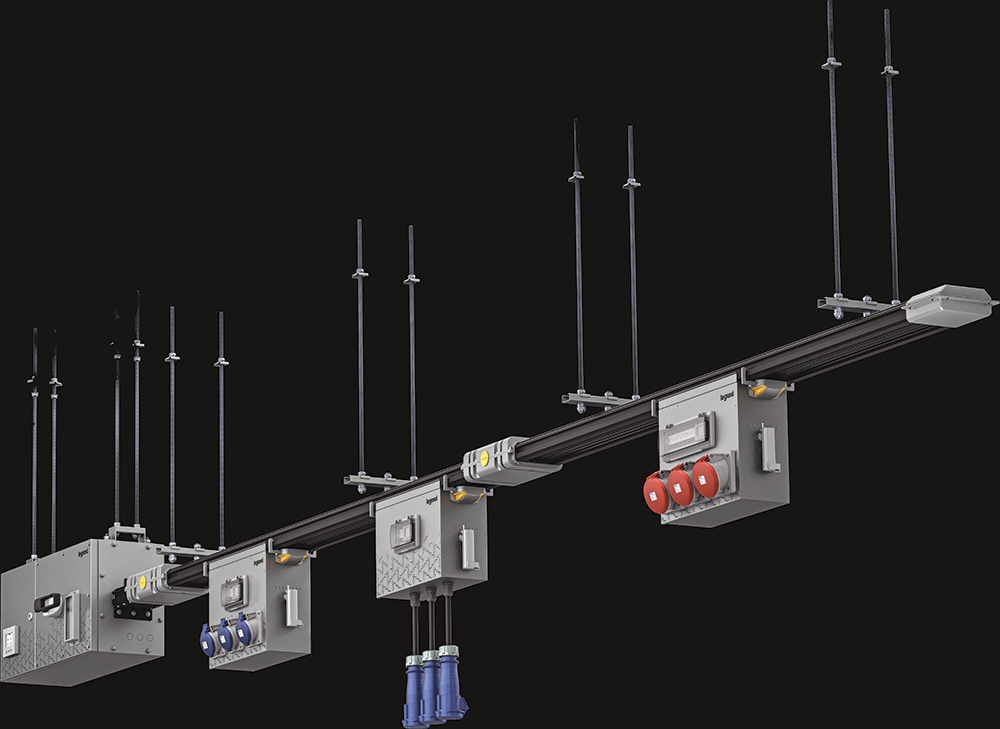
Thermal derating data is included for operation in ambient temperatures up to 60°C and the system conforms to IEC insulation clearance and creepage standards. Installation is supported by a modular hanging and support kit, allowing for free positioning of brackets and flexible deployment, even in space-constrained ceiling voids. Standard clearance requirements of 600 mm (horizontal) and 700 mm (vertical) ensure compatibility with common data centre layouts.

The Legrand Data Center Track Busway system is available in both monitored and non-monitored configurations, and includes MCCB-equipped end feeds for simplified field maintenance and enhanced circuit isolation. Tap-Off Boxes are offered in multiple output formats (up to 63 A) with options for angled front or bottom drop-cord connections. All units have consistent dimensions for modular integration and hot-swap metering enables live maintenance without service disruption.

The integration of standard advanced functionality into this system, including hot-swappable meters, multi-point temperature sensing and a compact, installation-friendly profile that eliminates the need for costly add-on features or complex customisation. This results in a lower total cost of ownership, while delivering high performance, reliability and low maintenance requirements.

For more information contact Legrand SA, +27 11 444 7971, legrand.south-africa@legrand.co.za, www.legrand.co.za


Share this article:
Share via emailShare via LinkedInPrint this page

Further reading:

The next generation of engineers is building living labs of innovation
Schneider Electric South Africa IT in Manufacturing
Graduate engineers at Schneider Electric East Africa designed, integrated and commissioned the smart building systems in the company’s new Nairobi head office, demonstrating how practical, real-world project experience accelerates engineering capability and confidence.

Read more...
Innodisk launches APEX series edge AI systems for industrial deployment
Vepac Electronics IT in Manufacturing
Innodisk has launched its APEX series edge AI systems, combining hardware, software and system design to simplify industrial AI deployment. The APEX-A100, powered by Qualcomm’s Dragonwing IQ9 processor, delivers up to 100 TOPS with guaranteed availability through 2038.

Read more...
Pilot project to optimise material flow
IT in Manufacturing
WEBER-HYDRAULIK has commissioned autonomous transport robots at its Güglingen site to handle internal material transport between warehouse and assembly areas. The pilot project uses RFID integration and SAP connectivity to automate material flows and reduce manual transport tasks.

Read more...
Accelerating pharmaceutical digital compliance and operational efficiency
Schneider Electric South Africa IT in Manufacturing
Cosmos Limited, one of Kenya’s leading pharmaceutical manufacturers, has partnered with Schneider Electric to implement an integrated monitoring, energy management and digital validation platform that has improved operational visibility, data integrity and regulatory compliance readiness.

Read more...
AI data centres, nature and innovation
Schneider Electric South Africa IT in Manufacturing
Artificial intelligence is driving unprecedented demand for data centre capacity, with liquid cooling now central to managing the heat generated by high-density GPU clusters. Schneider Electric examines how next-generation data centres can balance performance with environmental responsibility.

Read more...
Siemens powers next-generation reusable spacecraft development
Siemens South Africa IT in Manufacturing
A European aerospace startup focused on reusable space systems, has adopted Siemens Xcelerator software to connect engineering disciplines, reduce rework and accelerate spacecraft development, cutting the path from concept to flight hardware to nine months for its orbital demonstration capsule.

Read more...
How to navigate the high-stakes economics of AI infrastructure
IT in Manufacturing
Nearly 60% of data centre operators are expected to adopt liquid cooling within five years as AI workloads drive demand for higher rack densities. Understanding the full financial picture of liquid cooling, from capital investment to long-term operational savings, is now essential.

Read more...
Protecting the digital mine
RJ Connect IT in Manufacturing
As mining becomes increasingly connected and automated, cyber threats are emerging alongside the benefits of digitalisation. RJ Connect and provides rugged networking, edge computing and cybersecurity technologies from MOXA to help protect critical mining operations from evolving attacks.

Read more...
SICK launches AI-powered 3D quality inspection
SICK Automation Southern Africa IT in Manufacturing
SICK has combined deep learning with 3D height data analysis in its Nova machine vision platform.

Read more...
Predictive maintenance is the critical enabler for AI data centre liquid cooling systems
Schneider Electric South Africa IT in Manufacturing
As liquid cooling becomes essential for AI data centres, predictive and condition-based maintenance are emerging as critical enablers of thermal stability. Schneider Electric argues that the infrastructure is already generating the data needed and the question is whether operators are equipped to use it.

Read more...


While every effort has been made to ensure the accuracy of the information contained herein, the publisher and its agents cannot be held responsible for any errors contained, or any loss incurred as a result. Articles published do not necessarily reflect the views of the publishers. The editor reserves the right to alter or cut copy. Articles submitted are deemed to have been cleared for publication. Advertisements and company contact details are published as provided by the advertiser. Technews Publishing (Pty) Ltd cannot be held responsible for the accuracy or veracity of supplied material.


© Technews Publishing (Pty) Ltd | All Rights Reserved

