



As Europe’s first large-scale green hydrogen plant, Shell’s Holland Hydrogen 1 is a landmark renewable energy project. Its electrolyser units, with a total capacity of 200 MW, will generate up to 60 000 kg of hydrogen per day, drawing power from the Hollandse Kust Noord offshore wind farm.
The facility is unique and has wider significance in the establishment of viable, sustainable fuel sources for energy-hungry applications, such as construction and road haulage. Significant engineering expertise was required to ensure its ambitious blueprint could be built to schedule.
Mammoet was involved from the early stages of the project to consult on its constructability at the FEED phase and ultimately to plan and manage the road movements and key lifts that would bring the facility to life.
Mammoet’s early involvement, detailed planning and precision engineering was key to ensuring the biggest building blocks for this groundbreaking project were delivered safely and to schedule.
Constructing the plan
For more than two years, Mammoet assisted Shell with constructability planning for the facility, inputting into the engineering design process. This experience, honed from thousands of complex modular construction projects over decades, helped Shell to establish the optimum modularisation strategy.
“We started our involvement supporting with the route survey, as part of wider pre-study activity,” said Paul van der Waal, tender specialist at Mammoet. “I was actively involved in the constructability meetings to look at the build from a transport and lift perspective”. From this study, the team determined the optimum routes and equipment needed to transport the heaviest items to the site, many arriving by sea. The Euromax Terminal in Rotterdam was selected as the receiving port.
A study on a section of its quayside was conducted to ensure the ground was strong enough to bear the weight of the heaviest components and ensure this did not become a limiting factor on the size and cost-efficiency of modules. Working inside this section of the quay, the heavy items were unloaded from arriving vessels using a 750 ton mobile crane and placed onto conventional trailers pulled by prime movers. Once offloaded, they were moved to a temporary storage area inside the port or transported directly to the site, 15km away.
Safe and efficient lift and transport planning
Following the FEED phase, Mammoet was heavily involved in delivery by providing the means to unload, transport and ready the components for installation. Emissions were not permitted during the significant phases of this project taking place indoors. Following its work over recent years to decarbonise many heavy lifting and transport scopes, Mammoet was prepared for this scenario.
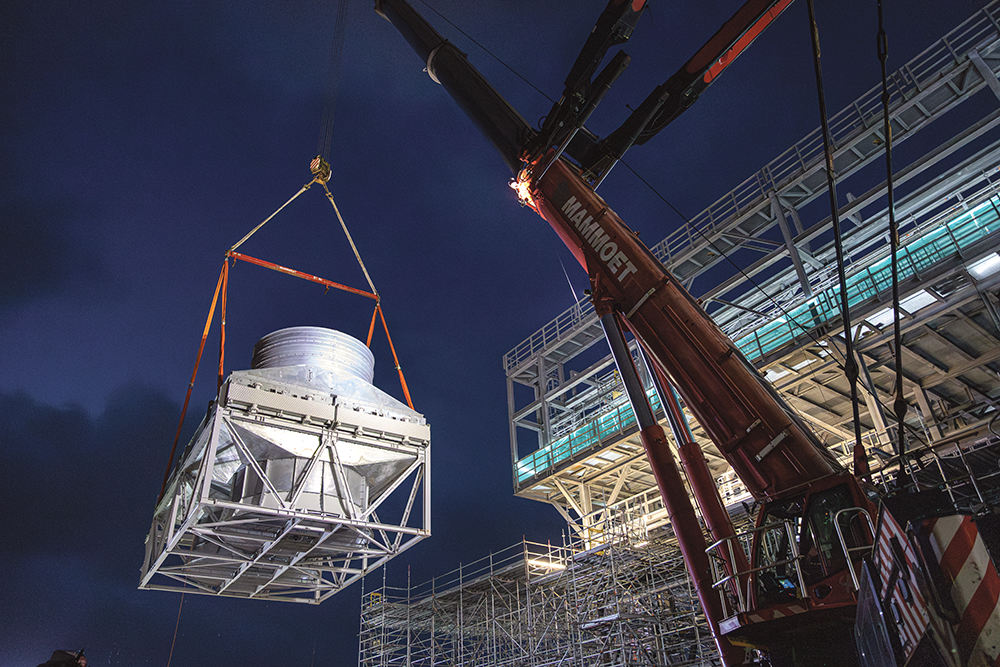
An assortment of zero-emission equipment was used on site, including a heavy-duty carrier (HDC hydraulic platform trailer), robot mover and LTC1050-3.1E crane, all powered by electricity. Mobile cranes, with capacities ranging between 60 and 750 tons, were utilised throughout. Heavy items were installed by being skidded or lifted into position. Transformers 90 to 165 tons were installed by skidding and jacking. Ten large air cooler units of 80 tons each were lifted onto the facility’s roof using a dedicated steel structure.
Mammoet also supported the installation of around 200 items inside the building housing the electrolyser. These comprised ten electrolyser units, each built from approximately 20 parts.
The teams to deliver
With space on the site limited, finding ways to help alleviate this was never far from the minds of the team. This led to a large pipe rack unit being fabricated offsite instead of inside the facility. Mammoet was able to move and install the rack in two sections, providing a modular construction solution that saved time and space and minimised onsite disruption.
Early involvement and effective communication brought huge benefits during the project, with dedicated engineering and operations teams at Mammoet supporting at every stage. “We had an active onsite team who was fully immersed in the process,” said Marco Barendregt, project manager at Mammoet. “We maintained good communication with Shell, as well as with all the other parties on the mechanical, steel and construction sides of the build. This ensured the installation schedule went to plan, with every heavy movement integrated smoothly with the next”.
The project demonstrates how long-term experience in modular construction is being used to help construct future sustainable energy alternatives. Through its successful completion, another step has been taken on the journey towards an emission-free future for heavy industry, supported by emission-free equipment from Mammoet.






© Technews Publishing (Pty) Ltd | All Rights Reserved
 printer friendly version