



For large, complex or hard to reach equipment, unplanned downtime quickly becomes a major problem. Predictive maintenance helps to minimise the probability of this occurring. The more detailed the knowledge about the current state of the plant, the more efficiently maintenance can be planned and performed. A digital twin creates the ideal conditions for this. The digital twin starter kit from Bosch and Pepperl+Fuchs offers an extremely simple introduction to this technology, and can also be easily used in existing plants.
If a geothermal pump needs to be hauled from a great depth, a wind turbine nacelle needs to be climbed, or a kilometre long conveyor belt system needs to be inspected for the repair, it will inevitably become expensive. The maintenance operation itself is very time consuming, and the production downtimes often contribute to additional costs. Predictive maintenance, which is intended to prevent or at least minimise downtimes, has so far often been linked to fixed cycles, and is initiated without precise knowledge of the actual plant condition. It is therefore not really predictive, but instead preventive, and tends to always take place earlier than necessary, or oherwise too late.
Modular solution for data-based prediction
Truly predictive or proactive maintenance requires insight into the plant and information from the field that is as precise as possible. In a digital twin, the available data is combined and can therefore serve as the basis for demand-oriented and efficient maintenance planning. In new plants, the digital twin is often implemented during installation. By contrast, existing plants feature a barrier for integrating additional technology into a functioning system.
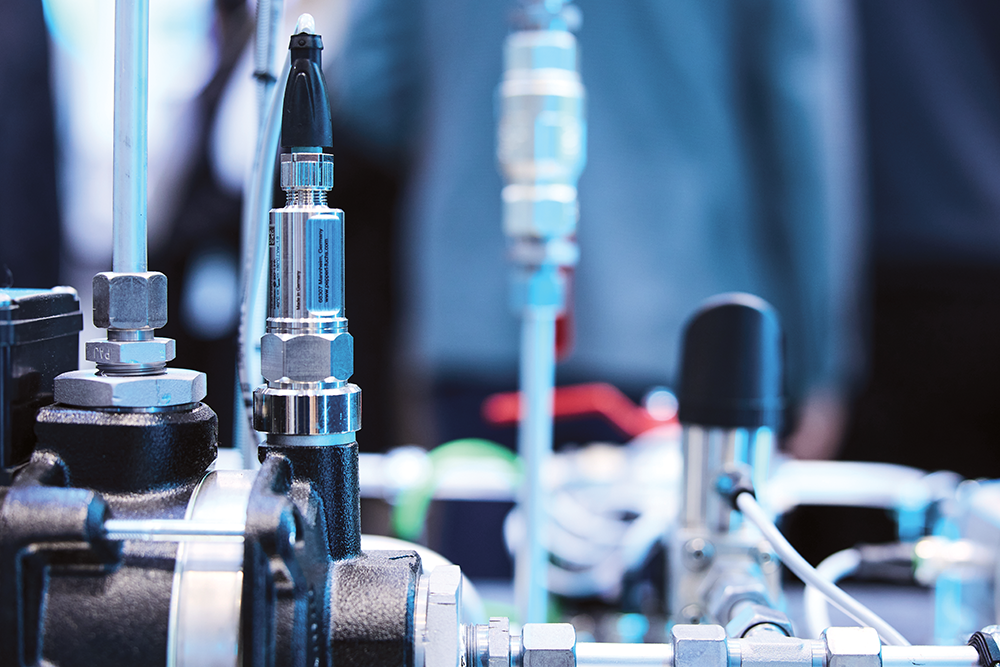
The digital twin starter kit from Bosch Digital Twin Industries and Pepperl+Fuchs is specifically designed to overcome this threshold. It is a ready-to-use complete hardware and software solution that can be integrated into running plants according to the plug-and-play principle. The hardware consists of a powerful 12 kHz vibration sensor, an ICE2/3 IO-Link master, and the BTC22 embedded PC from Pepperl+Fuchs. Together, these devices establish a connection between the field level and a Bosch cloud.
Significant vibration plus field-cloud communication
The vibration sensors are included as standard to detect vibrations on machine and system parts. Their data can be used to draw far-reaching conclusions about the condition of individual components and larger units. They can be used to monitor critical wear parts in a targeted manner to determine any remaining runtimes. In addition to the vibration sensors, other sensors from the extensive portfolio offered by Pepperl+Fuchs can also be integrated to determine a wide range of process and status values. Device versions with approval for hazardous areas are also available.
The IO-Link master collects the sensor data from the field via an IO-Link connection and initially transfers it to the industrial BTC22 box thin client, which acts as an edge gateway. This fanless computer is not only powerful, but is also highly rugged and designed for continuous operation in harsh industrial environments. Using the pre-installed software from Bosch, it processes the sensor data from the field before forwarding it to the cloud in an aggregated manner.
Evaluation with ML and AI
The intelligent asset performance management tool is used to perform data analysis on the digital twin platform using a simulation model in real time. The platform is based on established cloud platforms such as AWS and MS-Azure. The analysis is performed using machine learning algorithms and artificial intelligence. Among other things, it enables the prediction of future failures, the optimisation of maintenance schedules, and the derivation of recommendation of actions. Mechanical problems can be predicted and visualised in detailed 3D models.
The kit is optimised for easy startup. The sensors, the IO-Link master and the BTC are installed according to the supplied wiring diagram and connected to the network. The initialisation process, in which the system automatically configures itself, starts automatically as soon as the voltage is switched on. After a short one-time programming phase, the process and device data is transferred to the Bosch platform, where it is processed and analysed. The operating state and further detailed plant data are displayed in the browser on the dashboard. Push notifications with information on critical situations can be sent to select recipients via email, SMS and other communication channels. The platform uses open communication standards and the system can be adapted to a wide variety of plant types and scaled as required.
| Tel: | +27 10 430 0250 |
| Email: | [email protected] |
| www: | www.pepperl-fuchs.com/en-za |
| Articles: | More information and articles about Pepperl+Fuchs |






© Technews Publishing (Pty) Ltd | All Rights Reserved
 printer friendly version