Cincinnati Incorporated (CI) has been building sheet metal processing equipment for 125 years and continues to support its durable machines for decades. The company is able to do this because it develops everything in-house, from the hardware to the software. However, the further development of proprietary control technology became too costly and challenging to support. Since the switch to PC-based control, the only limits to development have been physical.
CI has remained at the forefront of metalworking. The reliable, high-performance equipment for bending, shearing, laser cutting, and more has made the company an iconic American machine builder brand. The ‘Own It’ philosophy guides every aspect from product development and sales to long-term service and support, according to business unit leader, Matt Garbarino. “Machines that we shipped decades ago are still in service, and in many cases, are supported,” he says. “We still make spare parts for equipment from the 1940s. Of course, supporting both new and old equipment presents challenges.”
Growing pressure for innovation
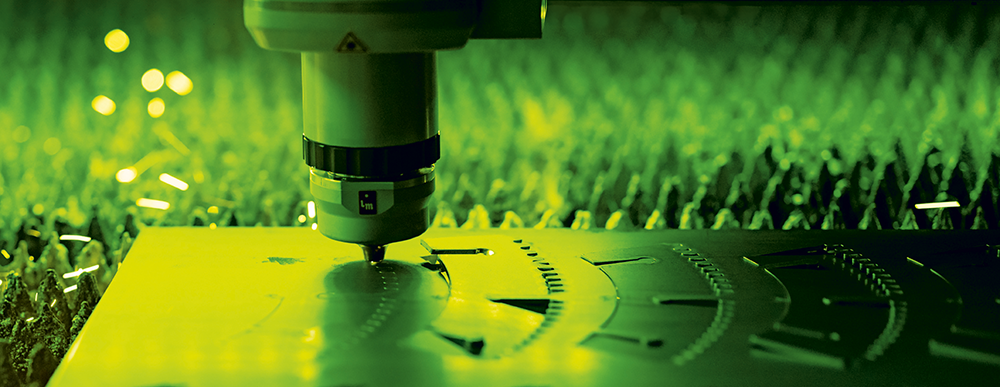
With the CLX Fiber Laser System, CI needed to design more than its next generation of a laser cutting machine. Most importantly for its customer base – about one-third OEMs, two-thirds job shops – the CLX needed to be fast, intuitive and dependable. Downtime is unacceptable for laser cutting systems, as it creates a domino effect across an entire manufacturing facility. “If the lasers go down, you also have to send press brake operators home, and then in a number of hours, you have to send welders home,” says product manager, Troy Wilson. “In the ’80s and ’90s, we led the market as one of the first US laser cutting machine builders. But back then, the pace at which we had to add features, remove features or change how we did things typically took about three years. Today, it’s six to 18 months,” Wilson says.
Today, machines are increasing in complexity, for instance by adding handling systems between metalworking processes to feed material and remove completed parts. However, CI’s legacy motion control system from a previous vendor lacked scalability and used programming languages outside of IEC 61131-3 standards. This slowed development and shrank the talent pool for recruiting new engineers.
In addition, CI’s customers regularly wanted to adapt machines for higher wattage lasers or other features. While competitors would require customers to buy a new machine, CI faced excessive, labour-intensive efforts to accommodate such requests. So, a future platform would need to be flexible to connect and disconnect devices, and easily change parameters in software.
Always cutting-edge technology
The CLX Fiber Laser System leverages a C6030 ultra-compact Industrial PC to control the entire CNC machine. The scalable machine controller offers ample processing power combined with flexible interface options. Above all, it eliminates the previous obsolescence struggles. Beckhoff designs its PC-based controllers and software to be backwards compatible and accommodate future technology developments.
“A major advantage that drew us to Beckhoff was the promise that we’d no longer have to worry about controls obsolescence. Beckhoff takes care of it for customers,” Matt Garbarino says. “With Beckhoff, IPC upgrades are just a natural progression in product development. When we built our own CPUs, it was paralysing when chips and other components expired. To have a vendor deal with all that is a game changer for us.”
A choice of modern programming standards
As a universal engineering and runtime platform, TwinCAT 3 automation software also ensures future-proof scalability. From IEC 61131-3-compliant PLC languages with their object-oriented extensions, to custom and predefined function blocks, to computer science standards, TwinCAT’s integration into Microsoft Visual Studio empowers engineers to program in the languages that best fit the application. This was a major step ahead from the previous vendor’s proprietary script.
TwinCAT Scope, the software-based oscilloscope, has helped with debugging. Another advantage is TwinCAT’s no-cost engineering environment, with a license required only at runtime. “It doesn’t cost me anything to create prototype systems in TwinCAT,” says electrical engineering manager, Zackary Bischoff. “And with the coding flexibility, I regularly copy and paste software modules from one program to another.”
Access to the controls during machine operation has become even more intuitive via the user interface on the CLX. Operators and maintenance personnel don’t have to dig through outdated Ladder Logic to troubleshoot or make adjustments to the machine. A dual-screen 61 cm CP3924 control panel installed on a mounting arm offers a generously sized, sleek interface customised with CI branding.
Flexible automation with EtherCAT
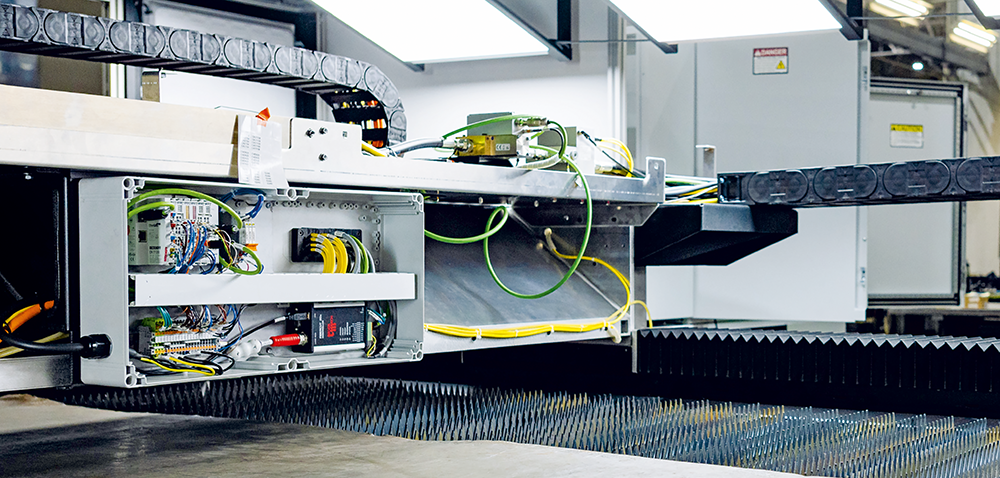
The EtherCAT industrial Ethernet system and servo drive technologies from Beckhoff further enhanced performance and scalability. Beyond fast real-time communication, EtherCAT delivers free selection of network topology, and handles up to 65 535 nodes in a single network. As an open protocol, it simplifies connection to other industrial communication protocols. CI also uses TwinSAFE to add functional safety in the same I/O segment as non-safety equipment.
“We use a wide range of EtherCAT I/O modules from Beckhoff,” Bischoff says. “The hot connect capability – to plug and unplug EtherCAT equipment in ongoing operation – has been very powerful, especially with our automatic nozzle changer. That flexibility will be even more important as we integrate robots, and possibly even a press break, in a comprehensive manufacturing line.”
The AX8000 multi-axis servo system delivers a powerful motion control solution in a space-saving form factor. The dual-channel drives can power two AM8000 series servomotors each, and One Cable Technology means a single cable can provide power and feedback signals to the motors. Beyond that, the Beckhoff servo solutions provide high dynamics and precision.
“With our previous machines, the limitations were with control hardware and networking. That is no longer the limit,” Wilson says. “Now, our limit is physics.”
Own it – for generations to come
The CLX Fiber Laser System has achieved incredible results, but the engineering team isn’t stopping there. The second-generation machine will launch in late 2024. The inherent ability to transmit machine data to the cloud using PC-based control feeds directly into Industry 4.0 initiatives at CI. The company’s software solutions, including those for cloud-based machine monitoring, can pull performance and diagnostic information directly from a connected CLX, according to Paul Frederick, associate director of engineering at CI. Engineers can log in remotely, see what’s happening via three machine vision cameras inside the cutting cell, or use TwinCAT Scope for further analytics.
“In the design process and performance evaluations, managing data access from the Beckhoff controls was an order of magnitude easier for us, so we could optimise performance,” he adds. “We could graph any parameters from the machine in real time.”
The engineering team expects to simplify programming and support by standardising on Beckhoff going forward. As manufacturing equipment begins to work together, rather than operating as islands of automation, director of engineering, Rogers sees modularity as key. “Rather than relying on dedicated boards that we’ve built in-house with a vertical manufacturing strategy, we now have a modular platform that could deploy across all facets of our business,” he says. “Modularity also supports how we give upgrade paths for existing equipment. We have a great foundation to support all our customers far into the future.”
| Tel: | +27 11 795 2898 |
| Email: | info@beckhoff.co.za |
| www: | www.beckhoff.com |
| Articles: | More information and articles about Beckhoff Automation |






© Technews Publishing (Pty) Ltd | All Rights Reserved
 printer friendly version