As a long-established importer and manufacturer of air dryers, Artic Dryers often sees the results of poor installation and issues with aftercoolers that create serious problems in air drying systems.
With any air dryer, the removal of liquid condensates before the inlet to the dryer is vital. With refrigeration dryers, liquids entering the dryer impose an extra heat load on the dryer’s refrigeration system. This wastes energy, as the freon system is designed to condense water vapour into a liquid. If we allow liquid condensates into the dryer at its inlet, the system is now working to condense water vapour into a liquid, and also cooling down actual liquid water to a temperature of 3°C.
This creates a problem in the main air-to-freon exchanger, and also in the condensate drain system. They are being forced to handle more actual liquid content than the dryer and its drain were designed for. This can lead to liquids being entrained in the air flow and pushed into the compressed air system. This automatically leads to a higher dewpoint, resulting in wet compressed air in the plant’s distribution system.
What is an aftercooler?
An air compressor’s aftercooler is the integral first stage in the air treatment system. It is essentially a radiator with hot compressed air inside the tube stack. This has a fan to push colder atmospheric air over the radiator to cool the hot compressed air in the radiator. This cooling process can condense up to 70% of the water vapour that is pulled in by the air compressor from atmosphere, and compress it to 7 bar for your factory. The aftercooler is supposed to eject this condensed liquid to waste via an attached water separator and autodrain system.
This partially dried air leaving the aftercooler can be now allowed to enter the prefilter and air dryer for further treatment. If the aftercooler is not fitted, or a water separator is missing (or not supplied by the OEM) or the drain has malfunctioned, there will be a liquid water overload in the air dryer, leading to wet compressed air.
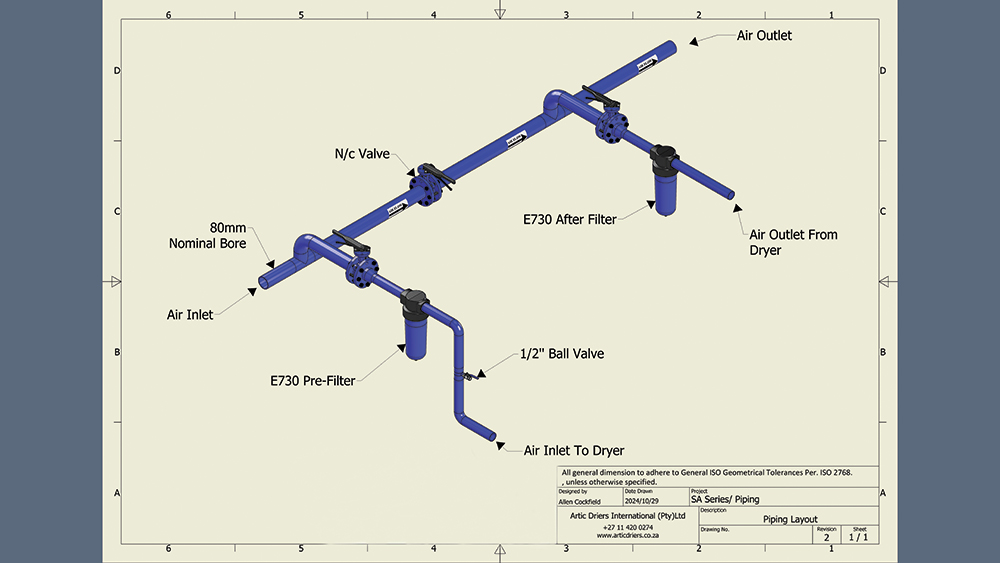
Inline air filters are not designed for bulk liquid removal; they are installed to coalesce compressor oils and trap airborne particles and debris. Poor piping installations can also add to bulk liquid contamination. The correct layout is shown below. Inlet and outlets, valves and filters should be located at the highest points.
Compressor aftercooler and filter drains must be function checked daily. The installation of a low-cost dewpoint monitor S306 from Artic’s Suto iTEC range is a good protection against compressed air system contamination. A high dewpoint alarm tells operators that a fault on a drain valve, a failure, or a trip condition of a dryer has occurred.
The same issues of bulk water contamination, aftercooler, and piping issues can also be applied to heatless twin tower chemical air dryers.
Electrically operated, energy-efficient double diaphragm pumps Bearing Man Group t/a BMG
Pneumatics & Hydraulics
BMG has introduced the EVO series 210 electric double diaphragm pump range from ARO, offering lower energy consumption and quieter operation than air-operated alternatives, with access from one side for both diaphragms, and optional electronic leak detection for critical applications.
Read more...Integrated Air Solutions opens KwaZulu-Natal branch
Pneumatics & Hydraulics
Integrated Air Solutions has opened a KwaZulu-Natal branch in Pinetown, establishing a local turnkey compressed air partner for the province with equipment, installation, servicing, rapid emergency response and rental offerings under one roof.
Read more...Precision and durability in metal manufacturing and injection moulding Parker Hannifin - Sales Company South Africa
Pneumatics & Hydraulics
From 800 bar hydraulic circuits in metal presses to low-pressure cooling systems in injection moulding machines, Parker Hannifin’s fluid connector systems are engineered for the contrasting demands of high-pressure sealing, thermal resistance and rapid serviceability.
Read more...Turning compressed air into a strategic energy advantage
Pneumatics & Hydraulics
Compressed air accounts for up to 80% of a system’s lifecycle costs, yet often remains overlooked in energy strategies. CompAir’s Energy Check provides a data-driven analysis of the complete compressed air network to identify energy savings of 20 to 30% or more.
Read more...Air compressor secures premium meat company’s legacy
Pneumatics & Hydraulics
A tailored ELGi compressed air solution from Integrated Air Solutions is helping Tulisa Meat Market protect six decades of quality and consistency in its premium meat production.
Read more...Identifying signs of hydraulic cylinder wear and tear CT Hydraulics (Nqoba)
Pneumatics & Hydraulics
Recognising the early warning signs of hydraulic cylinder degradation is crucial for preventing costly downtime, ensuring operator safety and maximising the lifespan of your hydraulic systems.
Read more...Integrated Air Solutions opens Pinetown branch
Pneumatics & Hydraulics
Integrated Air Solutions has opened a branch in Pinetown, bringing world-class diesel and electric air compressor services closer to customers in KwaZulu-Natal.
While every effort has been made to ensure the accuracy of the information contained herein, the publisher and its agents cannot be held responsible for any errors contained, or any loss incurred as a result. Articles published do not necessarily reflect the views of the publishers. The editor reserves the right to alter or cut copy. Articles submitted are deemed to have been cleared for publication. Advertisements and company contact details are published as provided by the advertiser. Technews Publishing (Pty) Ltd cannot be held responsible for the accuracy or veracity of supplied material.










 printer friendly version