



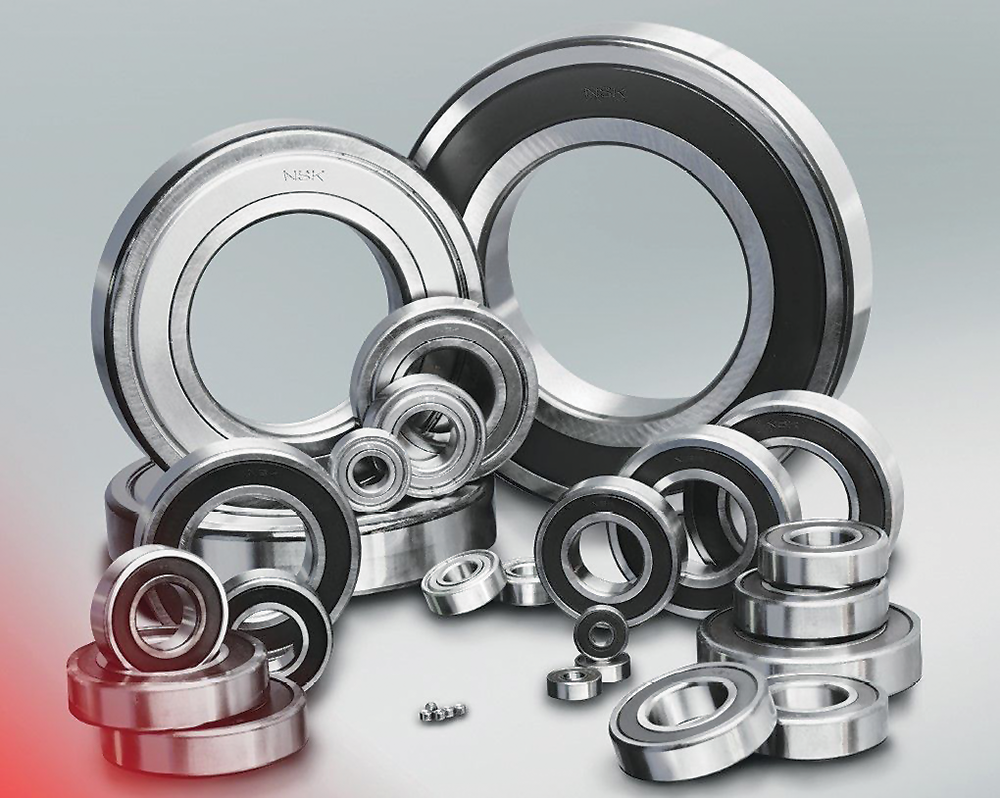
In a world first, NSK has introduced a new method of accurately predicting the lifespan of rolling bearings based on their size and the amount of non-metallic inclusions in the steel the bearings are made from. Going forward, NSK’s angular contact ball bearings, cylindrical roller bearings, deep groove ball bearings, and tapered roller bearings will all see their lifespans increased, potentially even doubled, by this optimisation of basic dynamic load ratings.
Load ratings are governed by the ISO 281:2007 standard, which states that when you test a batch of identical bearings, nine out of every ten need to make it through those million revolutions without issue. ISO 281 does allow for an increase in the service life under certain conditions, but in the past, any modifications to the bearing had to be followed by a further battery of tests. NSK, however, has developed a non-destructive testing method for these situations, which makes it possible to dispense with further testing, and allows the end user to benefit from a fundamental increase in the service life of their bearings.
Generally speaking, most people use a manufacturer’s existing catalogue to calculate bearing life. Alternatively, they can usually input the external loads and the bearing information into a calculation program. The basic calculation, however, is still carried out in accordance with ISO 281. This type of calculation has become the standard worldwide. However, since the methods of determining a bearing’s lifespan were developed and introduced (all the way back in 1962), material purity and manufacturing capabilities have both come on in leaps and bounds. As a result, the actual service lifespan of a bearing tends to be quite a lot longer than that which is suggested by testing under ISO 281.
NSK’s solution has been to simplify things, bringing in computer-aided models alongside empirical tests. The basic idea is that we use these models as a digital twin, with the ultimate aim of being able to dispense with service life tests with real, physical bearings and to determine changes to dynamic load ratings purely by means of digital evaluations.
NSK’s own internal research has shown that the composition and quality of bearing steel, in particular the proportion of the steel which is made up of non-metallic impurities, has a huge impact on a bearing’s service life, indeed is actually a more accurate indicator of its lifespan than the above calculation methods. NSK’s engineers realised that an evaluation method based on fracture mechanics, a field of mechanics concerned with the study of the propagation of cracks in materials, could provide more meaningful insight.
The company worked with Kyushu University in Japan to develop a quantitative evaluation method that could determine which factors influenced the process of crack propagation in a material, and to what extent. Notably, by combining the new method with an ultrasonic inspection technique that scans the non-metallic inclusions in a large volume of steel, NSK discovered it could predict the life of its bearings with much higher accuracy.
As a direct result, NSK has revised the basic dynamic load rating of many bearings with no change in design or materials, while still applying the appropriate safety margin to any uprated values. With this revision, the estimated life of radial roller bearings, for example, is up to twice that which it was before.
Even better, as the basic dynamic load ratings of bearings improves, they become suitable for use in higher load conditions, meaning that companies can opt for smaller bearings which are still able to perform the same function of their larger counterparts. Obvious benefits include machine downsizing and weight reduction.
End users can rely on the fact that the new bearing life values are determined on the basis of a carefully studied methodology supported by an extensive empirical database. All new values, which are fundamentally higher, will be within the safe range. NSK’s researchers and developers used a quantitative evaluation method to determine which factors, or the number and size of impurities, influence the process of crack propagation in a rolling bearing steel and to what extent. Computers with extreme computing power were used to run and analyse simulations.






© Technews Publishing (Pty) Ltd | All Rights Reserved
 printer friendly version