



When starting in-plant control courses I always ask the class members to give me their individual estimates as to how many of their loops they believe to be operating satisfactorily in automatic. In a recent series of courses given to 12 of the control technicians and engineers in a large continuous processing plant, the estimates ranged from 50 to 75%. The nature of the processes in that type of plant demand good control if really top product quality and economy in production is to be optimally achieved. Literally millions of rands annually can be saved by keeping certain parameters within tight limits.
After completing the classroom training, the class went into the plant for a week to apply their new learning on live loops. During this period 25 loops were examined and optimised where possible. The findings were an absolute eye opener to the delegates and plant management.
The following extracts are taken from the final report sent to plant management:
The exercise highlighted the following:
* Every control loop examined was so badly detuned that it was unrealistic to expect them to follow load changes satisfactorily.
* Changes to setpoints, such as on start-ups, could not be performed satisfactorily in auto due to the tuning. In addition, the wrong parameter was set in those controllers where operators need to make setpoint changes, so the controllers could only respond slowly with integral action alone.
* On two of the most critical controls in the plant, the ability to follow setpoint changes as dictated from the advanced control systems, without variance, can lead to huge improvements and savings. This was impossible with controls set in their original state.
* The analysis uncovered major equipment problems in many loops which were unknown to operating staff. The control strategy was also changed in several loops to improve performance.

In general the loops that were optimised are now responding to changes, probably between 20 and 200 times faster.
Recommendations to improve the control status in the plant are:
(a) Optimisation needs to be recognised as a separate and continuous discipline in the plant. It needs support from all disciplines including management at all levels, process specialists, operations and of course the instrumentation and control (I&C) people. An optimisation programme without such cooperation and management support is doomed to failure.
(b) An optimisation team needs to be appointed. Although primarily probably two I&C people can perform the work, they should work in conjunction with a process specialist and a production staff-member. These latter people will not only help decide on control and process strategies but can ensure cooperation of the other departments in the optimisation exercise. Our experience is that when an optimisation programme is undertaken, the plant starts performing so differently, that many people actually start resisting, as they do not understand what is happening. A short one-day course on practical control is also recommended for process people and operators.
(c) Not only the I&C people but all the people on the team need training, so they can fully understand the procedures.
(d) Proper optimisation test and tuning equipment will be needed.
In general if optimisation is carried out properly, then the following benefits would be obtained:
* Increased production.
* Increased efficiency or productivity.
* Increased quality.
* Less reject product.
* Less dependence on operator intervention.
* Far less control variance, meaning that load changes would have far less effects on quality.
* Ability to set and maintain tighter critical control parameters.
* Vastly decreased wasted time during start ups and grade changes.
* Savings in materials and utilities.
Apart from the above remarks, findings included:
1. Many valves exhibited severe hysteresis, sometimes larger than 10%.
2. Slip stick cycling was discovered on some valves which introduced undesirable low frequency cycling into interactive processes.
3. Control personnel lacked understanding of correct strategies for tuning level control systems. (As discussed in previous articles, tight level control is sometimes desirable, dictating higher gains in the controllers, with resultant larger movements in valves responding to changes. In other cases level controllers must not react quickly and are in fact only needed to keep the level between certain high and low limits).
4. Many levels were continuously cycling due to poor tuning and in one case due to interaction from another cyclic level.
5. Some extremely oversized valves were encountered, resulting in valves operating very close to seat under normal control conditions which is undesirable. Oversized valves also contribute to poor control variance in direct proportion to the number of times they are oversized.
6. Huge process variable filter delays of over half a minute were encountered on certain flow transmitters, apparently to mask problems in the transmitters.
7. Many valves that were required to operate over wide ranges had nonlinear installed characteristics.
8. Incorrect calibrations were found on some transmitters.
9. On certain loops, the controller outputs were restrained by ramps and thus prevented from responding properly to control changes. This type of strategy affects PID control very badly.
Some "before and after" performance examples are as follows:
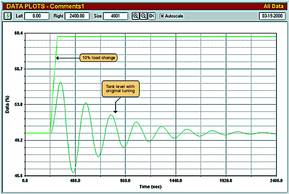
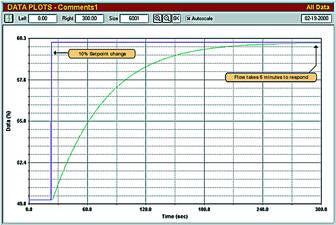
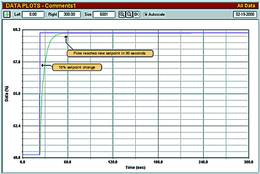
Figure 1 illustrates a tank level responding to a 10% load change as originally found and Figure 2 the response after optimisation. Figures 3 and 4 illustrate before and after optimisation responses to setpoint changes on a typical flow loop.
It is interesting to note that the plant is not new and is in fact many years old. How is it possible that a plant wherein control is so important could have been running for all these years without anyone being aware of the problems and the true state of the controls? Sadly however, as has been stressed repeatedly in these articles, this is the normal state of affairs in most plants around the world and it is entirely due to the fact that there is almost a complete dearth of knowledge on practical control. Many senior control engineers refuse to believe that there are any problems in the so called 'base control layer' in their plants and spend their lives trying to institute high level control systems. These can never work as well as they might, as all these higher level controls do, in fact, is order up the setpoints of the base layer controllers. I have been told repeatedly by some of these engineers that tuning PID controllers is a simple matter, suitable for lower level skills. In fact, in the particular plant under discussion in this article, the previous control engineer had emphatically told me that there were no problems in the plant and that everything was well tuned and running well.
It does appear unbelievable that situations like this exist and are in fact pretty much the 'norm' and it is often very frustrating trying to convince management in plants that they could dramatically improve their controls. However optimisation is not easy and as mentioned above requires a lot of work and commitment from all parties. Tuning by itself is not the answer. Optimisation requires much analytical work and effort before tuning can be effective. Most people are convinced that the 'magic tuning package' exists somewhere and are often prepared to spend small fortunes on purchasing expensive continuous on-line tuning packages that control vendors are only too delighted to sell. However I have still to find a single plant where the user is happy with them.






© Technews Publishing (Pty) Ltd | All Rights Reserved
 printer friendly version