



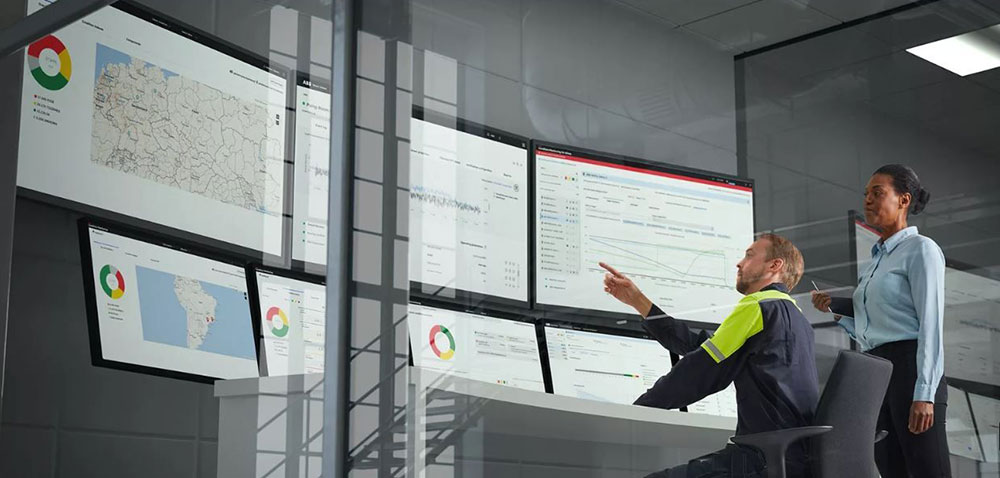
Finding better ways to manage energy and manufacturing resources is a key concern for businesses in Africa. However, achieving this can be a complex challenge. ABB is seeing first-hand how digital solutions are empowering businesses in African countries, to not only unlock improvements in energy management, but also to enhance their operational excellence and process performance.
Digital in Africa: industry adoptions
There’re some interesting trends relating to how and why companies in Africa are adopting digital solutions. Currently, ABB is providing a great amount of support to cement, pulp and paper, and mining companies. Others taking a strong interest in their digital solutions to drive sustainability, process performance and operational excellence goals, are food and beverage businesses. While food and beverage companies have a strong focus on traceability from raw materials to finished goods, and the related supply chain tracking, businesses in the mining industry are concentrating more on their underground fleet, and how to decarbonise, electrify and track their locations, aiming for near real-time optimisation of their production plans.
Africa’s mining sector is showing a lot of interest in ABB’s short interval control solutions. This software allows companies to convert and then track their long-term production schedule into smaller-scale weekly and daily plans. The system can auto-reschedule tasks as suggestions to meet the mine production targets, based on the constraints being experienced. The company is experiencing a strong demand from the mining and pulp and paper sectors for advanced process control solutions, through which they provide process optimisation to help reduce raw material consumption, reduce energy consumption, reduce process variability, and improve production throughput. Their work with Africa’s cement industry is highlighting the need for digital solutions to optimise processes and reduce materials used for manufacturing, while also improving on quality.
From silo to single viewpoint
Organisational silos can stand in the way of critical operational and performance management improvements. Companies often rely on and interact with multiple systems, but lack a single, unified view of what is happening across their organisation. Additionally, they lack a common way of working across their systems. These issues can lead to increased wastage, reduced efficiency and a knock-on effect on performance and profitability. To counter this, ABB is implementing operational excellence solutions across businesses in southern Africa, which collect, contextualise, and convert data into actionable insights. This enables industries to improve operations, optimise assets, streamline processes, and increase safety and sustainability. Beyond moving from fragmented silos to data unification that drives operational excellence insights and productivity improvements, businesses then have the option of using the higher-level ABB AbilityT Genix platform to gain additional analytical insights and leverage AI machine learning to progress with their goals even further.
Case study: cement
A recent example of digital solutions helping a company to overcome system silos is ABB’s work with a leading southern African cement company. After delivering an operational excellence solution for three of their sites in Zimbabwe, ABB is now implementing this at seven of their sites in South Africa. ABB consolidates information from various manufacturing and business systems into one end-to-end system, ABB Ability Knowledge Manager, leveraging its extensive domain knowledge in the cement, minerals and mining industries. Knowledge Manager has a long track record, with an install base dating as far back as three decades, deployed at multiple global customer sites. The solution helped break down organisational silos for this customer, supporting unified decision making and better collaboration across different business functions.
Maximising asset performance
Improving asset performance management is vital in the journey towards maximum performance and availability of plant assets. It directly impacts reliability and profitability, and minimises risk. ABB works with many businesses in Africa, particularly those in the pulp and paper industries, who have a keen interest in understanding how they can maximise performance of their assets, and better manage their maintenance schedules with those assets. These companies are leveraging ABB’s asset performance management solutions to address complex challenges. Scheduled maintenance on one end of the scale leads to over-maintenance, resulting in excessive, unnecessary maintenance costs. At the other end, it leads to under-maintenance, resulting in breakdowns, downtime, and costly reactive maintenance. By gaining real-time insights into the status and performance of assets, businesses can more easily avoid breakdowns, downtime and the associated financial impact.
Accelerating business performance in Africa
These are exciting times for African countries and the companies operating within them. Digital innovation is playing a central role in this and helping to shape a better future for businesses in Africa. This is not only by enabling them to unlock improvements in energy and asset management, but also by empowering them to respond to new opportunities. By collaborating with trusted partners with proven experience in Africa, industries can reap the rewards and sustained tangible benefits of digital innovation.
| Tel: | +27 10 202 5000 |
| Email: | [email protected] |
| www: | www.abb.com/za |
| Articles: | More information and articles about ABB South Africa |






© Technews Publishing (Pty) Ltd | All Rights Reserved
 printer friendly version