



By definition, Smart Mining Operation Management refers to the implementation of advanced technologies and intelligent systems in the management and operation of mining activities. The overall goal is to enhance efficiency, safety and sustainability in mining operations by applying advanced systems and technologies to each aspect of mining activities, and through integration of these technologies, transform traditional mining practices into more efficient, sustainable and safe operations. As these technologies evolve and mature, so the benefits will accrue to mining operations.
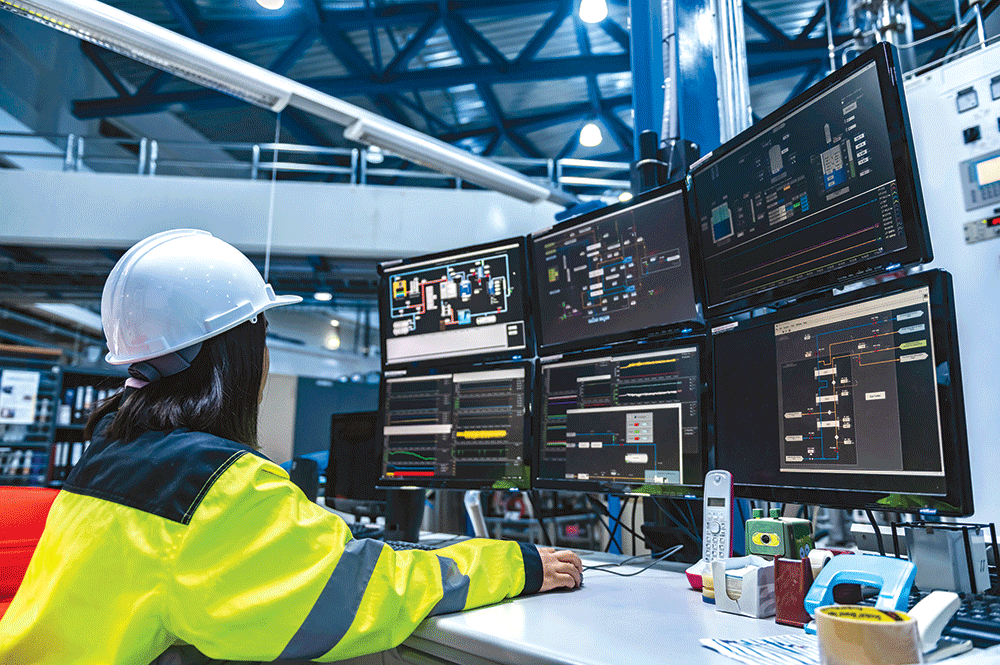
The application of these technologies provides many quantifiable benefits:
• Automation and robotics: Implementing automated machinery and robotics to perform various tasks, reducing the need for human intervention in hazardous or repetitive tasks.
• Internet of Things: Utilising sensors and connected devices to collect real-time data from mining equipment, vehicles and other assets. This data can be used for monitoring, maintenance and optimisation of operations.
• Data analytics: Employing advanced analytics tools to analyse the massive amount of data generated by mining operations. This helps in making informed decisions, predicting equipment failures, optimising processes, and improving overall efficiency.
• Remote monitoring and control: Using remote monitoring systems to oversee mining operations from a centralised location. This allows for better management of resources, timely decision making, and improved safety.
• Artificial intelligence (AI): Implementing AI algorithms for tasks such as predictive maintenance, ore grade estimation, and optimisation of drilling and blasting operations.
• Digital twin technology: Creating digital replicas or twins of physical mining assets and processes, allowing for simulation, analysis and optimisation, without affecting actual operations.
• Blockchain technology: Implementing blockchain for transparent and secure record-keeping, especially in the supply chain and tracking the origin of the minerals to ensure ethical and sustainable mining practices.
• Drones and remote sensing: Using drones and satellite-based technologies for surveying, mapping, and monitoring mining sites, providing accurate and up-to-date information.
• Energy management: Implementing smart energy solutions to optimise power consumption, reduce environmental impact and enhance energy efficiency in mining operations.
• Safety systems: Integrating smart safety systems, including wearable devices for miners, real-time monitoring of environmental conditions, and automated emergency response systems.
Dimensions
In order to implement a SMOM, one has to define the key elements and boundaries, which are typically:
• Digitise the entire mining value chain.
• Consider the effects and consequences to people, processes and technology.
• Address business and operational strategy alignment.
• Capture data and information.
SMOM approach and functionality
Our experience in rolling out SMOM systems has led us to offer mine management the following tips for a successful and less painful transition from traditional operations:
• Think big, start small, move fast – this is the best way to create value for the business.
• Undertake a digital maturity assessment, with a roadmap as the outcome.
• Align SMOM with business and operational strategies.
• Ensure that your digital platform is scalable, modularised, feature rich, and extendable.
• Augment existing systems that work rather than discarding for something new.
• Always adhere to best practices and standards – deviating to save money will bite you.
• Ensure appropriate solutions for your business; don’t be bamboozled into the ‘latest and greatest’.
• SMOM generates a lot of invaluable data – make sure that you own your data.
In conclusion, smart mining operation management delivers a comprehensive set of benefits that go beyond traditional mining practices. By embracing advanced technologies, mining operations can achieve higher efficiency, improved safety and a reduced environmental footprint, ultimately contributing to a more sustainable and responsible mining industry.
| Tel: | +27 12 349 2919 |
| Email: | info@iritron.co.za |
| www: | www.iritron.co.za |
| Articles: | More information and articles about Iritron |






© Technews Publishing (Pty) Ltd | All Rights Reserved
 printer friendly version