Why choose a quality quick coupling?
January 2024
Pneumatics & Hydraulics
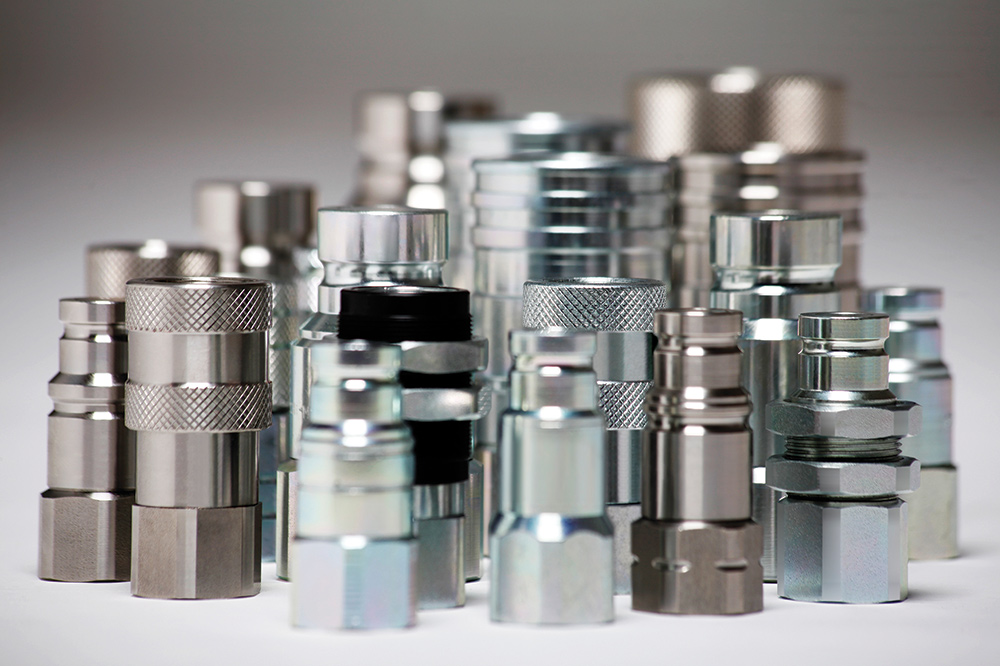
Quality quick couplings reduce risks and costly losses while providing many operational benefits. The concern over making sure that work machinery and tools are functioning 100% is one that is shared by many industries, especially among companies using hydraulic systems. A single hydraulic accident can cause damage to costly devices, resulting in downtime, contamination in the work area and even worse, potentially injuries to operators.
Reduce risks with quality quick couplings
One of the most sensitive points for hydraulic systems are the connections. In sectors like agriculture, earthmoving, industrial operations, and gas and crude oil extraction, much of the equipment used must be connected by sealing off the hydraulic circuit and making sure it stays that way, even when it is subjected to strong mechanical stress, for example, if the mechanical excavator boom becomes twisted.
If the connection system fails, the following risks may be incurred:
• Financial losses: machinery blocked due to inadequate couplings can cause losses in the range of tens of thousands of Euros due to production downtime.
• Accidents in the workplace: the fluids used in hydraulic systems are pressurised; a leak, no matter how small, can result in the liquid being ejected with great force, potentially causing serious physical injury to operators in the vicinity.
• Environmental contamination: hydraulic fluid leakages, which spill onto the ground and into bodies of water can irreparably compromise these natural resources; in addition to environmental responsibility, contamination can lead to serious fines and, in the farming sector, damage the company’s source of income
• Loss of reputation: downtime, injuries to employees and environmental pollution bring an added cost in terms of reputation and credibility, which weakens the company’s image and alienates existing and potential customers.
• Cost of repairs: repairing the hydraulic system and machinery, and replacing the lost fluid, calls for the company to make a significant capital investment; in the worst cases, the damage can also extend to buildings or places where the equipment is housed, further increasing the expenses to be covered.
Choosing quality hydraulic couplings is, therefore, an essential investment to safeguard your company, employees and the environment.
Benefits of leak-free quick couplings
The benefits are not just limited to preventing leaks. Quick couplings guarantee a highly secure hydraulic connection, while speeding up coupling and uncoupling operations. This increases productivity, adding significant value to daily operations.
By drawing on 60 years of experience, Stucchi offers extremely high-quality quick couplings with solutions designed to eliminate leaks. Stucchi improves both coupling/uncoupling and circuit operations, and safety systems, to protect against any potential issue.
For more information contact Stucchi South Africa, +27 11 458 1202, [email protected], www.stucchigroup.com
Further reading:
Electrically operated, energy-efficient double diaphragm pumps
Bearing Man Group t/a BMG
Pneumatics & Hydraulics
BMG has introduced the EVO series 210 electric double diaphragm pump range from ARO, offering lower energy consumption and quieter operation than air-operated alternatives, with access from one side for both diaphragms, and optional electronic leak detection for critical applications.
Read more...
Integrated Air Solutions opens KwaZulu-Natal branch
Pneumatics & Hydraulics
Integrated Air Solutions has opened a KwaZulu-Natal branch in Pinetown, establishing a local turnkey compressed air partner for the province with equipment, installation, servicing, rapid emergency response and rental offerings under one roof.
Read more...
Precision and durability in metal manufacturing and injection moulding
Parker Hannifin - Sales Company South Africa
Pneumatics & Hydraulics
From 800 bar hydraulic circuits in metal presses to low-pressure cooling systems in injection moulding machines, Parker Hannifin’s fluid connector systems are engineered for the contrasting demands of high-pressure sealing, thermal resistance and rapid serviceability.
Read more...
BMG expands fluid technology portfolio with Boston by Danfoss industrial hose
Bearing Man Group t/a BMG
Pneumatics & Hydraulics
BMG has added the Boston by Danfoss Industrial Hose range to its fluid technology portfolio, giving customers a single source for both hydraulic and industrial hose requirements across Africa.
Read more...
Pneumatic solutions for versatility, operational safety and efficiency
Pneumatics & Hydraulics
As an authorised partner of Festo, BMG combines access to globally recognised pneumatic technologies with local application expertise and technical support.
Read more...
Turning compressed air into a strategic energy advantage
Pneumatics & Hydraulics
Compressed air accounts for up to 80% of a system’s lifecycle costs, yet often remains overlooked in energy strategies. CompAir’s Energy Check provides a data-driven analysis of the complete compressed air network to identify energy savings of 20 to 30% or more.
Read more...
Air compressor secures premium meat company’s legacy
Pneumatics & Hydraulics
A tailored ELGi compressed air solution from Integrated Air Solutions is helping Tulisa Meat Market protect six decades of quality and consistency in its premium meat production.
Read more...
How laser cladding delivers 33% more life and maximum ROI in hydraulic cylinders
Pneumatics & Hydraulics
By utilising advanced laser cladding, Honingcraft can help clients achieve a 33% longer life from their components, ensuring they secure the maximum return on their investment.
Read more...
Identifying signs of hydraulic cylinder wear and tear
CT Hydraulics (Nqoba)
Pneumatics & Hydraulics
Recognising the early warning signs of hydraulic cylinder degradation is crucial for preventing costly downtime, ensuring operator safety and maximising the lifespan of your hydraulic systems.
Read more...
Integrated Air Solutions opens Pinetown branch
Pneumatics & Hydraulics
Integrated Air Solutions has opened a branch in Pinetown, bringing world-class diesel and electric air compressor services closer to customers in KwaZulu-Natal.
Read more...










 printer friendly version