



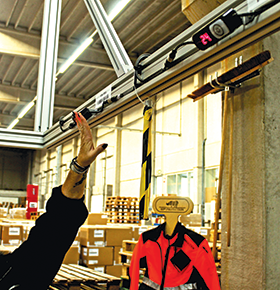
Anyone who works in challenging and potentially dangerous environments needs quality protective clothing that protects against injury or accidents. The Belgian company Sioen specialises in technical textiles and protective workwear, and produces more than three million pieces of protective clothing at 22 sites in 20 countries worldwide. At the Mouscron site, the family-owned company operates a large shipping and distribution centre in addition to four production plants. Garments produced worldwide are processed, stored and picked there so that they can be shipped to customers quickly and efficiently.
Previously, the inbound and outbound processes were largely carried out manually. After delivery, the pallets were transported to a coworker who scanned the individual cartons and placed them on defined pallet positions. These positions were reserved for specific goods – whether they were present or not. It took four to five coworkers around five hours to process a truck.
A coworker in the outbound area would receive a pick list for each customer and go through the stores in order to collect the goods. “This was obviously not an efficient way of working,” recalls Filiep Vanwymelbeke, head of logistics at Sioen Apparel. “We therefore looked for a system that could handle the challenges of the inbound and outbound logistics. We finally implemented a powerful warehouse management system (WMS) to solve this problem, in combination with an error-free pick-to-light solution based on the PTL110 series of Turck’s optical sensor partner, Banner Engineering.
Inbound: pick-to-light as a playmaker
In the incoming goods area (inbound), employees lift the cartons from the pallets onto a conveyor belt. A scanner captures the labels on the cartons as they pass by. They are then directed to one of six conveyor belts. Once a coworker at the end of the conveyor belt has scanned the delivered carton, the WMS immediately indicates via the pick-to-light system which pallet it must be placed on. The coworker places the carton on the appropriate pallet and acknowledges the action via the touch button of the PTL110 device above the pallet.
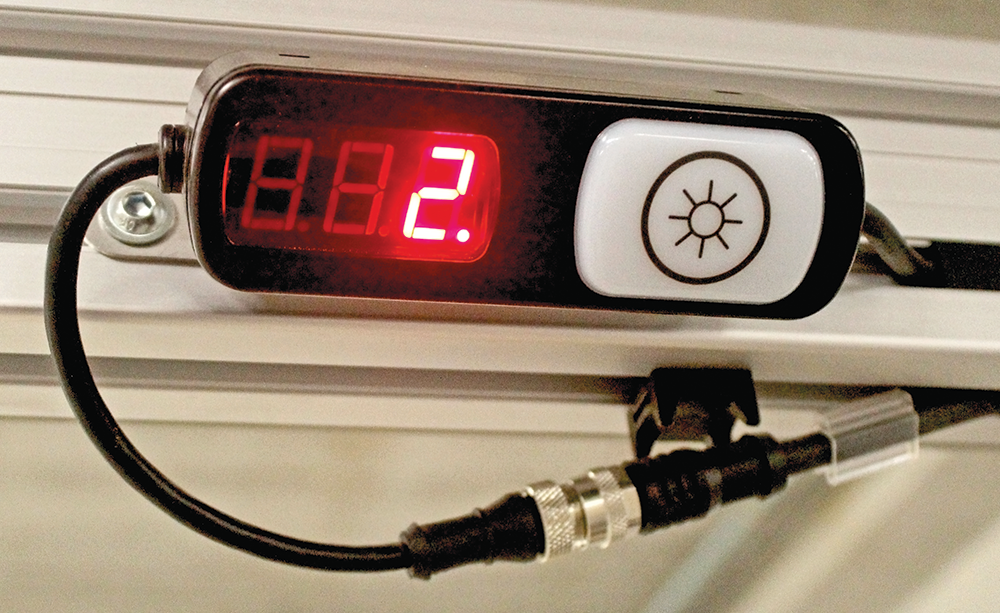
The PTL110’s three-digit display immediately shows the number of cartons on the pallet. The pick-to-light system provides several signal states. A green signal indicates that the system is ready for use, while red indicates an operating error. In addition, a purple signal indicates that a mixed pallet must undergo quality control. When the pallet is complete and can be removed, the LED of the PTL110 finally lights up blue.
Outbound: reliable order consolidation
Two streams of goods converge on the outbound conveyor: cartons with standard contents and cartons with a mixture of different goods that vary in height depending on the contents. At this point, the pick-to-light system becomes active again. The coworker scans the carton, whereupon the WMS determines the pallet on which it is to be placed, according to the customer or carrier. The PTL110s indicate the correct location of the pallet by means of simple colour signals.
Multiprotocol I/O module ensures reliable operation
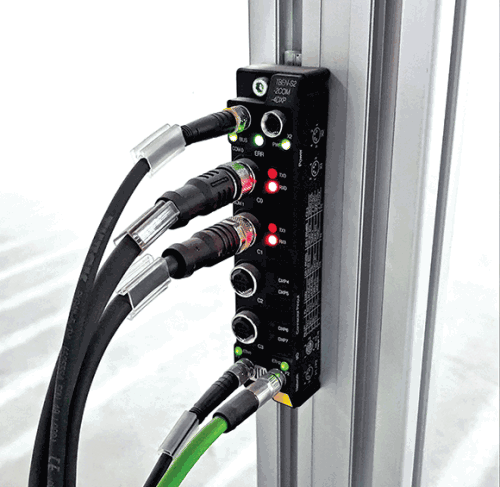
The communication of the PTL110 devices with the WMS is crucial for the optimal operation of the solution. All PTL110 devices are connected for this purpose via Turck’s TBEN-S multiprotocol I/O modules. The robust IP67 modules can be mounted directly on the conveyor line without a control cabinet, and feature as standard the web-based ARGEE field logic controller software.
Communication with the WMS can be easily configured by using PickIQ. The customer’s IT personnel do not need any special knowledge of automation software for this. PickIQ uses a serial bus protocol that uses a common ID to avoid latency or delays when polling multiple devices. This allows the system to operate without delays, even during peak hours.
Error rate reduced to zero
The versatility of the PTL110 devices is demonstrated by their application in both inbound and outbound systems. The multifunctional displays with touch button options, optical sensors and three-digit display with clear signal indication, enable simple and reliable monitoring of the number of cartons on a pallet. The M12 connectors enable fast and safe installation of multiple devices. The display also has the ability to show up to 14 colours, combined with several animation functions to distinguish different states.
“The inbound error rate has dropped to virtually zero,” Vanwymelbeke notes. “Where it used to take five coworkers up to five hours to handle a truck, it is now handled by three coworkers in two to three hours. This corresponds to a time saving of up to 15 hours per truck per day.”
| Tel: | +27 11 453 2468 |
| Email: | [email protected] |
| www: | www.turckbanner.co.za |
| Articles: | More information and articles about Turck Banner Southern Africa |






© Technews Publishing (Pty) Ltd | All Rights Reserved
 printer friendly version