



Polish system integrator, Smart Automation has developed and implemented a modular production line with decentralised control, for an automotive supplier, using a wide range of products from the Turck portfolio – from sensors to multiprotocol I/O modules, pre-assembled connection technology and LED lights, right through to RFID.
Modularity on multiple levels
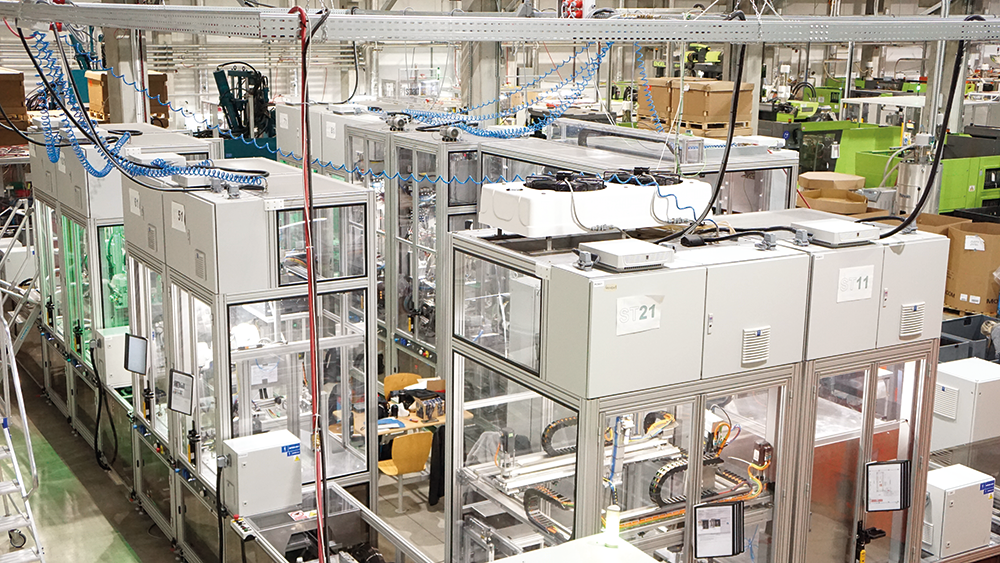
The development of the modular production line was a particular challenge, because of the customer’s need for flexibility on the one hand, and its size on the other. Never before had Smart Automation designed and implemented a production line on such a scale. The modern production plants for industry require increasingly more flexible solutions. Whether it’s changing production volumes, dynamic demands placed on the shape and size of the parts to be produced, or the need for rapid changeovers for new products, manufacturers in many industries are faced with the task of efficiently mastering the new challenges. The challenges are also causing machine builders to rethink their approach. Hierarchically structured machines with a central control system have been state of the art for a long time. Today, many requirements can usually be implemented much more efficiently with modular machine and system concepts, which make it possible to decentralise the control of individual modules.
Smart Automation is a specialist in the automation of industrial processes, and has many years of experience in various industries, including the furniture, food, chemical, pharmaceutical, and automotive sectors. The company, headquartered in Olsztyn, Poland, relies on innovative approaches for its customer-specific solutions based on Industry 4.0 technologies. Smart Automation developed a production line for valve covers for a tier 1 automotive supplier, based on modular machines and decentralised control. This modular concept enables more flexible and efficient production, allowing a faster response to changing market conditions and customer needs.
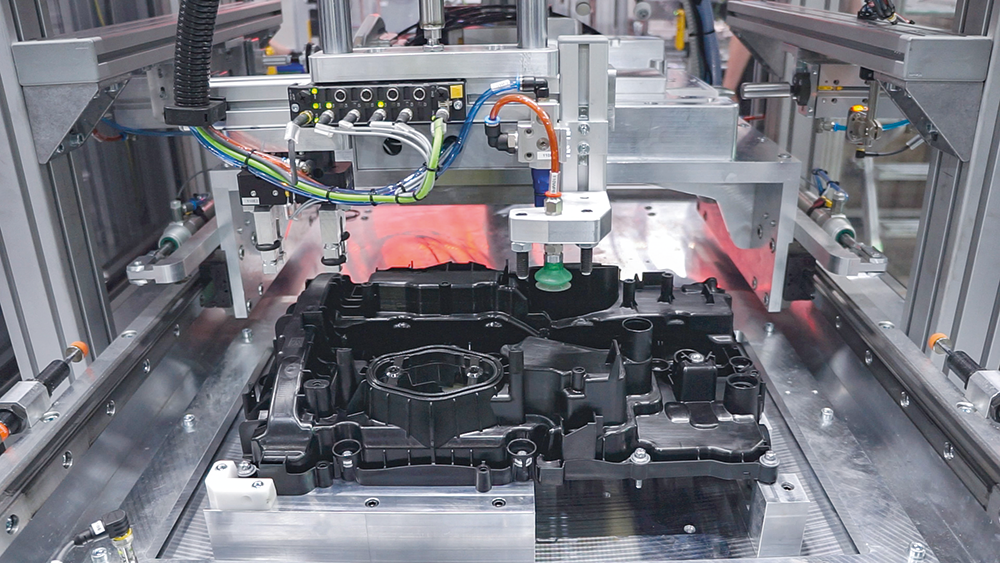
The line combines modules for numerous tasks, including the UV laser printing of data matrix codes for traceability, induction heating, assembly and measurement of aluminium inserts, and robot-based deionisation and surface cleaning for rubber sealing. Numerous measurements and leak tests also had to be carried out, from diameter and roundness to leakage, flow and pressure drop tests. Each workstation consists of three submodules for transport, process and construction.
With the modular structure of the workstations, Smart Automation was able to achieve standardisation at the design, assembly and programming levels, which greatly simplified any changes that may be necessary later in the life cycle of the machine. To implement this highly flexible line, the system integrator chose Turck as its automation partner. “Turck was already involved in the concept phase of the project,” recalls Cezary Zakrzewski, sales manager at Smart Automation.
“This helped us to discuss the optimal solution together with the customer and facilitated the subsequent phases of project preparation.”
Future-proof thanks to standardised device integration
A key requirement for the production line was the use of different Ethernet protocols. With their Ethernet multiprotocol functionality, Turck’s BL67 and TBEN series I/O modules were therefore the ideal solution for this project. They combine the three Ethernet protocols Modbus TCP, Ethernet/IP and Profinet in a single device and can be run automatically in any of the three networks. This enabled the number of device variants required to be effectively reduced. The identical planning of machine and plant sections with different Ethernet protocols also allowed standardisation in the integration of devices with different communication standards. A future reconfiguration of the plant could therefore be implemented without any major effort.
The Turck I/O modules used in the line also supported the decentralised control approach with their ARGEE onboard logic. This field logic controller functionality can handle small to medium control tasks without placing any burden on the central controller. This means that when I/O modules are changed or
replaced, the program in the central controller does not need to be adapted and the individual modules can be tested independently beforehand. They therefore provide considerable support for the modular machine design principle. As Zakrzewski confirms: “By working with Turck, we were able to achieve a high level of modularity for the entire production line. As a result, we are able to easily redesign the process as needed.”
Flexible process monitoring with RFID
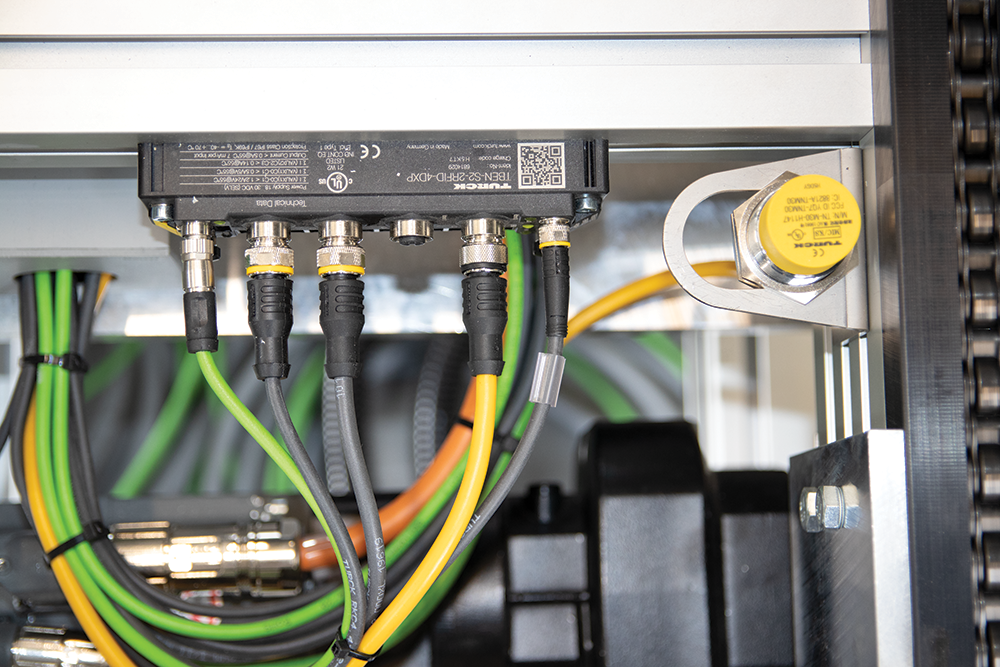
To fully monitor the manufacturing process, Smart Automation has implemented an RFID-based tracking system in which Turck’s TBEN-S module and HF read/write devices play a central role. All parameters and measured values of the manufacturing process are recorded for each individual part and stored in a database on a server and in the cloud. This solution makes it possible to flexibly design the manufacturing process, for example by skipping individual steps or reworking certain elements, at any time.
Factor 1 sensors with maximum switching distance for all metals
The company chose Turck’s uprox series for the inductive sensors required. As factor 1 sensors, the uprox devices detect all metals reliably and with the same switching distance, thus standardising sensor selection – another benefit in machine design. The uniform use of these sensors enables an easier integration into the plant, since differences in distance and target material do not have to be taken into account. Installation and maintenance are also less complex. This makes the production of the plant more efficient.
Production in view with LED technology
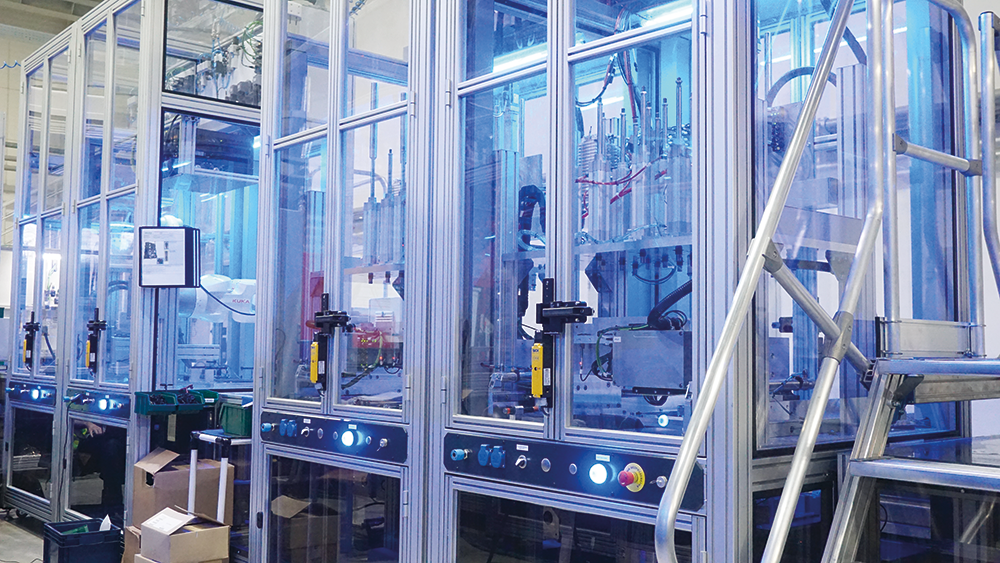
In such a large project, it was very important to display the current status at the various production stages. The company chose the WLS27 programmable LED strip lights from Turck’s optical sensor partner, Banner Engineering to indicate the status of the machine in each module using different colours. K50 illuminated touch buttons were used for intuitive communication with the user.
Fast and error-proof: pre-assembled cables
Another challenge with the complexity of this line was the connection technology. Smart Automation also found a solution for this in Turck’s extensive connectivity portfolio. Pre-assembled cables of various lengths were selected during the planning phase, and passive hubs were used where necessary. This not only enabled connection errors to be ruled out from the start, but also made it possible to accelerate assembly and commissioning of the individual modules significantly.
Conclusion
The combination of modular machine building and decentralised control offers multiple benefits with regard to the increasing production requirements in the automotive industry. Thanks to the solutions used, it was possible to reduce the number of operators and the amount of cabling, as well as the time required for the installation work. This would not have been possible with classic centralised control technology.
The modular concept also increased system availability, as only one module needs to be replaced if it fails. Ultimately, the modular design offered easy expansion options for the plant to also meet future requirements. This increased flexibility and ensured long-term cost efficiency. “It was very important to us that manual operations could be easily automated if the customer requested it at a later date,” Zakrzewski said. “Turck’s extensive portfolio enables easy handling of a wide variety of signals, from standard digital and analogue signals to RFID, which have been used for both operator logging and process tracking. By working with Turck, we were able to achieve a high level of modularity along the entire line.”
| Tel: | +27 11 453 2468 |
| Email: | sales@turckbanner.co.za |
| www: | www.turckbanner.co.za |
| Articles: | More information and articles about Turck Banner Southern Africa |






© Technews Publishing (Pty) Ltd | All Rights Reserved
 printer friendly version