



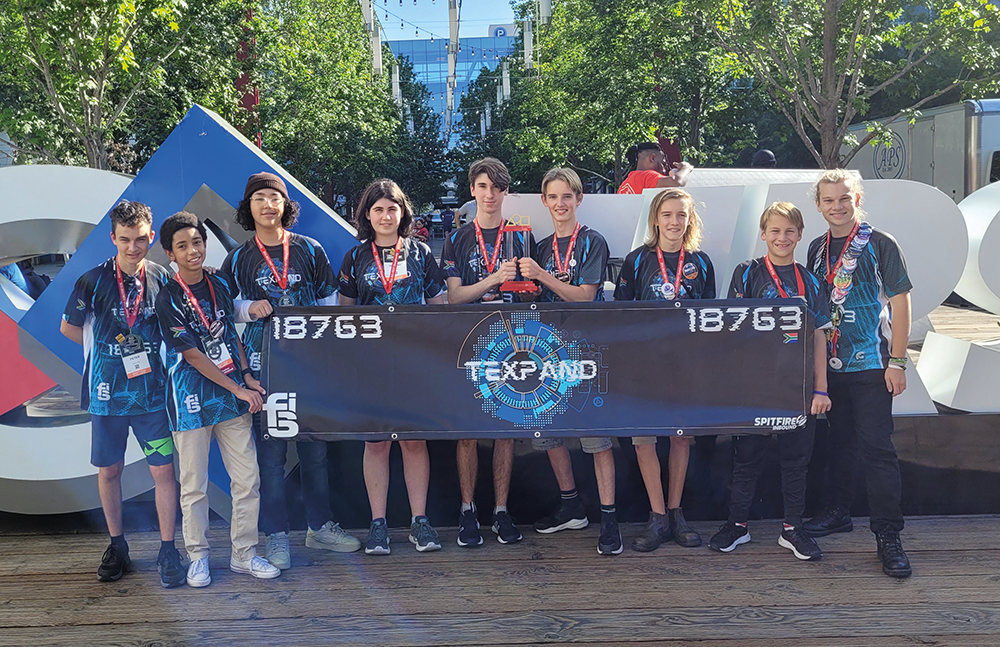
Team Texpand, a Cape Town based community robotics team aged from 13 to 16, has represented South Africa at the FIRST World Robotics Championships in April. They won first place in the THINK award. This goes to the team that is best at removing engineering obstacles through creative and scientific thinking.
The FIRST robotics competitions provide a fun way for kids to deepen their learning in the Science, Technology, Engineering and Mathematics (STEM) fields. The competitions centred around a game that is played by robots. Teams scored points by picking up cup sized cones and placing them on poles of different heights. The game was strategic because there were a limited number of cones. In each match, the team was randomly allocated another robot to play on the team. The teams had to stategise how their robots would play the game to win against the other two opposing robots.
In both the Western Cape regional and the SA national competitions, Texpand won the top award for the best team. The criteria included creative engineering and problem-solving; innovative design of the gripper system; multiple sensors to improve robot control; and volunteering more than 60 hours of training disadvantaged students in programming, mechanics and mathematics.
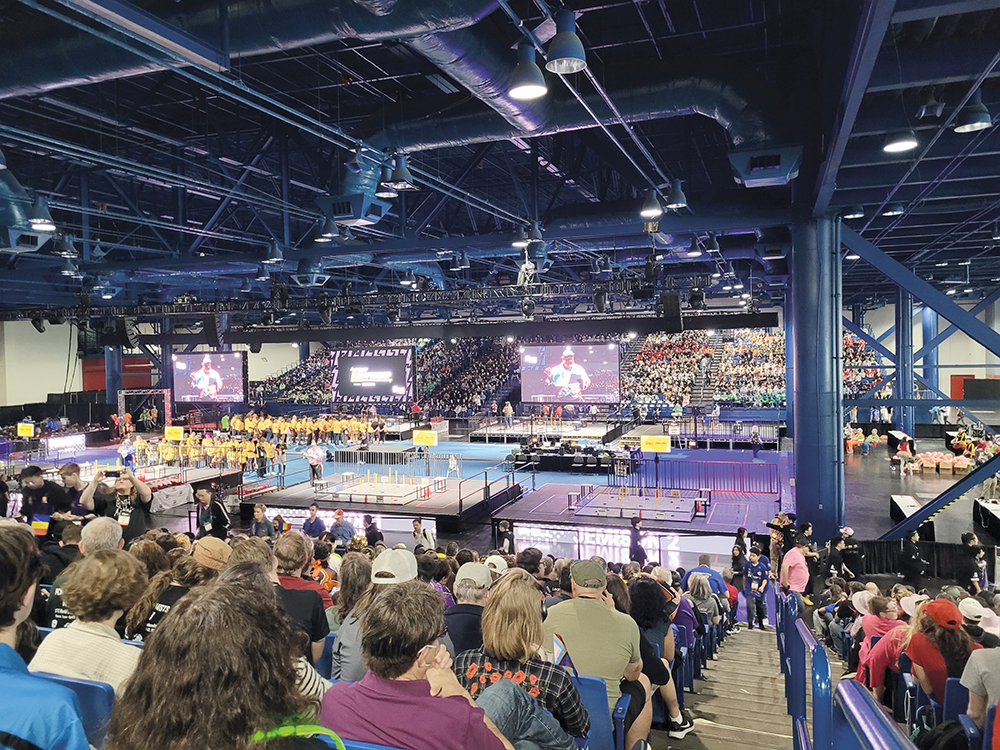
Competing in the Worlds was a tall task since top teams in the world have enormous budgets to buy the fastest components for their robots. With Texpand’s humble budget they could not compete with that, but they made the most of what they had. They ranked 25th out of 192 championship teams – a major achievement since more than 6800 other teams didn’t even qualify for the championship.
Ethan Buckle, who is the founding member of Texpand, explains their philosophy: “From the start we had our sights set on being the best SA team and qualifying for Worlds. We spent years watching the best teams in the world compete and showcase their robots. It was incredible to get the opportunity to see our hero teams compete in person and to meet and learn from them. Our initial goal was to make sure that we didn’t embarrass ourselves and look like we didn’t belong there.” This is what he believes was the key to their success:
• Keep the best in the world as your benchmark, not just the best in South Africa.
• Search for someone who is doing something much better than you, and learn from them.
• Be bold to reach out to those who are successful.
• Don’t wait to be taught something before you try something. Set an ambitious goal to build things that are beyond your current capability, and then find resources that will help you reach that goal.
Texpand has learned that robotics can be accessible to more people if the need for expensive and scarce technical coaches is reduced. In their own team they don’t have technical coaches and have learned to access online resources to teach themselves. They access the expertise of more experienced teams in the USA and then teach other kids what they’ve learned. The team has spent many hours teaching and running workshops at a local PDI primary school, on topics like mechanical design, coding and systems control, and basic maths for robotics. They have high hopes to develop more school robotics teams into thriving and self-sustaining teams, with the more experienced students learning how to pass their skills onto their younger teammates.
Texpand is looking to partner with companies that are committed to expanding STEM skills in South Africa. It is still very difficult for students to access robotics in South Africa because equipment is expensive and experienced robotics teachers are scarce. “Could your business fund equipment to start new teams that our team members will train and mentor in robotics? Could you fund our team to improve the range of parts we can purchase and build with? Do you have people in your business who have STEM skills and could give technical coaching to teams or are non-technical but good at organising and could be a non-technical team mentor?” asks Buckle.






© Technews Publishing (Pty) Ltd | All Rights Reserved
 printer friendly version