



When it comes to process instrumentation, companies attach great importance to a long service life. A growing number rely on external support to achieve this. In the past, such services were mainly concerned with calibrating the measuring instruments. As sustainable, resource-efficient management gradually becomes the norm, new services are emerging to match.
Industrial enterprises are under pressure to cut costs. Not surprisingly, they are constantly on the lookout for ways to improve their efficiency, and they operate their processes ever closer to the performance limit. This strategy has repercussions for the measuring instrumentation, which is required to be more accurate and more reliable than was the case in the past. As automation and digitalisation continue to gain ground, the market is increasingly demanding electronic devices offering advanced performance.
The ‘core competency’ of any measuring device is to supply a measured value within defined tolerance limits. The specified measurement quality must be maintained throughout its entire life. The most important service available for such devices is therefore regular calibration.
It has been quite a while now since users began calling for this task to be provided as an external service. After all, SANAS calibration – which must be traceable and accredited in accordance with ISO 17025 – is a condition of more and more QA audits. The Wika Calibration Service is SANAS accredited for pressure and temperature.
SANAS calibration is more complex than other test procedures. Furthermore, it is only allowed to be carried out and certified by an appropriately accredited laboratory. Coming up with an in-house solution for this is usually only worthwhile for companies with huge plant complexes like those in the chemical industry. External service providers are a better option for all other businesses. The test items are mostly calibrated in the provider’s laboratory. However, calibration vans that travel to the customer’s premises can often be a time-saving alternative.
Today, instrumentation-related services go far beyond calibration alone. They cover the entire life cycle, the aim being to extend the device’s service life to maximum until replacement becomes inevitable. The process begins with the instrument’s installation. This is partly a side-effect of demographic changes: as the baby boomer generation gradually goes into retirement, the process industry in particular is losing expertise for which no adequate substitute can be immediately found.
This gap is filled by the customer service departments of measurement technology manufacturers such as Wika. They take on the task of installing and commissioning complex systems, for example multipoints in refineries, or high-quality devices such as reference standards. Customers thus have the assurance that service life and performance will not be impaired before the life cycle even gets under way.
Installation services do not necessarily have to be performed by a team. In some cases, it is sufficient to call in just one specialist to supervise and communicate basic know-how to the customer’s experts. Special training can help lay the foundation for this initial instruction or for more in-depth information.
The service life of measuring instruments and solutions could be extended to maximum without any problem if all applications were to take place under laboratory conditions. In daily practice, of course, that is rarely the situation. Even with high quality, flawlessly manufactured products, in-process stresses invariably make themselves felt at some point, especially in automated processes running 24 hours a day.
Negative ambient conditions such as extreme temperatures, unsuitable supply media or contaminants in the plant, magnify the mechanical load. These factors can be a cause of ageing and wear on the components of measuring devices and are detrimental to their proper functioning. In this case, companies have traditionally tended to replace the affected device or system prematurely as the simplest solution.
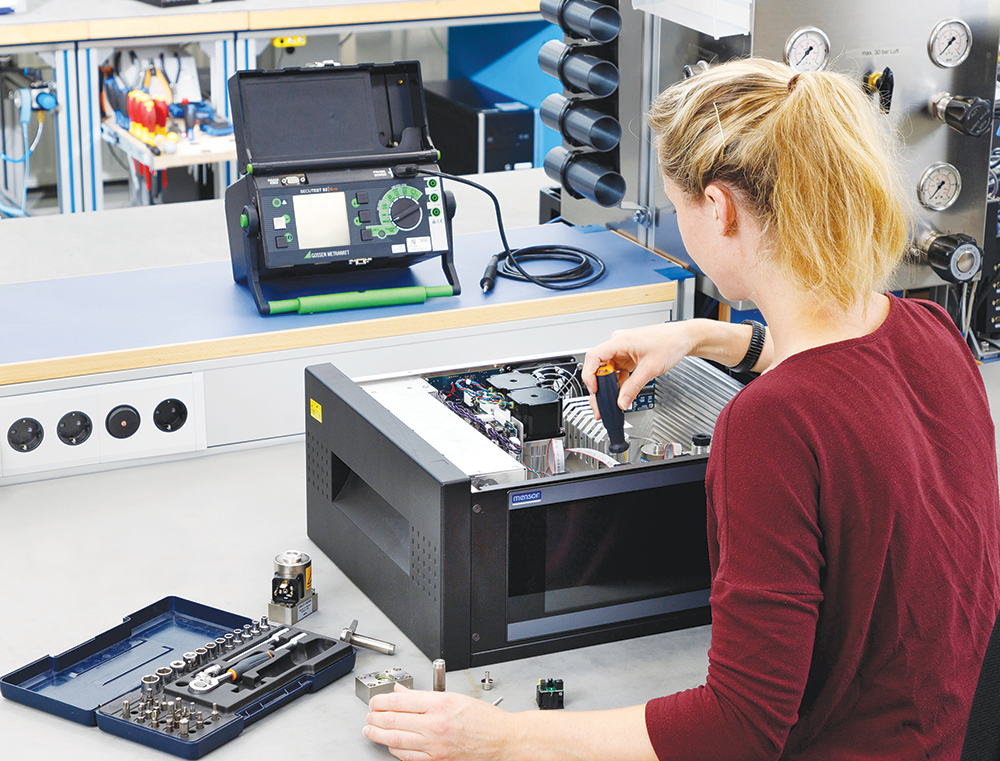
With sustainability high on the agenda, and at a time when resources are scarce and supplies short, attention is increasingly turning to repair options. With high-end products featuring complex technology such as pressure controllers or temperature baths, users will generally have no alternative but to enlist the services of an external provider with specialised knowledge.
The services offered by manufacturers such as Wika, which also extend to third-party products and are available through a worldwide service network, are based on a combination of production and application expertise. Before they replace a defective part, for example a solenoid valve, Wika’s experts check whether the entire part or only one component of it actually needs to be exchanged. This process usually includes a root cause analysis so that, if necessary, the user can take steps to prevent the same damage from re-occurring.
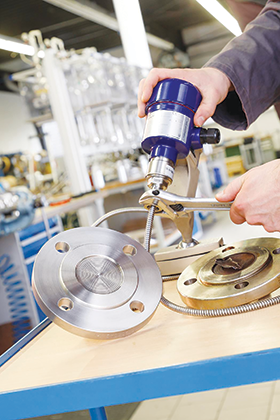
Diaphragm seal systems are a particularly good example of cost-effective and sustainable repairs. In the past, both the diaphragm seal itself, and the measuring instrument welded to it, were customarily disposed of completely as soon as the diaphragm seal became irreparably damaged due to long-term mechanical loading, aggressive substances or harsh ambient conditions.
However, experience shows that at least 95% of all measuring devices remain intact in spite of such damage. If a device is equipped with a process or other transmitter, it therefore makes sense to have the system opened by a specialist service partner and to only replace or, if possible, repair the diaphragm seal assembly. The instrument’s service life can be extended to maximum in this way.
Individual services are still first choice when it comes to calibrating, repairing or maintaining measuring instruments. However, more firms are meanwhile opting for a comprehensive service package under a framework agreement. This saves them the effort and expense of having to build up or find a substitute for essential know-how, or in some cases even create an infrastructure. Various models exist for such agreements.
One of these is based on plant maintenance cycles. During turnaround, the service provider firstly determines the actual condition of the measuring instruments in the processes on site at the customer, and which particular services are required. The resulting service scope is specified in the agreement. The service schedule automatically follows the maintenance cycle: devices are dismounted, calibrated, and repaired or replaced, as necessary. They are then reinstalled and put back into operation.
In an alternative model, the service provider and the customer get together upfront to discuss the fundamental nature of the requirements, and which service package is best suited for meeting them. The agreement which is subsequently signed lists precisely defined activities over a specific period of time. This scope can be expanded either during the term of the agreement or after it is renewed.
Summary
External services are an increasingly popular solution where process instrumentation is concerned. They cover every phase of a device or system’s life cycle – from installation through calibration and repair to replacement. By resorting to external service providers, companies can extend the service life of their monitoring and control instruments to the maximum. Sustainability commitments, impending supply shortages, and scarce material and human resources, in many places are leading to a growing demand for services. Against this background, more and more firms are opting for a comprehensive, contractually agreed package as an alternative to individual services.
| Tel: | +27 11 621 0000 |
| Email: | [email protected] |
| www: | www.wika.co.za |
| Articles: | More information and articles about WIKA Instruments |






© Technews Publishing (Pty) Ltd | All Rights Reserved
 printer friendly version