


Pneumatics & Hydraulics


How do you audit a compressed air system?

July 2022 Pneumatics & Hydraulics

The British and American governments estimate that as much as 10% of all electricity generated is consumed by air compressors, and that some 50% of this energy is wasted. Air leaks alone can account for 25% of these values.

Compressed air auditing is no longer a luxury, it is essential. By not knowing the facts around your compressed air consumption, you are doomed to a spiralling electricity bill.

Key points for a compressed air audit

What are the components of a comprehensive air audit? These are the basic steps in reducing operating costs for your compressed air system:

1. Measure the air flow and pressure entering a system for at least seven days.

2. Monitor and determine the compressor’s Kw/m3 efficiency.

3. Monitor and measure the consumption in various areas of the plant and benchmark your usage.

4. Measure the quality of the compressed air, dew point, particle count and oil carry-over, and classify your air quality.

5. Undertake an ultrasonic leak detection survey.

6. Identify wasteful air consumption practices.

7. Quantify the actual cost in these areas.
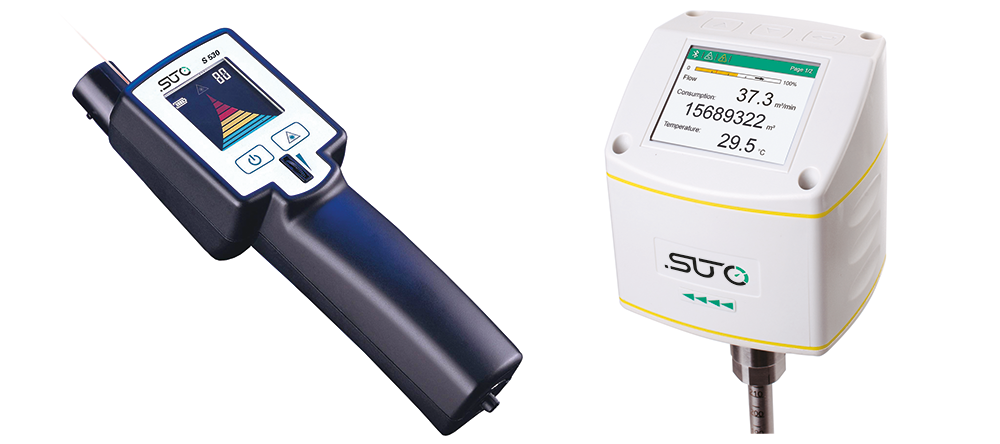
Air flow testing

On many sites compressors are often not operated at full capacity. By logging the flow and the power from the compressors, engineers will be able to determine a base load for the flow required in a plant. With detailed information, main load compressors can be selected from an existing fleet, with perhaps a variable speed drive compressor topping up the flow requirements. This type of decision will use power more effectively and cut energy wastage and costs

Air velocity

Compressed air velocity can be a useful pointer to the efficiency of a pipeline and/or distribution system.

High velocity = pressure drops = wasted power.

High velocity will carry airline contamination to the point of use.

Discharge pressure on occasion gets increased to overcome a poorly designed or overloaded piping system. This then in turn demands more power and pushes up maintenance costs, resulting in wasted kilowatts.

Leak detection

Ultrasonic air leak detection demands a methodical approach. The survey should identify the leak location points, the volume of compressed air lost, and the cost of the air wastage. This must be presented in a readable easy format.

Dew point

A blocked condensate drain, an open bypass valve, or worse still a fractured heat exchanger are all potential causes of water pollution in a factory. Compressed air dryers can pollute an air line for days before the cause of the pollution is located and rectified.

A dew point probe behind the dryer identifies a water contamination problem faster than any machine minder. These probes can easily be linked to a Scada system. A good air audit will show the flow, pressure, relative humidity and dew point in one concise graph

Auditing capacity

Make sure your auditor has the capacity to monitor all areas simultaneously to ensure a total overview within the same time frame.

Conclusion: auditing is a science

Auditing has now become a science. It requires a substantial monetary investment in equipment to provide a comprehensive overview for a client. This includes monitoring to ISO 8573. Auditors must have the ability, experience and knowledge to analyse and interpret the data to provide a meaningful report to the client.


Credit(s)


Share this article:
Share via emailShare via LinkedInPrint this page

Further reading:

CompAir introduces compressed air management solution
Pneumatics & Hydraulics
To maximise savings and extend the lifespan of compressed air systems, CompAir is launching the Compressed Air Management Solution powered by Ecoplant, an intelligent system in the cloud that represents the next level in operational management, and maintain the health

Read more...
Heavy impact, smart control
Axiom Hydraulics Editor's Choice Pneumatics & Hydraulics
Every now and then a project lands on your desk that’s equal parts heavy machinery and fine control - a tantalising mix for any engineer. A client approached Axiom Hydraulics with a project exactly like this.

Read more...
Making lines safer with smarter connection
Hydrasales Pneumatics & Hydraulics
Imagine connecting multiple hydraulic lines or a combination of hydraulic, electrical and grease lines with one single, confident movement. That’s the everyday convenience operators get from Faster’s MultiFaster multi-coupling systems.

Read more...
Achieving clean and dry compressed air
Artic Driers International Pneumatics & Hydraulics
Compressed air is an expensive source of motive power so it makes good sense to supply clean, dry compressed air to your distribution system.

Read more...
Navigating ISO standards in hydraulic cylinder manufacturing
Pneumatics & Hydraulics
For hydraulics professionals, understanding and leveraging ISO standards is a powerful way to ensure quality and gain a competitive edge. Here is a guide to the most critical ISO standards for hydraulic cylinder manufacturing, showing how to use them to your advantage.

Read more...
Hydraulic system upgrades to boost performance and save money
CT Hydraulics (Nqoba) Pneumatics & Hydraulics
Those working with hydraulic or pneumatic systems know that keeping your machinery running at peak performance balances productivity and cost. As systems age, they often become less efficient, requiring more energy and more frequent repairs. The good news is that you don’t always need to invest in an entirely new machine to solve these problems.

Read more...
Top 10 questions about pressure and temperature gauges
SA Gauge Pneumatics & Hydraulics
Some questions never go out of date, and in our industry, a few have been asked for decades. At SA Gauge, we hear them every week. Here are the ten questions we hear most often, and the practical answers that can save time, money and frustration.

Read more...
Gauge maintenance and calibration tips for shutdown or restart periods
SA Gauge Pneumatics & Hydraulics
As the year winds down, many plants across South Africa prepare for the annual shutdown. It’s also the perfect opportunity to give your pressure and temperature gauges the attention they deserve.

Read more...
Axial piston pump series for next-gen hydraulic applications
Pneumatics & Hydraulics
Moog has launched its new AXP Axial Piston Pump Series, a next-generation hydraulic solution engineered to deliver optimal performance, reliability and cost efficiency for industrial applications.

Read more...
The role of analogue gauges in a digital world
SA Gauge Editor's Choice Pneumatics & Hydraulics
With so much focus on digital systems, remote monitoring and automation, it’s easy to assume that traditional analogue gauges have become outdated. Yet if you step into almost any plant, mine or processing facility, you’ll still find them in daily use, quietly doing their job without fuss.

Read more...


While every effort has been made to ensure the accuracy of the information contained herein, the publisher and its agents cannot be held responsible for any errors contained, or any loss incurred as a result. Articles published do not necessarily reflect the views of the publishers. The editor reserves the right to alter or cut copy. Articles submitted are deemed to have been cleared for publication. Advertisements and company contact details are published as provided by the advertiser. Technews Publishing (Pty) Ltd cannot be held responsible for the accuracy or veracity of supplied material.


© Technews Publishing (Pty) Ltd | All Rights Reserved

