



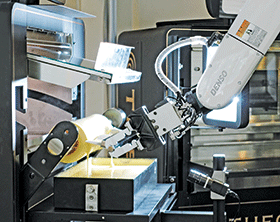
A novel solution for food manufacturing has been unveiled by confectionery manufacturer, Juchheim. Its robot, Theo, bakes high-quality Baumkuchen. This is a German style of layered cake that has become popular in Japan. Theo is controlled by an ultra-compact Beckhoff Industrial PC with TwinCAT software and supported by an AI application.
“Baking Baumkuchen requires advanced skills and experience from the confectioner,” says Mr Matsumoto, managing director of Juchheim’s central plant. “However, if the oven’s parameters can be captured and set remotely, and the baking temperatures can be displayed precisely, our pastry chefs can remotely control machines. With Theo, integrated AI, and the expertise of our master confectioners, Baumkuchen can be made anywhere in the world with the same Juchheim quality.”
When making Baumkuchen, a rotating core rod is repeatedly coated with raw dough and placed in the oven until 13 layers of dough are evenly baked.
The baking itself requires an expert. Theo replicates the expert’s skills with the help of AI. The Baumkuchen plant consists of three Theos, a vertical articulated robot and a conveyor belt that transports the dough containers and rods. All components are controlled by an ultra-compact Beckhoff C6030 Industrial PC with Intel-Core i7 processor and networked via EtherCAT.
The high-tech bakery is almost completely automated. All the operator has to do is prepare the dough and the core rods, place them on the conveyor belt, select one of the three ovens on the control panel and start the process. Then the conveyor belt automatically transports the dough container and core rod to the specified position. The robot picks up the container and rod and places them in front of the oven. Then the robot begins to coat the core rod with dough and apply the layers one by one. The AI functionality implemented in the oven monitors the process and ensures highly precise baking.
The advantage of the Beckhoff IPC and TwinCAT software is real-time process control via EtherCAT and Windows integration. TwinCAT 3 PLC controls the conveyor belt, the rotation of the oven, and the opening and closing of the door using EtherCAT drives and motors that are precisely synchronised with the robot’s motion. In addition, the IPC offers high scalability so that Juchheim’s own Windows applications can be used, as can solutions for remote system maintenance.
The AI functionality runs as a Windows application on the same IPC as TwinCAT. Multimodal AI technology is used to monitor the quality of the Baumkuchen. High-performance cameras are installed in front of each oven to capture images of the cake surfaces. This data is linked to other sensor data, including those from radiation pyrometers. The AI model is based on a convolutional neural network. It is implemented in the standard IPC as a Windows application.
As the number of dough layers increases, so does the diameter of the Baumkuchen. Accordingly, various parameters can vary, such as the distance from the oven wall and the baking time required to achieve a perfectly baked dough layer. It is a very delicate process that requires careful monitoring of baking conditions and the application of the next layer of dough.
During operation, Theo checks the image data from the camera and the data from other sensors in real-time to determine the quality. When a dough layer is in optimal condition, it is reported back to the control system. TwinCAT then stops the rotation of the dough tube and opens the door so the robot can remove the Baumkuchen. The total time required from data input into the trained model, including the inference output, until feedback to the control is around 100 to 200 ms.
Another technical challenge is the constant coating of the dough rolls with identical amounts of dough. For this purpose, TwinCAT controls the optimum position and angle of the rotating rod so that the robot can apply exactly the same dough thickness for each layer so material loss is minimised. “Here Theo is a better Baumkuchen baker than a master pâtissier,” Mr Matsumoto points out.
Several stand-alone ovens are in operation across Japan. Mr. Matsumoto explains: “We are developing a model for baking chocolate-based dough and a system with compact vertical articulated robot arms. Beckhoff will continue to provide optimal support for our ambitious and creative initiatives in baking.”
| Tel: | +27 11 795 2898 |
| Email: | [email protected] |
| www: | www.beckhoff.com |
| Articles: | More information and articles about Beckhoff Automation |






© Technews Publishing (Pty) Ltd | All Rights Reserved
 printer friendly version