



Providing a solution
From apple orchards and citrus groves to table grape vineyards and pecan farms, you can find farmers across southern Africa using Red Ant Agri Engineering machines. This is because Red Ant Agri Engineering, a division of Reid & Verwey, has spent more than a decade developing highly complex, niche agricultural equipment tailored to the needs of its customers. “Our business is highly solutions-driven,” says owner, James Reid. “Yes, we build agricultural hardware, but we don’t see ourselves as equipment builders. We pride ourselves on offering solutions to our customers.”
Increasingly complex machines
Meeting specialty needs, Red Ant Agri’s products help automate niche farming activities and are produced in small to medium production runs. Faced with the need to design and build increasingly complex machines, the company turned to Solid Edge software to support its rapid growth. This is part of the Xcelerator portfolio, the comprehensive and integrated portfolio of software and services from Siemens Digital Industries Software.
“Solid Edge has enabled us to enter a whole new world of product design and manufacturing,” says Reid. “In the past we made products that were simple and restricted by the materials and manufacturing technologies available. Many of the products were easy to copy and we often found that customers were buying materials and building the products themselves once we had done all the hard work to get the product working.”
With the 3D design and sheet metal capabilities of Solid Edge, Red Ant Agri now designs equipment that is far more functional and cost-effective than ever before. “Solid Edge has allowed us to migrate from being a local repair workshop to a recognised manufacturer of quality machinery in the agricultural space,” he explains. “Our customers are happy to pay for well-designed and well-built equipment that does what it is meant to do.”
A single product can include more than 500 components; being able to model and assemble the parts to check the fit and function of the machines has helped cut down on development time and cost. Solid Edge includes sheet metal functionality that improves the manufacturability of designs and allows for easy integration with cutting and bending tools on the manufacturing floor. The company also uses 3D renderings and models to assist with customer communications during the design phase and collaborate with subsystem providers and contract manufacturers.
Improving the success of new product introductions
Many of Red Ant Agri’s customers contact the company looking for a completely new or custom solution. This requires the company to filter requests and focus its design capabilities on projects that can be turned into a product line. With Solid Edge, Red Ant Agri can collaborate with customers on a digital model, developing new solutions and fine-tuning a digital prototype before the first metal piece is cut. This has resulted in a 300% improvement in new product release success. “In the past we would be happy with one in four projects progressing to commercial viability. Today we expect 75% of the new products to achieve commercial success,” says Reid. “In addition to the obvious functional improvements in our products, the software has enhanced the aesthetics of our products by being able to easily make subtle changes in design proportions and to the general look and feel of the product while it is still in the modelling environment,” he explains, “This has enabled us to sell 10 times more of each design we complete. Before using Solid Edge, we were happy to produce 10 to 20 units of a specific machine. We now have over 300 units of two of our products in the market and are well on the way with a third product.”
In addition to improvements in sales, the new processes have enhanced customer satisfaction and product serviceability. The company is now able to produce much more detailed maintenance and service literature based on the drawings and renderings available. Thanks to available 3D models and drawings, spare parts are easy to provide and changes made to new designs become improvements that can be retrofitted to older models.
Getting designs right the first time with digital prototypes
As a small company, Red Ant Agri needs to get designs right the first time and keep design costs low. It is critical for the firm to be able to make design changes easily and keep development costs low. With larger and more complex machines, it is no longer possible to iron out problems on physical prototypes. “We need the first production unit to work,” says Reid. “Solid Edge has assisted us greatly in ensuring that we go from design to production without time-consuming and costly prototyping stages.” The team no longer builds physical prototypes that end up on the scrap heap. Instead, a digital prototype can be used to check fit and manufacturing, as well as assembly sequences. This also ensures that all components are ordered or manufactured before fabrication and assembly. “This has dramatically improved the speed and the cost of designing new products,” says Reid. “While every product is different, I can safely say that by using Solid Edge we now deliver a working solution more than twice as fast as we did before.”
Creating digital prototypes also helps the company sell its vision to potential customers and secure sales before building starts. “In our environment farmers like to buy with their eyes,” says Reid. “The ability to produce lifelike 3D models and renderings is invaluable.”
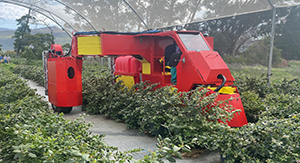
He mentions a customer who after viewing the first renderings of his high clearance berry sprayer, visited the office to see how the building process was coming along. The customer was surprised to learn the pictures he had seen were computer-generated and that he would have to wait a few more weeks to see the machine in real life. Being able to envision the completed product helps Red Ant Agri not only lock in deals, but also to make any necessary changes and adjustments to the design at earlier stages of development when these changes are easier, quicker and less expensive.
Addressing supply chain challenges and lowering costs
Recently, Red Ant Agri has seen the impact of supply chain issues on both price and availability of materials. This has required the use of a variety of contract manufacturers for laser cutting and bending. Each supplier has its own set of tooling when it comes to bending, so bending specifications must be tweaked to match the supplier. “We have found the Solid Edge sheet metal environment very user-friendly when needing to tweak drawings to get quotes from different suppliers,” says Reid. “This system flexibility has led to more than a 10% saving on sheet metal components as a result of this more efficient sourcing. Our Solid Edge 3D models have made it easy for us to search globally for more cost-effective components.”
The current situation with the supply and logistics around components internationally has put pressure on most manufacturers. Being able to verify form, fit and function on alternate components has become more necessary than ever before. “We have secured the supply of six hydraulic components across three products with a 30 to 50% cost savings for each component,” he continues. “Hydraulic components are expensive, so these types of savings have a significant effect on the final product cost. While every product is different, I can safely say that by using Solid Edge we now deliver a working solution more than twice as fast as we did before.”
Gaining a competitive edge with increased innovation
According to Reid, the most obvious impact the introduction of Solid Edge has had on the company is the scope of the products it can now tackle. As the team’s capabilities and confidence have grown, it has started taking on far more ambitious projects, which helps Red Ant Agri to compete in the market with new, relevant and innovative designs. This helps the company adapt its strategy from smaller batch, seasonally driven orders to the proactive introduction of new products into new markets, anticipating changes in the industry and spurring growth. The team tries to introduce two to three new products a year. “My design time is very limited,” says Reid. “So being able to develop new ideas fast is critical.” In the last 18 months, the company has even applied for two patents. Reid credits the team’s agility, supported by Solid Edge capabilities, with helping to manage engineering changes and deliver continuity in product supply. “Solid Edge has been instrumental in allowing a small to medium-sized company do big things,” he says. “The development of the Red Ant product range has added significantly to our company growth over the last eight years. This would not have been possible without Solid Edge.”
| Tel: | +27 11 652 2000 |
| Email: | [email protected] |
| www: | www.siemens.co.za |
| Articles: | More information and articles about Siemens South Africa |






© Technews Publishing (Pty) Ltd | All Rights Reserved
 printer friendly version