



Just before starting on this piece, I read a fascinating article by a valve manufacturer in the April issue of SA Instrumentation & Control, which mentioned a case where a relatively small 1,4% improvement in control variance which was achieved by replacing a poor valve, led to an annual cost saving of over R8 000 000! This was on only one loop!
In a study recently completed in the USA, and based on 300 control loop installations, it was stipulated that in the average plant, if 30% of the loops are operating inefficiently in automatic, the annual opportunity cost would exceed US$350 000.
As mentioned repeatedly in my articles, the experiences of myself and others have found that in the average plant worldwide, in fact over 85% of the loops are operating completely inefficiently in automatic. It literally boggles the mind as to what absolutely incredible annual economic benefits (certainly in the region of many millions of rands), could be achieved if people would firstly only admit that there are problems in their plants, and then institute optimisation as a separate discipline!
Time and time again I preach this message, but relatively few plants will do anything about it. In many cases their control chiefs refuse to admit that there are failings, and that they can learn some new and fascinating things about how practical control optimisation techniques can be applied. In other cases, the lower rungs of management find it difficult to present enough economic justification to top management and the board, to get the necessary funds needed to implement this discipline.
A very interesting example of the refusal to admit to problems arose recently in a processing plant with which I have been acquainted for many years, as I provided and built the original control systems and panels for the plant when it was built in the 1970s. The original controllers were of the old standalone electronic type. They were later replaced with a PLC-scada system.
When I specialised in regulatory control optimisation in the '90s, this was one of the first plants I visited, as I knew that for various reasons, there were probably tremendous problems with their controls. After a presentation lasting several hours I was told by their chief control engineer and leading technician, that none of the problems I had discussed existed in their plant, and it would be almost impossible to improve on its already impressive performance. As the years went by I had quite a few of their process engineers and specialists on my courses, but never any of their instrumentation and control people.
About two years ago I was optimising the controls on another plant in the same group, and I worked with a senior instrument technician who had recently been transferred across from the plant under discussion. He told me that although I was finding all the usual problems in the plant we were now working in, the controls in his old plant were absolutely perfect. He spent quite a long time telling me how well everything was working, and that it could be classed as a problem-free plant as far as the controls were concerned.
Strangely enough the process specialists who were on my courses were not so convinced that this was the case. A few years ago I offered to perform an audit for a day to examine a few of their faster control loops (which they were convinced were operating so well). The chief control engineer did not even bother to reply to my offer.
A few months ago the process manager decided after all that he would like to see the results of such an audit, and placed an order for it. The results of this work are really interesting. Seven loops were examined. On the whole they were simple fast loops that should have been working well. The results are shown below:
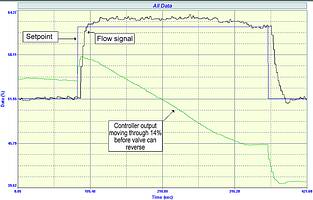
Loop 1 was a flow loop. The valve was three times oversized with 14% hysteresis. As discussed in the Loop Signature series, good control is difficult to achieve with valves oversized by more than a factor of two. As far as the other problem is concerned, control valves should not exhibit more than 1% hysteresis. With 14% hysteresis on a hugely oversized valve, good control is impossible. The tuning would have been good for a normal flow loop, but in fact it is better to detune a flow loop with excessive hysteresis. Figure 1 shows a closed loop test illustrating how long it takes to reverse the valve after the first overshoot on a setpoint change.
Loops 2 and 3 consisted of a level and a very important density control system, and were very interactive. All that was really needed was the density control. The control strategy was unworkable, and a better and more workable strategy was suggested.
Loop 4 was a flow loop. The valve had 13% hysteresis and the tuning was about 10 times slower than it should have been. Once again the control could be vastly improved if the valve was replaced.
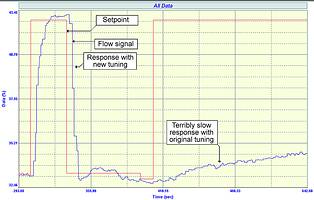
Loop 5, another flow loop, was completely detuned. The correct tuning was literally hundreds of times faster. In addition it was found that when the controller output was at zero, the minimum flow was at 32% of the span. Either the valve was passing, or it was stroked incorrectly. Figure 2 shows the difference in response with firstly the new tuning and secondly the original tuning.
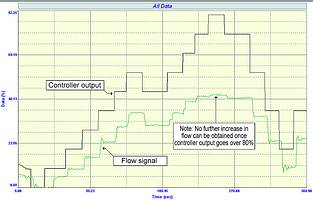
Loop 6 was a level control. Initial closed loop 'as found' tests showed the control was hopeless. Fortunately there was a flow indicator in series with the control valve. Tests showed firstly that the flow saturated at about 80% of the valve opening. (This is shown in Figure 3). Good control practice would dictate that the controller output should be limited at this point to prevent reset windup. Secondly, it was found that the flow through the valve varied widely when the controller was in manual and the output signal was kept constant. This was most likely due to pressure variations in the pipeline. The variations made it virtually impossible to achieve good control with the existing loop set-up.
To solve this, it would be easy to add a secondary cascade control loop on the flow, with the level controller feeding the setpoint of the flow controller. This control loop would be much faster than the level, and would allow the level controller to do a good job, as the flow controller could now take charge of eliminating variations in flow due to the pressure changes. (Refer loop signature article 'How to make a bad valve into a good valve' - SA I&C, August 2002).
Loop 7 was a level loop. When examined, it was found to be cycling badly due to extremely bad tuning. Good tuning soon solved that problem. One problem that still existed, was that there was a very high noise amplitude on the level signal. Unfortunately this was being amplified in the controller as higher gains are generally needed too achieve good 'tight' level control. Although filters are very undesirable it was suggested that one should be used in this case to minimise excessive wear on the valve.
It was really interesting that not one loop was found to be working properly in this audit on relatively simple loops. One must assume that if these are not operating properly then there is little chance that the slower more critical loops will be any better.
One wonders how many hundreds of millions of rands this plant has lost with bad control over the decades.
For more information contact Michael Brown Control Engineering, 011 486 0567, michael.brown@pixie.co.za, www.controlloop.co.za
Michael Brown is a specialist in control loop optimisation, with many years of experience in process control instrumentation. His main activities are consulting, and teaching practical control loop analysis and optimisation. He gives training courses that can be held in clients' plants, where students can have the added benefit of practising on live loops. His work takes him to plants all over South Africa, and also to other countries.
| Email: | michael.brown@mweb.co.za |
| www: | www.controlloop.co.za |
| Articles: | More information and articles about Michael Brown Control Engineering |






© Technews Publishing (Pty) Ltd | All Rights Reserved
 printer friendly version