Sizing of hydraulic tubing
October 2002
Pneumatics & Hydraulics
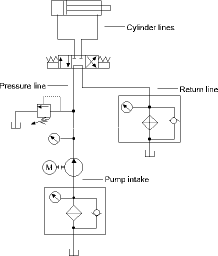
When determining tubing sizes one must always use the flow rate that is going to be transmitted in the tubing for calculating diameters. Do not use the pump inlet and outlet ports as a guide to determine the tube size. One can safely say then, that any component used in a hydraulic system must be chosen according to the flow it can handle and not according to port sizes. There are recommended flow velocities for the various lines in a hydraulic system. These fluid velocities are recommended for oil up to a viscosity of 68 centistoke at 40°C. The maximum fluid velocity for pump intake is 0,7 m/s (suction line). Fluid velocity for return lines is 3 m/s. The flow rate of oil leaving the cap end of a cylinder, when it is retracting, is more than the oil that is being delivered by the pump. The reason for this statement is that the oil is being forced into the rod-end of the cylinder, against the annulus area which is smaller than the full piston area. This means that the cylinder retracts at a faster rate than it extends, sending a higher flow rate out of the cap-end of the cylinder, which must be taken into consideration when determining the size of the return line.
Formula to determine the inside diameter of hydraulic tubing:
Where
D = inside diameter of tubing in millimetres
Q = oil flow rate in litres per minute
V = recommended fluid velocity in metres/s.
Useful hydraulic formulae
Pumps and motors:
Power to drive hydraulic pump (kW) = pressure (MPa) x flow (l/s) x 1,2 (extra power to overcome frictional losses).
Geometric flow rate of pump/motor (lpm) = Swept volume (cm3/rev) x shaft speed (rpm)/1000
Theoretical torque of hydraulic motor (Nm) = pressure (N/m2) x swept volume (m3/rev)
Heat equivalent (Joule/s) = pressure (N/m2) x flow rate (m3/s)
Cylinders
Flow rate (m3/s) = effective piston area (m2) x cylinder speed (m/s)
Theoretical force (N) = pressure (N/m2) x effective piston area (m2)
For more information contact Hydraulic Steel Tube, 011 394 2966, allan@hst.co.za, www.hst.co.za
Further reading:
Precision and durability in metal manufacturing and injection moulding
Parker Hannifin - Sales Company South Africa
Pneumatics & Hydraulics
From 800 bar hydraulic circuits in metal presses to low-pressure cooling systems in injection moulding machines, Parker Hannifin’s fluid connector systems are engineered for the contrasting demands of high-pressure sealing, thermal resistance and rapid serviceability.
Read more...
BMG expands fluid technology portfolio with Boston by Danfoss industrial hose
Bearing Man Group t/a BMG
Pneumatics & Hydraulics
BMG has added the Boston by Danfoss Industrial Hose range to its fluid technology portfolio, giving customers a single source for both hydraulic and industrial hose requirements across Africa.
Read more...
Pneumatic solutions for versatility, operational safety and efficiency
Pneumatics & Hydraulics
As an authorised partner of Festo, BMG combines access to globally recognised pneumatic technologies with local application expertise and technical support.
Read more...
Turning compressed air into a strategic energy advantage
Pneumatics & Hydraulics
Compressed air accounts for up to 80% of a system’s lifecycle costs, yet often remains overlooked in energy strategies. CompAir’s Energy Check provides a data-driven analysis of the complete compressed air network to identify energy savings of 20 to 30% or more.
Read more...
Air compressor secures premium meat company’s legacy
Pneumatics & Hydraulics
A tailored ELGi compressed air solution from Integrated Air Solutions is helping Tulisa Meat Market protect six decades of quality and consistency in its premium meat production.
Read more...
How laser cladding delivers 33% more life and maximum ROI in hydraulic cylinders
Pneumatics & Hydraulics
By utilising advanced laser cladding, Honingcraft can help clients achieve a 33% longer life from their components, ensuring they secure the maximum return on their investment.
Read more...
Identifying signs of hydraulic cylinder wear and tear
CT Hydraulics (Nqoba)
Pneumatics & Hydraulics
Recognising the early warning signs of hydraulic cylinder degradation is crucial for preventing costly downtime, ensuring operator safety and maximising the lifespan of your hydraulic systems.
Read more...
Integrated Air Solutions opens Pinetown branch
Pneumatics & Hydraulics
Integrated Air Solutions has opened a branch in Pinetown, bringing world-class diesel and electric air compressor services closer to customers in KwaZulu-Natal.
Read more...
Cartridge-style flowmeter
Axiom Hydraulics
Pneumatics & Hydraulics
Sun’s new cartridge-style flowmeter QMEH delivers precise, real-time flow measurements for demanding hydraulic applications. Using a custom-built, state-of-the-art sensor, the QMEH accurately detects flow and converts the electrical signal into a proportional flow rate.
Read more...
Robust sensors for pneumatic applications
ifm - South Africa
Pneumatics & Hydraulics
The pressure sensors from ifm have a G1/8 process connection, combined with a welded thin-film measuring cell. While offering an unbeatable price/performance ratio, this technology provides for high measuring accuracy in a very compact and robust housing.
Read more...










 printer friendly version