



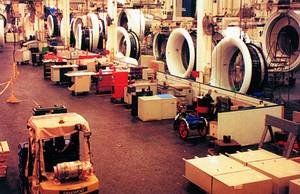
The Pratt and Whitney production test facility in Middletown, Connecticut, tests approximately 100 jet engines per month, round the clock, every day of the year. Some of the engines tested are newly manufactured, others after being overhauled and repaired for commercial airlines and the military.
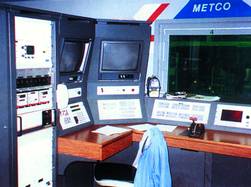
At the time of delivery to the Middletown facility each engine is mounted on a sling with special fittings so that it can be moved using an overhead monorail. Following any mechanical repairs it is run through a test cycle in a specially constructed test cell. The operator sits at a console in the adjacent control room. Existing control and alarm components of the console right down to the board level were all built by Pratt and Whitney over 10 years ago to specifications developed by their own engineers.
In 1995 the engineering department for the test facility recognised that changing conditions dictated an overhaul of the control system. Factors leading to the changeover included:
* An increased number of engine types going to be tested when Pratt and Whitney decided to overhaul and repair for other companies.
* The thousands of feet of wiring involved in the custom hardware, made maintenance difficult and time-consuming.
* Demands for increased productivity reduced the number of personnel available to perform set-ups between tests.
To monitor and supervise the test cycle, Pratt and Whitney chose a PC-based automation application called Citect for Windows, manufactured by Ci Technologies. Four test cells currently have 500 I/O point Citect licences installed, with the remaining four cells to be converted and networked in the future. Citect monitors the operation of the PLC controlling the engine during the test cycle. Citect also provides a graphic user interface with alarms and reporting and accepts operator inputs.
To meet FAA requirements the test data from each acquisition point is sent directly to a mainframe computer. Programming and control of the system's PLC is done by a PC. The PLC's discrete I/O is used to control the jet engine during the test process. Engine performance is reported to the mainframe from the operator console via Citect so that test data can be matched with the precise point in the test cycle where differences occurred.
The PLC uses digital and analog I/O to control the test cell and the engine during the test. It monitors, controls and reports on parameters such as fuel, air supply, salvage and stack temperature. The control system continuously monitors the health of the engine and allows an orderly shutdown in the event of emergencies such as overpressure or overspeed conditions, otherwise a runaway engine could destroy itself.
Gordon Champion, Lead Test System Engineer, is manager of the group implementing the system upgrade. 'The switch to an open, PC-based control system results in numerous improvements to the capabilities of the test facility,' Champion said. The test staff no longer experience the problems with maintaining thousands of wires. The new system will integrate diagnostic tools into the testing process and will enhance the facility’s ability to support the Pratt and Whitney test mission by becoming self documenting. Not only is the facility able to become more flexible in changeover between jobs, it can become more efficient overall and keep pace with changes in operations. The test department in 1995 had 16 engineers. Now, with the new control system six employees maintain an enhanced production schedule.
The choice of Citect for Windows allowed Ray Smollen, the Design Engineer, to continue using a generic 32 bit driver for the PLC while Ci Technologies developed a 32 bit driver for SyMax with Ethernet communications specifically for the Pratt and Whitney test facility. 'This choice ensured that we could make maximum use of our computing resources,'according to Smollen.
All system integration is being performed 'in house' by Smollen and takes full advantage of Cicode, the programming language included with the Citect application. The new installation replaced the existing console with a single PC and pushbuttons on a touchscreen. The Cicode algorithm enables the control system to automatically recognise the type of engine mounted when a new unit is brought into the test cell and select the appropriate test cycle and control parameters. This speeds job changeovers and eliminates any possibility of operator error.
Using Citect, the control program can multitask and restart an individual task - such as writing to a pushbutton on the screen or sending bits to the PLC - in the event of a stoppage. Smollen has written the program so that the software counts the number of loops and if the task has stopped, the computer simply restarts the task automatically. The process is, therefore, deterministic, with transparent restarts incurring no delays for an operator restart.
Future plans at Pratt and Whitney include expanding PC-based control to all test cells, networking the cells and making the entire process self-documenting.






© Technews Publishing (Pty) Ltd | All Rights Reserved
 printer friendly version