



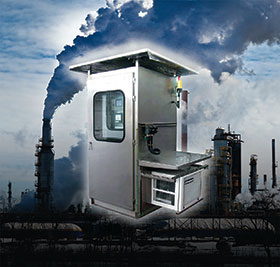
Since the 1970s, the United States Environmental Protection Agency (USEPA) has been responsible for establishing and enforcing environmental protection standards worldwide. An important element of these is the mandated monitoring requirements to verify that the standards are being met, especially for emissions into the atmosphere. For many plants, continuous emission monitoring (CEM) systems are a key component of their compliance responsibilities.
Yokogawa: a trusted partner towards 2020 plant emission compliance
The Air Quality Act, 39 of 2004 (AQA) controls air pollution in South Africa. This legislation requires that any operation producing air pollution – which in terms of the Act is referred to as an atmospheric emission – must ensure that they have an effective air quality management plan in place.
Companies must adhere to the national emission standards, which require the monitoring and management of these ambient air pollutants. Certain plants and businesses producing emissions must follow through with Atmospheric Emission License (AEL) applications if they want to operate legally, and within environmental and health responsibilities.
As it stands, the Department of Environmental Affairs has issued a list of activities detailing atmospheric emissions that could have a detrimental effect on the environment, including health, social, economic and ecological conditions. The deadline for the compliance of emissions in South Africa is April 2020. These listed activities and associated minimum emission standards are identified in terms of the National Environmental Management: Air Quality Act (2004).
The standards apply under normal operating conditions to permanently operating facilities, as well as experimental (pilot) plants. An averaging period is used so that the minimum emission standards are expressed in a daily average under normal conditions. Specific emission measurements are applicable using standardised sampling and analysis methods, which are provided for in the Act.
Why emission monitoring?
The goal of emission monitoring is to reduce air pollution caused by toxic gases like SO2, NOx etc. emitted from the burning of fossil fuels. Under the USEPA CFR40 part 60, each plant must continuously measure and record its emissions of SO2, NOx, and CO2 (+O2). In most cases, a continuous emission monitoring (CEM) system is required.
The standard system consists of a sample probe, filter, sample line, gas conditioning system, calibration gas system, and a series of gas analysers which reflect the parameters being monitored.
Typical monitored emissions include: sulphur dioxide, nitrogen oxides, carbon monoxide, carbon dioxide, hydrogen chloride, airborne particulate matter, mercury, volatile organic compounds and oxygen.
All CEM systems must be in continuous operation and need to be able to sample, analyse and record data. They are usually housed in a field-mountable enclosure, where the sample gas is extracted, conditioned and analysed. The data is then processed via the required calibration validation calculations or procedures. The unit also serves as a data acquisition system, storing relevant emissions calibrations and alarms.
Applications of CEM systems include: petrochemical (process heaters and FCC units); power plants (stack monitoring); steel plants (furnaces).
Industrial boilers (CEMS may be required depending upon the size of the plant); municipalities and utilities (accurate and reliable CEMS are a necessity); pulp and paper (a variety of emissions sources including power and recovery boilers); cement kilns; and mining.
Customised environmental measurement solutions to comply with CFR40 part 60
Services available cover the entire spectrum of analytical system design, equipment selection, and system manufacture. With extensive experience in the analytical products from other manufacturers, each system can be tailored with the optimum selection of equipment to provide the most cost-effective solution. Available products and services include:
• Field audits of installation sites.
• Selection of analyser types to perform the measurements.
• Complete sample system and automated calibration design.
• Data acquisition systems to gather and report the data needed for both federal and state agencies.
Comprehensive field service capabilities
Professional installation, start-up and commissioning, as well as training on the proper operation and maintenance of the analysers, is available to ensure the long-term reliable performance of the analytical system.
Yokogawa has the experience and resources to work with customers during all phases of the field installation and commissioning and the Analytical Service Team has the expertise to provide service and maintenance on nearly any type of analyser on the market. Other available support services include:
• Coordination of the Relative Accuracy Test certification.
• Priority technical support service (on call).
• Remote monitoring and diagnostics services.
• Annual service maintenance contracts.
Yokogawa has successfully commissioned CEM systems in many process industries like power, refining, petrochemicals, cement, sugar, paper and mining. The capable customer service support team assists with installation, commissioning and maintenance of these analysis systems. A plant operating at optimum levels goes a long way towards ensuring that sites are compliant with regulations, and as such, CEM systems are able to provide the mandated data as well as minimise long-term operational costs.
For more information contact Christie Cronje, Yokogawa South Africa, +27 11 831 6300, [email protected], www.yokogawa.com/za
| Tel: | +27 11 831 6300 |
| Email: | [email protected] |
| www: | www.yokogawa.com/za |
| Articles: | More information and articles about Yokogawa South Africa |






© Technews Publishing (Pty) Ltd | All Rights Reserved
 printer friendly version