The IoT can transform agriculture
Technews Industry Guide: Industrial Internet of Things 2017
IT in Manufacturing
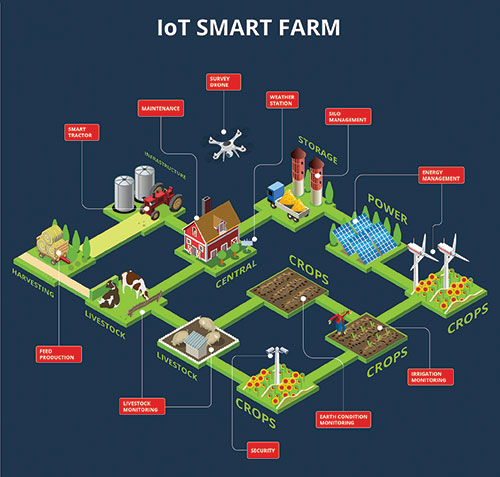
Using IoT technologies can push the efficiency of farming to new levels as the food demands of a growing global population puts increasing pressure on agriculture around the world.
According to a report by Business Insider published at the end of last year, the world will need to produce 70% more food in 2050 than it did in 2006 in order to feed the earth’s growing population, based on numbers produced by the UN Food and Agriculture Organization.
André Strauss, director of partnerships at IoT.nxt, highlights five key areas where the use of IoT technology can improve efficiencies and reduce costs:
Digitisation of the value and supply chains allows for produce to be tracked and traced from source to retail shelf, delivering quality control and the ability to identify problem areas at production source.
By connecting all legacy machinery warehousing/packaging plants can be more productive and efficient. Farm managers can, for instance, assess how many packers, machines and delivery trucks will be required on any given day.
Energy management, a significant cost at large scale farming operations. Use of power, management of irrigation, pumps, dam levels, water required at production plants are all aspects of energy use that can be managed in real time and changed seamlessly for exceptional cost savings and improved efficiency.
Tracking of livestock which, amongst other things, will allow for management of health of livestock.
Management of fuel, another variable cost that has a direct impact on the cash flow of any farm. Using a digitised, connected management system allows for exact planning of fuel supply required for times of peak and reduced levels of activity.
BI Intelligence, Business Insider’s research service, predicts that IoT device installations in the agriculture world will increase from 30 million in 2015 to 75 million in 2020, for a compound annual growth rate of 20%.
According to the BI report the value of using IoT smart agriculture is evident in numbers available for the current leader of using IoT in farming, the United States, where 7 340 kg of cereal (e.g. wheat, rice, maize, barley, etc.) is produced per hectare of farmland, compared to the global average of 3 851 kg per hectare.
For more information contact Daleen van Wyk, IoT.nxt, +27 (0)83 302 0827, [email protected], www.iotnxt.com
Further reading:
Even in autonomous systems, human insight is important
Schneider Electric South Africa
IT in Manufacturing
As AI, IIoT and digital twins reshape industrial operations, Schneider Electric’s Kobus Vermeulen and Bafana Msibi argue that the operator’s role is shifting from controlling equipment to interpreting intelligence, validating AI recommendations and making decisions that improve
Read more...
AI-based quality inspection scales across P&G operations
Siemens South Africa
IT in Manufacturing
Siemens and Procter & Gamble are expanding an AI-based visual inspection system across P&G’s manufacturing operations worldwide, inspecting products in real time at full line speed, and reducing scrap rates by 10 to 20% depending on the product.
Read more...
How sustainability unlocks real business impact
Rockwell Automation
IT in Manufacturing
Sustainability has moved from a compliance obligation to a strategic driver of resilience and value for manufacturers. Rockwell Automation explains how its Triple A framework and connected-data approach help producers cut energy, water and waste while improving productivity.
Read more...
Mining’s AI future will depend on people as well as technology
IT in Manufacturing
South Africa’s mining industry is embracing digitalisation and AI, but AvenirHoldings chief executive officer, Tshidi Mndzebele says the real test is whether the people behind the industry are equipped to move forward with it, and outlines five things mining needs to get right.
Read more...
How BIC overcame operational silos to integrate technology and people
Rockwell Automation
IT in Manufacturing
Manufacturing giant BIC deployed Plex MES from Rockwell Automation at its Bizerte plant in Tunisia, replacing fragmented, partly in-house software with a single cloud-based execution system that broke operational silos and improved shop-floor visibility.
Read more...
AI in industry is an early warning system, not a guarantee
Schneider Electric South Africa
IT in Manufacturing
Schneider Electric’s Paul Steyn argues that AI in industrial maintenance is only as good as the infrastructure and people behind it, and explains the three layers a facility needs before predictive maintenance can deliver on its promise.
Read more...
SA’s mining industry must put people at the heart of its digital future
IT in Manufacturing
South Africa’s mining industry employs around 470 000 people while its digital transition accelerates. Avenir’s chief executive officer, Tshidi Mndzebele argues that technology should enable and upskill the workforce rather than replace it, setting out five ways mining can make technology work for its people.
Read more...
Quality control supports efficient tissue production
Valmet South Africa
IT in Manufacturing
Valmet’s advanced quality control technology is helping tissue producers improve product consistency while reducing energy and raw material consumption. Its latest installation at KORO Paper in Vietnam combines real-time measurement, process optimisation and non-contact, nuclear-free quality control.
Read more...
Patented algorithm maximises operator efficiency
Rockwell Automation
IT in Manufacturing
Rockwell Automation piloted a patented anomaly detection algorithm and FactoryTalk DataMosaix at its Twinsburg electronics plant, giving operators 30 to 60 days’ advance warning of stencil failure, improving fail rates by 22% and achieving a 200% return on investment.
Read more...
Cybersecurity must become part of the next era of industrial automation
Adroit Technologies
IT in Manufacturing
The EU’s Cyber Resilience Act is setting a global benchmark for connected products, making cybersecurity a core engineering requirement in industrial automation. Adroit Technologies and Mitsubishi Electric explain how building security into controllers, PLCs and drives from the outset helps South African manufacturers protect production and meet international expectations.
Read more...










 printer friendly version