



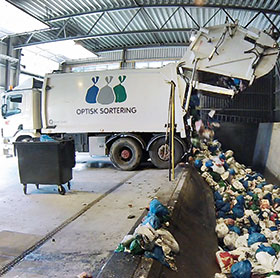
Garbage recycling and conversion into biogas are major contributors toward environmental protection. However, multiple truck trips to collect waste from separate bins for different materials release more harmful CO2 into the atmosphere. Swedish equipment maker, Envac Optibag has developed a solution that is as simple as it is intelligent. In communities that use the Optibag concept, household waste is presorted into colour-coded plastic bags, which are deposited in the same container and hauled off. In the waste processing plant, the bags are then sorted by colour with a fully automated, camera-based system and routed to the appropriate recycling facility.
Waste avoidance and recycling concepts often fail because they are difficult to implement and/or are rejected by consumers. In other words, the easier it is to put a concept into practice, the more successful it will be. Envac Optibag built Sweden’s first optical waste sorting system in 1990. Since then, rising interest in environmental responsibility has created a growing international market for the company, which is part of Sweden’s Envac Group.
The concept is quite simple: Participating households receive garbage bags in different colours for different kinds of waste, such as green for compost, red for paper, blue for composite materials, and so forth. All bags wind up in the same chute or container and are picked up by the same truck. Once they arrive at the waste processing plant, they are dumped onto conveyor belts and routed to the camera systems. The cameras read the colour of each bag, and a mechanical ejector pushes the bags onto the appropriate conveyor belt, which takes it to a container or directly to a processing facility. Each line processes approximately nine tons of garbage per hour.
Flexible expandability built-in
Envac Optibag selected a CX2040 Embedded PC as the central control platform of the automated bag sorting facility, EtherCAT as the communication system, and TwinSAFE to implement safety functionality. The mechanical ejectors are also managed via a CX2040 that controls safety I/O components and AX5118 Servo Drives. The openness and expandability of the PC-based control platform ensure that stricter waste incineration guidelines or substantially higher volumes can be accommodated without the need for additional conveyor belts.
Waste separation in milliseconds
Christian Toräng, R&D manager at Envac Optibag, sees the company’s choice of an Embedded PC and EtherCAT Servo Drives as a strategic decision that will greatly simplify future projects: “We have been working with Beckhoff since 2004 and appreciate the openness of the PC-based control system, as well as the ease of integration with other components. We can easily add new systems that operate with other protocols, and make these changes at no extra cost. The CX2040 provides additional benefits compared to other control systems we used in the past. The time necessary to identify the bags and mechanically separate them has been substantially reduced to only 240 milliseconds, which represents a 30% improvement. This kind of speed is particularly important for large systems or municipalities that must handle huge amounts of garbage. The fact that existing system capacity can be increased as garbage volumes rise is a significant benefit.” The R&D manager also sees advantages for future installations in large metropolitan areas: “Accelerating the separation process reduces the need for parallel systems to handle large volumes. That’s why our motto ‘twice the performance in half the space’ is so important for city planners.”
Embedded PC integrates camera system for optical recognition
While past camera systems required separate controllers, the job can now be handled by a single, centralised PC-based platform. “The quad-core processor in the CX2040 is so powerful that the optical separation system, the PLC and the HMI can all run on one device, enabling much easier installation and operation. You no longer need to set up separate network components, so the installation itself is much easier and faster. Another benefit is the fact that the CX2040 provides a standardised programming environment. This makes things easier not only for us, but also for the consultants we work with in various phases of each project. And since the systems are connected to the Internet, we can monitor them remotely. For example, we can troubleshoot components down to the motor level over the Internet via a special communication module,” explains Christian Toräng.
For more information contact Kenneth McPherson, Beckhoff Automation, +27 (0)11 795 2898, [email protected], www.beckhoff.co.za
| Tel: | +27 11 795 2898 |
| Email: | [email protected] |
| www: | www.beckhoff.com |
| Articles: | More information and articles about Beckhoff Automation |






© Technews Publishing (Pty) Ltd | All Rights Reserved
 printer friendly version