



Electromagnetic flowmeters are popular and proven devices for flow measurement of electrically conductive process fluids and for volumetric filling machine applications. Of prime importance to a mag meter’s accuracy and long-term performance is the condition of the metering section of the flow sensor.
Unlike in most processes, mag meters in filling machine applications are frequently subject to widely varying conditions during normal operation.
As a result, they are viable candidates for evaluating their long-term performance in an accelerated use environment. Therefore PTB, a German research and approvals agency, in association with Krohne, undertook an extensive project to study the long-term measurement stability of mag meters in filling machine applications.
Overview
Faraday’s law is the basis of a mag meter’s measuring principle. The design generally features an electrical isolating liner on the inner wall of the measuring tube. Linings such as PTFE, PFA or polypropylene or for hygienic reasons, PFA (perfluoroalkoxy) are used. Pressure bearing ceramic pipes are also used. PFA is known to absorb moisture, it can flow under pressure and temperature, which means that it changes structure and shape which, in turn, affects the interior diameter of the measuring tube. Changes in the inner diameter of the measuring tube lead to measurement errors. This can lead to problems, especially when extreme precision or repeatability are at stake. This only takes effect after the devices have been in use for longer periods of time and through the corresponding frequent cleaning processes using liquid or steam as are common in the food industry.
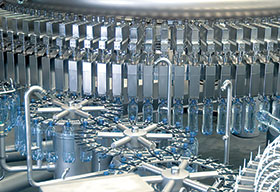
The effect is particularly significant when it comes to mag meters used on filling machines for filling PET bottles. In this case, an extremely high degree of repeatability is required and the quality of the filling process is directly visible in each individual bottle.
That is why, in a joint research cooperative with the Physikalisch-Technischen Bundesanstalt (National Metrology Institute) (PTB), Krohne tested the measurement stability of filling mag meters. Meters with PFA liners and with ceramic measuring tubes were both tested. The PTB was interested in this test because for more than 20 years mag meters with ceramic measuring tubes have been the norm in the normal PTB measuring systems as well as in many other calibration test stations. Thanks to this test, the PTB was able to gain additional knowledge about the behaviour of these devices under difficult conditions.
Results
Results from PTB testing conclude that when compared to PFA lined mag meters, the filling mag meters with ceramic measuring tubes have the following advantages:
• Ceramic meters have a temperature coefficient three times lower than the change in the flowing media temperature.
• Their long-term stability result is at least three times better.
• Repeatability depending on flow speed response is two to three times better.
These results make it clear that when it comes to the long-term behaviour of filling mag meters, there are qualitative differences between measuring tubes with plastic lining and those with ceramic measuring tubes.
The ceramic measuring tube remains mechanically stable despite the stress of heat and steam of rapid filling process changes and this can be seen in the constantly high repeatability, which results in constant filling quality.
While these tests and results deal specifically with filling machine mag meters, the implications may also affect other applications throughout the process industries, especially where accuracy and long-term repeatability are key requirements.
Interested readers can find the full report at http://instrumentation.co.za/+J1160
| Tel: | +27 11 314 1391 |
| Email: | [email protected] |
| www: | www.za.krohne.com |
| Articles: | More information and articles about KROHNE |






© Technews Publishing (Pty) Ltd | All Rights Reserved
 printer friendly version