


IT in Manufacturing


Reliable power supply for the data centre

May 2016 IT in Manufacturing

Efficiency and reliability of power supply in the rapidly expanding data centre business is crucial to feed the ever-hungry global information economy. As a leading technology innovator, ABB has considered the needs of data centres and continually enhanced products to meet ever-expanding needs.

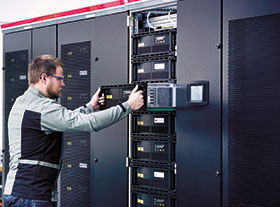
“MNS-Up is the result of ongoing customer-centric product development. Data centres are continually growing and two key aspects, space requirements and scalability have needed to be addressed,” says Ronald van Leeuwen, business unit manager for electrification solutions in South Africa. “MNS-Up addresses these two areas very efficiently by combining the switchgear and uninterruptable power supply (UPS) technologies into a single unit.”

Space saving

In traditional power distribution environments three discrete areas are required. The first area is dedicated to housing the input switchgear which is fed by the main transformer. The second area, in turn provides power to the modular UPS through either cable or external bus duct systems. The third area houses the UPS output switchgear, feeding power to the points of consumption. As the assemblies are physically separated, a specific level of safety is assumed and this architecture is well-proven and has established itself as the norm. However it does have significant drawbacks. This topology relies on providing separate incoming and outgoing switchgear assemblies, with the associated power cabling or bus duct, resulting in a large footprint and great expense to interconnect the three assemblies.

ABB’s MNS-Up eliminates the need for the three separate areas, allowing for a single assembly housing the power input, uninterrupted power supply modules and the power output (distribution). Footprint savings of 20% are typical for a 500 kW system, rising to a significant 30% for 2 MW systems upwards.

Scalability

Today’s information economy requires data centres to provide cost-effective solutions that can grow alongside information consumption. Avi Ramdhin, sales manager for electrification solutions, points out that, “With modules of 100 kW capacity that can be added to accommodate power requirements MNS-Up can quickly react to market driven power demands, increasing the data centre’s ability to service clients.”

UPS modules are expandable in 100 kW blocks. Each frame can support a total of five 100 kW UPS modules, this can be further expanded with a duplication of the frames. Up to six frames can be joined together providing 3 MW of power. It need not end there; further systems may be added in parallel.

Tried and tested

Safety lies at the heart of the design. Complete compliance with the International Electro Technical Commission (IEC) 61439-2 and TR 61641 form the base on which MNS switchboards are designed. The broad scope of ABB switchgear extends beyond its proven track record in power distribution, a core area of ABB’s expertise. The MNS technology boasts an installed base of 1,5 million systems worldwide. For MNS-Up, ABB has selected the Conceptpower DPA 500 uninterrupted power supply, which sports a transformerless, double-conversion architecture. This solution is the choice of mission-critical users including major international stock exchanges.

The design of the system is such that a decentralised parallel architecture is used, each module has its own input switch, bypass, UPS and output switch and the hardware and software combination operates self-sufficiently. This allows for module isolation; as a result failure elsewhere in the system does not impact the entire operation.

For more information contact Paul Louw, ABB South Africa, +27 (0)10 202 5916, [email protected], www.abb.co.za/lowvoltage


Credit(s)


Share this article:
Share via emailShare via LinkedInPrint this page

Further reading:

Overcoming the bottling industry’s fragmented visibility
Schneider Electric South Africa IT in Manufacturing Electrical Power & Protection
Beverage bottling facilities are among manufacturing’s most energy-intensive environments, yet many still operate without granular insight into where that energy goes. Rezolia Muller-Potluri of Schneider Electric explains how tiered metering architecture and advanced

Read more...
Advancing intelligent apparel manufacturing with industrial AI and humanoid robotics
IT in Manufacturing
Jack Technology, a global maker of industrial sewing equipment, has chosen Siemens software and engineering tools to bring artificial intelligence and humanoid robots into apparel production, aiming to shorten development cycles and lift manufacturing efficiency.

Read more...
New chiller line for high-density AI data centres
Schneider Electric South Africa IT in Manufacturing
Schneider Electric has launched the Uniflair XCA, a new series of air-cooled and free-cooling chillers designed for artificial intelligence-driven, high-density liquid-cooled data centres.

Read more...
Turning system integrators into trusted technology partners
Schneider Electric South Africa IT in Manufacturing System Integration & Control Systems Design
Schneider Electric’s Alliance Partner Programme is repositioning system integrators from hardware suppliers into lifecycle-value partners. Oriel Soupen explains the competency framework, certification model and real-world results that are already helping African system integrators win higher-value, longer-term engagements.

Read more...
Why renewable projects need integrated protection and control
IT in Manufacturing
Fragmented secondary plant integration in renewable energy projects causes costly delays during commissioning. ACTOM Protection and Control’s Secondary Plant Integration solution consolidates all secondary systems under a single engineering framework, reducing risk and accelerating grid

Read more...
When digital twins move from concept to critical tool
IT in Manufacturing System Integration & Control Systems Design Maintenance, Test & Measurement, Calibration
Digital twins are moving out of the lab and onto the mine, the factory floor and the transport network where they predict failures before they happen. Amritesh Anand looks at where they earn their keep, the data and integration work behind them, and the security questions every organisation should ask before switching one on.

Read more...
How a digital foundation can overcome the LNG trilemma
Schneider Electric South Africa IT in Manufacturing SCADA/HMI
The LNG sector is racing to add capacity, but without a digital backbone, growth creates complexity rather than capability. Christophe Begat of Schneider Electric explains how connecting data, systems and analytics across the LNG value chain can resolve the trilemma of secure supply, lower emissions and tighter costs.

Read more...
Decarbonisation is reshaping mining strategy in Africa
Schneider Electric South Africa IT in Manufacturing Electrical Power & Protection
Mining companies across Africa are embedding decarbonisation into operational strategy, driven by investor, regulatory and customer pressure to reduce emissions while improving resilience.

Read more...
Siemens and HighByte partner to scale industrial AI
Siemens South Africa IT in Manufacturing Fieldbus & Industrial Networking
Siemens is expanding its Industrial Edge ecosystem through a partnership with HighByte, enabling customers to connect, contextualise and transform data from operational technology and information technology sources to build AI models and applications at scale.

Read more...
Africa on the edge of a digital future
Schneider Electric South Africa IT in Manufacturing
Edge computing promises lower latency, stronger reliability and real-time responsiveness across Africa, yet its rollout keeps colliding with one stubborn obstacle, power. Steven Santini explores how renewable microgrids, smart energy management and the right partnerships could turn the continent’s energy gap into its biggest edge opportunity.

Read more...


While every effort has been made to ensure the accuracy of the information contained herein, the publisher and its agents cannot be held responsible for any errors contained, or any loss incurred as a result. Articles published do not necessarily reflect the views of the publishers. The editor reserves the right to alter or cut copy. Articles submitted are deemed to have been cleared for publication. Advertisements and company contact details are published as provided by the advertiser. Technews Publishing (Pty) Ltd cannot be held responsible for the accuracy or veracity of supplied material.


© Technews Publishing (Pty) Ltd | All Rights Reserved

