



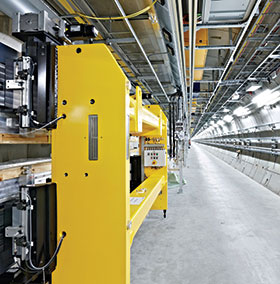
An exciting new research facility is currently under construction in Hamburg, Germany. Opening in 2017, the centre will house the European XFEL X-ray laser, an apparatus generating ultra-short X-ray flashes at 27 000 times per second with a brilliance that is a billion times higher than that of current X-ray radiation sources. PC-based control and drive technology from Beckhoff is used to position 91 special high precision magnet assemblies (undulators) in the underlying electron accelerator.
A world of new possibilies
This X-ray laser will open up completely new fields of research, making possible 3D nanoworld images, deciphering of the atomic details of viruses and cells, and examination of ultra-fast chemical reactions. The facility has a total length of 3,4 km, located mainly in underground tunnels, and will be operated by the independent research organisation, European XFEL. It will be available to research teams from all over the world.
A special feature is the very high repetition rate of 27 000 X-ray flashes per second, facilitated by the superconducting accelerator technology. The flashes have a wavelength of 0,05 to 6 nm, which is so short that even atomic details become visible. With a time duration of less than 100 femtoseconds (1 fs = 10-15 s), it will even be possible to record the formation of molecules. The laser light properties will enable 3D images at the atomic level.
The secret is in the control
The starting point for the formation of the X-ray flashes is a 1,7 km long superconducting linear electron accelerator. Electron packets are accelerated to a high energy state, nearly reaching the speed of light. They then speed through undulators – special magnet assemblies which force the particles through a tight slalom course. The electrons radiate synchronously, resulting in ultra-short, intense X-ray flashes which have properties similar to laser light.
An undulator consists of two magnet structures and the distance between determines the wavelength of the laser light. This makes the drive control very demanding. Two servomotors are used to move each of the two magnet structures. The control process has to be highly synchronised in order to avoid a phase shift between the electron and photon bundles and the sequence error must be less than 1 m. In addition, repeatability of ±1 m must be ensured with respect to the distance of the magnet structures, as this guarantees a high reproducibility of the magnetic field strength and therefore the photon wavelength.
PC-based control from Beckhoff provides the solution
Research associate, Dr Suren Karabekyan, says that after an evaluation phase lasting several months, Beckhoff’s PC-based control and drive technology emerged as the ideal candidate. The high-performance TwinCAT software with integrated motion control functions offers a wealth of benefits. He explains that TwinCAT enables the implementation of a high precision, highly dynamic drive control system which can synchronise several axes exactly.
The undulator sections are each controlled using a C5210 48 cm slide-in industrial PC. They are networked via an EtherCAT ring topology with cable redundancy. Fibre-optic cables are used due to the tunnel being several kilometres in length. In addition, the undulator cells in each section are daisy chain linked with each other via Ethernet. In each undulator cell, a C6925 control cabinet PC is used, controlling the two AX5206 servo drives for the four AM3052 servo motors via TwinCAT NC PTP. The IPC also controls three stepper motors – two for a quadrupole mover and one for a phase shifter. The phase shifter motor runs synchronous to the servo drives and corrects the phase of the electron and photos packets between the individual undulator cells. The required I/O data is provided with 35 EtherCAT terminals per undulator cell, digital and analog I/Os, as well as pulse train, encoder and bridge terminals. Overall, the PC-based control solution comprises three C5210 48 cm slide-in industrial PCs, 91 C6925 control cabinet PCs, 182 AX5206 servo drives, 364 AM3052 servomotors and approximately 3200 EtherCAT terminals.
According to Karabekyan, the result is a compact and powerful control system for the 91 undulator cells. The operations include high-precision synchronisation between the master and slave axes for controlling the magnet structures, and exact synchronisation of the phase shifter with respect to the changes in magnet distances. This high performance control and drive technology is capable of positioning heavy components such as the undulator magnet structures in conjunction with high magnetic forces up to 10 tons, or the quadrupole movers weighing around 60 kg, with μm precision.
For more information contact Kenneth McPherson, Beckhoff Automation, +27 (0)11 795 2898, [email protected], www.beckhoff.co.za
| Tel: | +27 11 795 2898 |
| Email: | [email protected] |
| www: | www.beckhoff.com |
| Articles: | More information and articles about Beckhoff Automation |






© Technews Publishing (Pty) Ltd | All Rights Reserved
 printer friendly version