



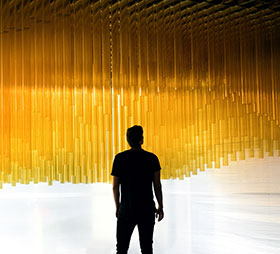
Norwegian oil company, Lundin Norway, recently presented its unique kinetic art creation at the ONS Energy Convention, the world’s largest offshore energy trade show. It comprised 529 Plexiglas tubes moving continuously together to simulate ocean waves and symbolised the constant search for oil under water off the Norwegian coast. The objective was to create a work of art that expressed the identity of Lundin Norway. This was a complex project, both artistically, mechanically and in terms of the control technology. Beckhoff supplied the control system for this engineering marvel.
The undulating virtual ocean waves were coloured from bright to saturated orange depending on the viewpoint and the density of the tubes staggered one behind the other. The multitude of overlapping translucent pipes created a moving landscape of organic, rock-like formations. If a person approached the installation, the virtual ocean landscape opened up. The tubes were driven to a safe position, allowing the viewer to ‘dive in’.
The mechanics and supporting structure consisted of a framework of 23 steel girders. Each steel girder was equipped with 23 honeycomb-shaped stainless steel housings, every one of which accommodated a Plexiglas tube, an AM8121 Beckhoff servomotor, a drive wheel and six support wheels for guidance, as well as a capacitive sensor for position compensation. A 3D depiction of an undulating sea was created based on a cleverly devised relationship between speed, tube diameter and the distance of the tubes from one another. These were implemented mechanically, with a total of 529 installed servomotors. The associated control electronics were located at both ends of the support structure and consisted of an EK1100 EtherCAT coupler and a set of I/O components. These included digital input terminals, servo terminals for controlling the servomotors and buffer capacitor terminals for stabilising the supply voltage.
A total of 10 200 connection points had to be processed, representing a challenge both mechanically and with regards to the control electronics. The compact design of the control and motion modules and the servo drives in a 12 mm terminal housing were a prerequisite for the successful technical implementation of the artistic concept.
The control system architecture encompassed three main components: the sensor and actuator level, consisting of EtherCAT terminals and specific safety sensors; the PLC level based on four C5102 industrial PCs, and the superordinate application level.
To enable the interaction between people and the kinetic sculpture, two overlapping sensor data levels were installed: a 40 m² capacitive sensor floor installed under the flooring and four K4W sensors (depth cameras) installed in each corner of the room. The higher-level control application was developed in openFrameworks. This provided a real-time model of the environment, for which a motion diagram was created to simulate the undulating movements.
The application communicated with the four IPC platforms, which also controlled the servomotors via TwinCAT ADS. Various open Frameworks add-ons were used. In addition to that the team of developers developed three new add-ons for ‘breaking the surface’. These were ofxMultipleKinect, controlling the display and alignment of several Kinect point clouds in the same co-ordinate system; ofxBeckhoffADS, facilitating the transmission of data between openFrameworks and the Beckhoff control platform; and ofxSensfloor, directing the communication and visualisation of sensfloor data in openFrameworks.
The set values of the motion diagram, which were programmed in C++, were imported into the TwinCAT NC PTP automation software via the ADS interface. In connection with the ultra-fast EtherCAT bus system and the servo terminals, the point-to-point axis positioning software calculated the position for each individual tube in a cycle time of 1 ms. An interpolating motion resulted, which the viewer perceived visually as natural undulation. If the sensors signalled a movement such as a person entering the ‘ocean’, then the axis positions of the undulation were overwritten. The position of the pipes in close proximity were adjusted to form a protective dome around the person moving around in the space. A thin metal ring attached on the inside of each tube gave a reference signal every time it passed the capitative sensor inside the drive unit. This made it easy and safe to double check and control the adjustment positioning algorithm which gave the exact position of the tube at any time.
To read the full story online visit http://motioncontrol.co.za/+beckhoff1
For more information contact Kenneth McPherson, Beckhoff Automation, +27 (0)11 795 2898, [email protected], www.beckhoff.co.za
| Tel: | +27 11 795 2898 |
| Email: | [email protected] |
| www: | www.beckhoff.com |
| Articles: | More information and articles about Beckhoff Automation |






© Technews Publishing (Pty) Ltd | All Rights Reserved
 printer friendly version