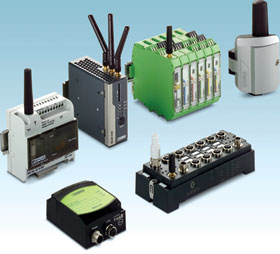
Internationally, Phoenix Contact is a leading supplier of automation infrastructure and the company’s industrial wireless products provide users with reliability and security for transmission of data and I/O signals. Wireless systems enable easy and effective negotiation of many of the challenges faced in the industrial communication infrastructure environment.
A key requirement for the use of wireless technologies in industrial applications is that the technology must be as rugged and reliable as a cable connection, even under harsh conditions. With wireless communication, the data is transmitted by means of electromagnetic waves through free space and the wireless connection is therefore subjected to interference fields that can adversely affect the transmission. In addition, reflections, fading, interference and shadowing can occur.
Despite the influences described, Phoenix Contact Bluetooth, Trusted Wireless, Wireless HART and WLAN 802.11 are interference free, thanks to their particular method of design and operation.
Outdoor cellular routers for potentially explosive areas Phoenix Contact
IS & Ex
Phoenix Contact has extended its Cellulink outdoor cellular router range with new versions approved for Zone 2 potentially explosive areas, featuring end-to-end IECEx and ATEX certification of the complete router, antenna path and antenna system.
Read more...Isolated Modbus gateways with built-in Wi-Fi for industrial IoT applications Vepac Electronics
Fieldbus & Industrial Networking
Vepac Electronics offers the Sielco Sistemi SS10680 series of isolated Modbus gateways with built-in Wi-Fi, providing three configurations for industrial data acquisition: cloud publishing via MQTT, local USB and FTP logging, and straightforward Modbus TCP to Modbus RTU conversion.
Read more...XPlanar aids innovation in laser processing Beckhoff Automation
Fieldbus & Industrial Networking
Aalborg University is among the first in the world to test Beckhoff’s XPlanar intelligent transport system in advanced laser processes, opening the door to faster, tool-free production of metal parts.
Read more...Belden expands edge computing portfolio with ProLinx Edge Gateway
Fieldbus & Industrial Networking
Belden has released the ProSoft Technology ELX3 ProLinx Edge Gateway, combining operational technology protocol conversion with Docker-based edge application hosting on a single ruggedised hardware platform for deployment in harsh industrial environments.
Read more...Anybus Communicators are CRA-ready Industrial Data Xchange (IDX)
Fieldbus & Industrial Networking
HMS Networks has upgraded its Anybus Communicator range to meet new EU cybersecurity rules, giving industrial manufacturers and integrators an easier path to compliance.
Read more...A software-based controller for the industrial future Phoenix Contact
IT in Manufacturing
With Virtual PLCnext Control, Phoenix Contact is launching a software-based controller solution that enables flexible automation functions in virtualised IT environments.
Read more...Remote I/O modules provide flexible options for distributed applications
Fieldbus & Industrial Networking
Dinkle International is now stocking the iO-GRID NEMO industrial-grade remote input/output modules, offering support for five leading industrial Ethernet protocols and a range of discrete channel configurations for distributed automation applications.
Read more...Daudin expands fieldbus modular remote I/O series
Fieldbus & Industrial Networking
: The Dinkle iO-GRID X modular remote I/O family is now available, offering fieldbus coupler modules for major industrial Ethernet protocols, and over 20 types of I/O modules to help integrators and equipment builders create flexible, efficient control systems.
Read more...Siemens and HighByte partner to scale industrial AI Siemens South Africa
IT in Manufacturing Fieldbus & Industrial Networking
Siemens is expanding its Industrial Edge ecosystem through a partnership with HighByte, enabling customers to connect, contextualise and transform data from operational technology and information technology sources to build AI models and applications at scale.
While every effort has been made to ensure the accuracy of the information contained herein, the publisher and its agents cannot be held responsible for any errors contained, or any loss incurred as a result. Articles published do not necessarily reflect the views of the publishers. The editor reserves the right to alter or cut copy. Articles submitted are deemed to have been cleared for publication. Advertisements and company contact details are published as provided by the advertiser. Technews Publishing (Pty) Ltd cannot be held responsible for the accuracy or veracity of supplied material.










 printer friendly version