



Each year, the Festo Bionic Learning Network provides new inspiration for automation technology. The emerging fields include research in the areas of function integration, lightweight construction, self-configuration and machine learning. With the WaveHandling system and the LearningGripper, Festo shows how principles from nature can be applied in automation technology.
As a global manufacturer of pneumatic and electric automation technology, Festo aims to help shape the production and working environments of the future by offering its customers innovative solutions for the production systems of tomorrow. “This is essential for our long-term reputation as a competent partner with a high level of problem solving skills,” emphasises Dr Heinrich Frontzek, head of corporate communication and future concepts. “What we need to do is simplify the challenges involved in production sequences and guarantee intuitive control of machines and plants. The current projects from the Festo Bionic Learning Network provide visionary approaches on how to do this.”
WaveHandling system
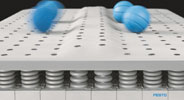
With the WaveHandling pneumatic conveyor, engineers from Festo have developed a modular system that can move a surface in such a way that objects are transported and sorted purposefully. Thanks to the integration of a sorting function, an additional handling unit is no longer required for this process. The conveyor consists of numerous bellows modules that deform the surface creating a wave motion that transports the objects in a targeted manner.
Inspiration for this principle was provided by waves in nature. The movement of the wind over the smooth surface of the water produces small ripples, which grow as the wind pushes against them. However, what is being moved by the waves is energy, not water. The water molecules within a wave move up and down in a circular motion, but remain in roughly the same place, yet the energy produced causes the wave to roll over the surface of the sea. The WaveHandling system behaves in a similar way: while each individual bellows advances and retracts in the same spot, a wave moves over the surface of the conveyor.
The individual modules are self-configuring. This means that the system can be started up quickly and without programming, no matter what the layout is. The food industry is one of the potential applications of the platform, as it is ideal for automatically transporting delicate items like fruit and vegetables and for sorting them for the next process step. With the WaveHandling transport system, Festo is already demonstrating how, in the future, the configuration of a system will be handled by the individual modules themselves.
LearningGripper
The LearningGripper is a four-fingered gripper that looks like an abstract form of the human hand. Twelve bellows actuators with low-level pressurisation actuate the four fingers of the gripper pneumatically. What makes this bionic gripper so special is its learning ability, thanks to learning algorithms which take the place of highly complex programming.
Thanks to machine learning, an offshoot of artificial intelligence, the gripper can teach itself to carry out complex tasks such as gripping and positioning a ball. In concrete terms, the gripper assigns itself the task of turning a ball so that a particular point of the ball points upwards. It picks up the corresponding motion sequences through learning by reinforcement. With this principle, self-learning systems like the LearningGripper could be built into future production lines and autonomously optimise their own performance.
The Bionic Learning Network links Festo to well-known universities, institutes and development companies. The objective of this initiative is to transfer biological principles to industrial technology and to produce innovative solutions and visions for industrial applications, all through bionics. Automated motion sequences can be made even more energy-efficient and productive using bionics, potentially providing industry with completely new solutions for practical problems.
For more information contact Tracey Swart, Festo, 086 003 3786, sales.interaction@za.festo.com, www.festo.com
| Email: | sales.za@festo.com |
| www: | www.festo.co.za |
| Articles: | More information and articles about Festo South Africa |






© Technews Publishing (Pty) Ltd | All Rights Reserved
 printer friendly version