



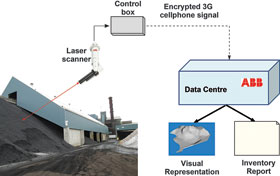
Advanced laser-based instrumentation now makes accurate inventory management of granular stockpiles possible. The sophisticated system from ABB, the VM3D Volumetric Laser Scanner, accurately measures the volume of irregularly shaped piles of material. The stockpiles may be stored out in the open or in large structures like silos, bunkers, domes, and sheds.
At the Gold Fields South Deep Gold Mine, the ABB Volumetric Scanner System is used to measures mineral ore in a large external stockpile for daily operations planning. Other premier applications in South Africa include 79 scanners measuring fertiliser bunkers at Omnia Fertiliser, one of the largest fertiliser producers in South Africa. Tongaat Hulett Starch is a producer of starch and glucose in Africa. Its Kliprivier mill is the newest of the mills and is the technological hub of the organisation and also where the ABB Volumetric Scanner System was pioneered to measure the volume of maize in silos. The system can be applied to virtually any granular stockpile in industries such as mining, coal, quarry, agriculture, plastic pellets and bulk chemicals.
This non-contact system consists of a laser scanner, a control box, remote monitoring and data processing services. Large complex areas can use multiple scanners networked together. The laser scanner sits above the stockpile and accurately maps its complex surfaces, producing a 'cloud' of data points.
The control box collects the raw point cloud and transmits it over an encrypted 3G cellphone network to the ABB data centre. Computers in the data centre analyse the data cloud, generating an illustration of the stockpile along with an estimate of its volume. The estimate is accurate to 2% for stockpiles as large as 100 cubic metres. ABB will enter into a legally binding agreement with the customer not to reveal any confidential inventory information.
How it works
In operation, the scanner emits a series of laser pulses to measure distances to the stockpile surfaces. An optical receiver within the scanner senses pulse reflections. The distance to a stockpile surface point equals the time it takes for the light pulse to travel to the surface and back to the instrument divided by two. Despite the extremely fast speed of light (300 000 km/sec), modern electronics permits these time-of-flight measurements, even for distances as short as half a metre.
The scanner emits an extremely narrow laser beam, which diverges less than 0,3% during its time to strike the stockpile surface and reflect back. The system tolerates dust and fog by taking only the last reflected pulse received as the target measurement. As a rule, if you can see the stockpile surface through the dust, it can be measured by the system. With a 905 nm wavelength, the laser beam is invisible and completely safe to the unaided human eye.
The laser scans across the stockpile in 140 concentric circles, accumulating 3678 points of stockpile levels. A single scan takes roughly 45 minutes. The customer determines the optimum time for the scan, usually when expectations are for little activity in the surroundings.
The ultimate range of the scanning system depends on the reflectivity of the scanned material. In general the range is greatest for light coloured granular material such as sugar and flour (about 90 m), and decreases for darker materials. The ability to scan over a complete hemisphere along with its automatic ranging capabilities allows the scanner to cover large surface areas with significant depth variations. A tube prevents dust from settling on the lens and standard heated optics prevents condensation.
Analysing the data cloud
The analysis of the raw point cloud at the data centre can make use of building blueprints to determine the depth of the stockpile and account for the geometry of its surroundings. This avoids having to empty the building or structure to baseline the system. The computations account for the empty condition, developing a profile of the volumetric three-dimensional shape of the stockpile. With a known density of the material, the calculation can also determine the weight or mass of the stockpile.
ABB offers several service levels to customers wishing to use its VM3D system. An installation is given one free scan every month for three years. Customers can schedule these automatic scans on any day and time during a month. Results are usually available within 24 hours or sooner if necessary.
For more regular scans, customers can choose from a variety of data packages such as daily, weekly and on demand. ABB installs and commissions the system and receives and processes the data. Customers merely download the results.
Data analysis includes interpretation of the scan by ABB staff. They are able to identify extraneous obstructions in the scan, such as a parked front-end loader in the middle of the stockpile. This human intervention makes the product and service offering uniquely accurate and reliable.
| Tel: | +27 10 202 5000 |
| Email: | [email protected] |
| www: | www.abb.com/za |
| Articles: | More information and articles about ABB South Africa |






© Technews Publishing (Pty) Ltd | All Rights Reserved
 printer friendly version