


Maintenance, Test & Measurement, Calibration


On-site test service minimises ­process downtime

April 2013 Maintenance, Test & Measurement, Calibration

Time is money, therefore a continuous process is the ideal in industry. Some interruptions in operations, however, are unavoidable – as a result of the calibration of the measuring systems used, for example. The respective instruments are taken out, sent off, and are returned after some days to be reinstalled. The result is significant process downtime, added to the risk that the highly-sensitive measuring instruments could be damaged in transit. The obvious disadvantages of such external testing can be minimised, however, through a mobile calibration service.

In WIKA’s experience, having offered such an on-site service for pressure and temperature measuring instruments since the middle of the 1990s, the entire control process can be sped-up by as much as a factor of five. This means that while a process can stand idle for five days due to a calibration, with direct inspection at the customer’s site, it can be up and running after one day.

The demand is increasing

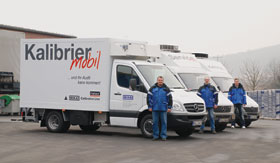
The word is out in the industry. The demand has risen steadily over the last few years. WIKA’s certified calibration vans are in constant use. Each year they drive to around 250 companies across a range of different industries – one fifth of those more than once. Since 2008, for example, every quarter a WIKA laboratory has rolled up at the Airbus factory in Hamburg. At this aircraft manufacturer, over 12 months, several hundred measuring instruments must be calibrated, from simple pressure gauges through transmitters and up to highest-precision reference instruments.

The more test items, the more effective using the calibration van becomes. Nevertheless, despite the high fixed cost, the service can even be worth it for as few as 10 instruments. The local requirements are not complicated, whether for Airbus or a medium-sized equipment manufacturer. The vehicle only needs a parking place and a power connection.

The first step is the climate control of the vehicle. In accordance with DKD guidelines, a stable set temperature of between 18 and 28°C must be maintained. The subsequent test of the pressure and temperature measuring instruments is made successively to avoid unnecessary loss of time. For safety reasons, customers remove and re-install the instruments themselves. If required, the WIKA tester can also calibrate the instruments in-situ in the plant. This, for example, is the case with Airbus, where in addition to the measuring instruments, the complete evaluation unit, including the measuring station, must be checked.

The vans are fully self-contained

The basic configuration of the calibration van covers most test requirements. On-board oxygen bottles and a compressor deliver pneumatic and hydraulic pressure to enable the control of the accuracy of pressure readings from -1 to 1600 bar. Each vehicle has 10 fixed and mobile reference instruments for pressure and temperature, with an accuracy of 0,01%. Additional equipment can be brought from the WIKA laboratory if, as with Airbus, there are a wider range of requirements during a visit.

The calibration van is a rolling all-inclusive package. In addition to the measuring instruments, it also has a work bench and standard spare parts for minor repairs. All information on the test procedure is entered into a PC, and the results printed out immediately.

As the example of Airbus demonstrates, it is not only the demands on the technical equipment in our calibration vans which are high. Its crew – one man per vehicle – must have experience across a broad product range. After all, they do not only calibrate instruments from their own company.

WIKA Namibia already has a calibration vehicle in service, and in South Africa, WIKA’s Cape Town branch has just taken delivery of its own mobile calibration vehicle.


Credit(s)


Share this article:
Share via emailShare via LinkedInPrint this page

Further reading:

Infrared thermometers for electrical, industrial and HVAC applications
Comtest Maintenance, Test & Measurement, Calibration
: Comtest, distributor of Fluke test and measurement equipment, explains how handheld infrared thermometers are transforming maintenance in electrical, industrial and HVAC environments, with three measurement strategies and a wide range of practical applications.

Read more...
Reverse-engineering legacy industrial gearbox parts
Maintenance, Test & Measurement, Calibration
WEG Africa’s turbine workshop uses 3D scanning technology to reverse-engineer components for legacy gearboxes, turbines and compressors, enabling equipment to run for decades after OEM support and spare parts have dried up.

Read more...
Unlocking ICCP remote monitoring
Omniflex Remote Monitoring Specialists Maintenance, Test & Measurement, Calibration
Cathodic protection keeps buried and submerged pipelines safe from corrosion, but verifying it traditionally means costly, hazardous manual site visits. Omniflex explains how a retrofit module brings remote monitoring to ageing transformer rectifiers without replacing functional infrastructure.

Read more...
Microdieseling – the explosions you never hear
Maintenance, Test & Measurement, Calibration
Microdieseling is a pressure-induced thermal degradation mechanism in which entrained air bubbles are compressed so rapidly that the surrounding oil ignites, producing soot, varnish and sludge. WearCheck explains how it happens, why the damage varies, and how oil analysis detects it.

Read more...
Electrostatic spark discharge – when static strikes back
Wearcheck Maintenance, Test & Measurement, Calibration
WearCheck technical manager, Steven Lumley explains how static electricity accumulates in modern low-conductivity lubricants, why compact system designs and fine filtration make ESD more likely, and how to recognise the degradation it leaves behind.

Read more...
High-speed cameras for crash testing
Horne Technologies Maintenance, Test & Measurement, Calibration
Vision Research has expanded its Phantom C-series with two cameras optimised for crash and safety testing, offering 4 and 8 megapixel sensors rated to 170G, up to 1180 frames per second, and Phantom Academy application training planned for South Africa next year.

Read more...
SKF extends remanufacturing expertise to bearing clearance modification
SKF South Africa Maintenance, Test & Measurement, Calibration
Using its clearance modification expertise, SKF helped a mining equipment OEM salvage spherical roller bearing inventory that would otherwise have been scrapped, confirming a new capability within its remanufacturing services and avoiding redundant procurement.

Read more...
When maintenance-system compliance starts replacing plant reliability
Wearcheck Maintenance, Test & Measurement, Calibration
WearCheck ARC division manager, Annemie Willer argues that the greatest threat to effective maintenance is no longer a lack of technology, but the gradual replacement of technical judgement by CMMS compliance, leaving no one owning the machine.

Read more...
Automatic lubrication systems drive mobile mine machine reliability and uptime
SKF South Africa Maintenance, Test & Measurement, Calibration
SKF’s Lincoln P203 progressive lubrication systems are improving reliability and uptime on mobile machines at a Zambian gold mine, with installation of 45 units completing by October 2026.

Read more...
Nitration: the acid you didn’t see coming
Wearcheck Maintenance, Test & Measurement, Calibration
Nitration is as destructive as oxidation in many engines but far less understood. WearCheck technical manager, Steven Lumley explains how nitrogen oxide gases degrade lubricants, why the process is difficult to detect, and what oil analysis can reveal before damage occurs.

Read more...


While every effort has been made to ensure the accuracy of the information contained herein, the publisher and its agents cannot be held responsible for any errors contained, or any loss incurred as a result. Articles published do not necessarily reflect the views of the publishers. The editor reserves the right to alter or cut copy. Articles submitted are deemed to have been cleared for publication. Advertisements and company contact details are published as provided by the advertiser. Technews Publishing (Pty) Ltd cannot be held responsible for the accuracy or veracity of supplied material.


© Technews Publishing (Pty) Ltd | All Rights Reserved

