A key technology for sustainable power generation in Africa.
The average daily solar radiation in most African countries makes concentrated solar power (CSP) one of the most attractive renewable energy solutions to ensure a secure supply of clean electricity to power economic and infrastructure growth on the continent.
As a company, Siemens believes CSP is a key technology of the 21st century and is one of the world’s leading solar power technology suppliers. “We are already the market leader in steam turbines for solar thermal power plants and, with the power block, we can offer a key part for solar power plants – the part that is responsible for power generation,” says John Hazakis, head of solar and hydro at Siemens Southern Africa. Hazakis says that Siemens was the first steam turbine supplier to re-enter the CSP market in the 21st century, pioneering commercial solutions in the US and Spain. Today, Siemens is the world market leader in steam turbines for CSP plants, and has more than 20 years of experience with steam turbines for daily cycling.
With the acquisition of Solel in 2009, Siemens now boasts high-efficiency receiver technology and comprehensive expertise in the engineering and construction of solar fields. “We are able to offer the key components for the construction of parabolic trough power plants from a single source and to further enhance the efficiency of these plants, and this expertise is available for our customers in Africa,” adds Hazakis.
“The roll-out of CSP in South Africa and the rest of Africa, is not only good for ensuring a sustainable source of electricity, it also offers huge potential for job creation and localisation,” says Hazakis. “However, to create a sustainable industry more capacity needs to be allocated to CSP technology to ensure that the necessary investments can be made in local manufacturing and skills development.”
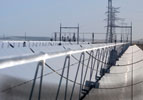
Siemens CSP power plants are very much like a standard power plant with an energy source, steam, and conversion of thermal power to electricity. In these plants the energy source is sunlight, focused by parabolic mirrors onto solar receivers located in the focal line of the parabolas. The entire parabola moves to track the sun and maximise the collection of solar energy. A fluid, typically a synthetic oil, flows through the receivers as a heat transfer medium. In the process the fluid is heated and its energy is transferred via a heat exchanger to water. The steam thus produced is used to generate electricity in a steam turbine-generator.
Africa’s net-zero ambition must become operational Schneider Electric South Africa
Electrical Power & Protection
Schneider Electric’s Rohit Chashta argues that the biggest gap in Africa’s green transition is not ambition but execution, and outlines how advisory services, bankable project roadmaps, digital visibility and SF6-free switchgear can turn sustainability commitments into measurable progress.
Read more...High-efficiency half-brick DC-DC converters Vepac Electronics
Electrical Power & Protection
The Supreme series half-brick DC-DC converters from Vepac Electronics use synchronous rectification for high conversion efficiency, in a six-sided metal case built to withstand harsh industrial and transportation environments.
Read more...AI-based quality inspection scales across P&G operations Siemens South Africa
IT in Manufacturing
Siemens and Procter & Gamble are expanding an AI-based visual inspection system across P&G’s manufacturing operations worldwide, inspecting products in real time at full line speed, and reducing scrap rates by 10 to 20% depending on the product.
Read more...Zinc-based batteries power a more sustainable energy future
Electrical Power & Protection
Zinc-based batteries are gaining ground as a safe, recyclable and cost-effective energy storage option, from consumer electronics to grid-scale systems. The International Zinc Association’s Simon Norton explains why zinc is well placed to support the clean energy transition.
Read more...Energas introduces lower-cost German gas genset for South African market
Electrical Power & Protection
Energas Technologies will supply R Schmitt Enertec’s new Energy Line genset to the South African market, offering German-engineered gas-to-power generation of 400 to 500 kW at a lower entry cost through focused standardisation and a simpler standalone architecture.
Read more...ACTOM plays key role in large transmission substation project in Swellendam ACTOM Electrical Machines
Electrical Power & Protection
ACTOM has been appointed to engineer, procure, construct and commission the 1000 MVA main transmission substation for the Overberg Wind Farm in Swellendam, one of the largest substations of its kind in South Africa.
Read more...Reliable power conversion from high-voltage DC buses Conical Technologies
Electrical Power & Protection
The MEAN WELL DDRH-240 from Conical Technologies is a high-reliability DIN-rail DC-DC converter with a wide 250 to 1500 V DC input range, deriving stable low-voltage power directly from high-voltage DC buses in renewable energy, storage, charging, railway and industrial installations.
Read more...AES maintains a strong value and safety stance on boiler retrofits
Electrical Power & Protection
AES Commercial Director Dennis Williams explains when a boiler retrofit makes more sense than replacement, outlines the range of efficiency and emissions upgrades available, and draws the line at safety: a boiler not legally signed off is shut down, no exceptions.
Read more...Measure, Manage, Maintain: The operating model behind SA’s water resilience Siemens South Africa
News
South Africa’s growing water crisis is putting pressure on infrastructure, municipalities and the economy. Siemens highlights how digital technologies, smarter operations and safe water reuse could help shift the country from crisis response towards a more resilient and sustainable water future.
Read more...The grid needs to become more intelligent Schneider Electric South Africa
Electrical Power & Protection
South Africa’s power grid is becoming bidirectional and far more dynamic as distributed energy resources proliferate. Schneider Electric’s Nishandra Bajinath explains why digitalisation, DERMS and aggregation are essential to keep this increasingly complex grid stable and efficient.
While every effort has been made to ensure the accuracy of the information contained herein, the publisher and its agents cannot be held responsible for any errors contained, or any loss incurred as a result. Articles published do not necessarily reflect the views of the publishers. The editor reserves the right to alter or cut copy. Articles submitted are deemed to have been cleared for publication. Advertisements and company contact details are published as provided by the advertiser. Technews Publishing (Pty) Ltd cannot be held responsible for the accuracy or veracity of supplied material.










 printer friendly version