



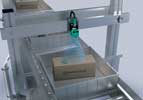
Ultrasonic sensors have become significantly more compact, powerful and less expensive, opening up a whole new range of applications.
Ultrasonic sensors are used in factory automation predominantly to measure the running time or amplitude of sonic pulses in air. The sensor emits a package of ultrasonic pulses and measures the time taken until an echo is received; a single ultrasonic converter functioning as a transmitter and receiver is normally used. The distance from the sensor to the object generating the echo can then be determined if the speed of sound in air is considered constant.
Ultrasonic converters
The main component of an ultrasonic sensor is the converter. Durable solid converters that consist of a piezo ceramics for generating the mechanical vibration and a matching acoustic layer, required to match the acoustic impedances of the ceramic to that of air, are used in most applications. Without the acoustic layer, only a small fraction of the energy would be released into the air (during transmission) or picked up (in receiver mode), which would drastically decrease the sensing range. In addition to ensuring optimised adaptation to the acoustic conditions, a high degree of mechanical stability, high resistance to chemicals, a wide temperature range, good acoustic isolation from the sensor enclosure and a competitive price are important.
Expertise pertaining to both the theoretical physical aspects as well as practical manufacturing methods is the key to the success of the Pepperl+Fuchs ultrasonic sensor ranges. The most recent development is a converter covered by a stainless steel membrane that enables the production of hermetically sealed sensors for distance measurement.
Functionality
In transmitter mode, sound waves are generated by applying a stimulating voltage (up to several hundred volts) to stimulate the converter to resonate (frequencies in the range 40 kHz to 1 MHz are used).
In receiver mode, the converter operates as a microphone. The receiver signal, with a magnitude of a few millivolts, is amplified, demodulated and transmitted to a threshold detector. The distance to the object is then calculated from the duration of the sonic interval.
In addition to the hardware design, signal processing by the microcontroller is a decisive performance determinant. Today, powerful 32-bit controllers that can reproduce complex algorithms in real-time are installed as standard. Algorithms include an adjustable sound cone width and the ability to improve measuring results under difficult conditions by measuring echo amplitudes (in addition to run times). These possibilities are far from fully exploited.
Characteristics and application advantages
Compared to photoelectric sensors, ultrasonic sensors are more resistant to dirt and humidity. The durability is comparable with that of inductive sensors, but the sensing range is about 100 times greater. Cylindrical ultrasonic sensors as small as size M12 and block-shaped models enclosed in typical proximity switch or photoelectric sensor enclosures are standard today. Furthermore, versions are available that are adapted to special requirements eg, measuring fill levels. Sensors with digital switching outputs or an analogue 4-20 mA interface are commonplace, with the IO-Link industrial standard added recently. Most sensors can be parameterised via an interface for adaptation to the respective application.
Applications can be found in almost every sector involving automated processes: in the print industry for monitoring the level of ink in containers or presence checking, in mobile plant and agricultural machinery for measuring distances, positions and filling levels, in material handling, in the packaging industry and in assembly and handling technology. Ultrasonic double sheet sensors used in printing machines, scanners, ATMs and similar machines are becoming increasingly popular as they prevent several sheets from being drawn in simultaneously. These do not measure run times, but amplitude damping through the objects.
For more information contact P&F Products, +27 (0)11 609 8188, sales@pandf.co.za, www.pandf.co.za
| Tel: | +27 10 430 0250 |
| Email: | info@za.pepperl-fuchs.com |
| www: | www.pepperl-fuchs.com/en-za |
| Articles: | More information and articles about Pepperl+Fuchs |






© Technews Publishing (Pty) Ltd | All Rights Reserved
 printer friendly version