Trojan uses LiveCD for Android running on x86 platforms as bait
June 2010
IT in Manufacturing
With the growing interest in testing the new Android OS on x86 platforms, cybercriminals are looking to exploit vulnerable users wanting to install the operating system on their PCs. A piece of malware is hosted by a fake webpage, imitating the original Android LiveCD one, and offering the 'hunted' software.
In essence, Google Android is a Linux kernel-based operating system for mobile phones. The statistics published on different Android-related sites and mobile advertising networks reflect its success worldwide:
* About 60 000 Android phones are sold daily and about 22 000 000 a year.
* Android Market delivers over 30 000 Android Apps.
* About 60% of Android Apps are free.
* 167 Apps have been downloaded between between 667 000 and 2,9 million times.
* The average paid Android app is priced at $3,27.
Android-powered Netbooks have recently appeared on the market, meaning that Android OS can now be installed on Netbooks and, of course, on normal PCs. A quick search on the Internet for 'Android on PC' and, here it is: a long list of sites offering the possibility to test the new OS on x86 Windows platforms.
Figure 1. Results for 'Andoid on PC' Internet search
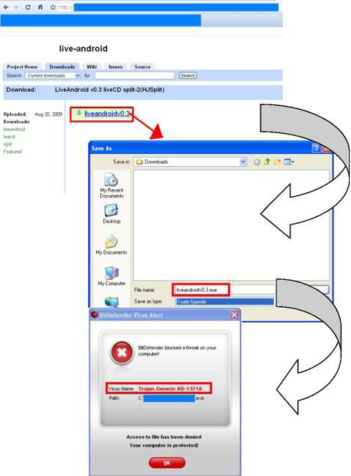
An apparently unsuspicious link in the returned list of results, one click, and the user is redirected to a look-alike of the LiveAndroid page, which, instead of the promised OS for PCs, delivers a Trojan.
Figure 2. Trojan instead of Android OS
Identified by BitDefender as Trojan.Generic.KD.13718, this piece of malware affects only Windows platforms and contains malicious or potentially unwanted software which it drops and installs on the system. Frequently, it installs a backdoor which allows remote, clandestine access to the infected system. This backdoor may then be used by cybercriminals to upload and install additional malicious or potentially unwanted software on the captured system.
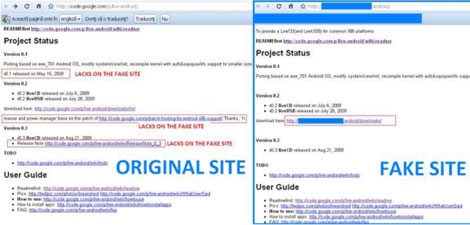
A closer look at the fallacious site and at the downloaded file reveals several differences, the most important of which being that the downloaded file should have an .iso image, not an .exe extension. The sites may look the same, but there are a few minor details that will set the bogus apart from the genuine one (as indicated in the screenshots below):
Figure 3. Original Live Android site vs. Fake Live Android site
In order to stay safe, BitDefender recommends you to install and update a complete antimalware software solution on your system.
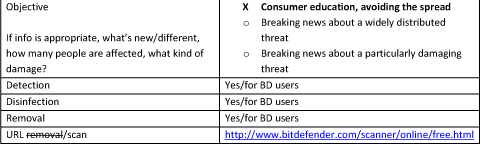
Other details about this malware alert:
For more information contact: Alina Anton, senior PR and marketing coordinator, EMEA & APAC Business Unit, BitDefender, +40 212 063 470, [email protected], www.bitdefender.com
Further reading:
Even in autonomous systems, human insight is important
Schneider Electric South Africa
IT in Manufacturing
As AI, IIoT and digital twins reshape industrial operations, Schneider Electric’s Kobus Vermeulen and Bafana Msibi argue that the operator’s role is shifting from controlling equipment to interpreting intelligence, validating AI recommendations and making decisions that improve
Read more...
AI-based quality inspection scales across P&G operations
Siemens South Africa
IT in Manufacturing
Siemens and Procter & Gamble are expanding an AI-based visual inspection system across P&G’s manufacturing operations worldwide, inspecting products in real time at full line speed, and reducing scrap rates by 10 to 20% depending on the product.
Read more...
How sustainability unlocks real business impact
Rockwell Automation
IT in Manufacturing
Sustainability has moved from a compliance obligation to a strategic driver of resilience and value for manufacturers. Rockwell Automation explains how its Triple A framework and connected-data approach help producers cut energy, water and waste while improving productivity.
Read more...
Mining’s AI future will depend on people as well as technology
IT in Manufacturing
South Africa’s mining industry is embracing digitalisation and AI, but AvenirHoldings chief executive officer, Tshidi Mndzebele says the real test is whether the people behind the industry are equipped to move forward with it, and outlines five things mining needs to get right.
Read more...
How BIC overcame operational silos to integrate technology and people
Rockwell Automation
IT in Manufacturing
Manufacturing giant BIC deployed Plex MES from Rockwell Automation at its Bizerte plant in Tunisia, replacing fragmented, partly in-house software with a single cloud-based execution system that broke operational silos and improved shop-floor visibility.
Read more...
AI in industry is an early warning system, not a guarantee
Schneider Electric South Africa
IT in Manufacturing
Schneider Electric’s Paul Steyn argues that AI in industrial maintenance is only as good as the infrastructure and people behind it, and explains the three layers a facility needs before predictive maintenance can deliver on its promise.
Read more...
SA’s mining industry must put people at the heart of its digital future
IT in Manufacturing
South Africa’s mining industry employs around 470 000 people while its digital transition accelerates. Avenir’s chief executive officer, Tshidi Mndzebele argues that technology should enable and upskill the workforce rather than replace it, setting out five ways mining can make technology work for its people.
Read more...
Quality control supports efficient tissue production
Valmet South Africa
IT in Manufacturing
Valmet’s advanced quality control technology is helping tissue producers improve product consistency while reducing energy and raw material consumption. Its latest installation at KORO Paper in Vietnam combines real-time measurement, process optimisation and non-contact, nuclear-free quality control.
Read more...
Patented algorithm maximises operator efficiency
Rockwell Automation
IT in Manufacturing
Rockwell Automation piloted a patented anomaly detection algorithm and FactoryTalk DataMosaix at its Twinsburg electronics plant, giving operators 30 to 60 days’ advance warning of stencil failure, improving fail rates by 22% and achieving a 200% return on investment.
Read more...
Cybersecurity must become part of the next era of industrial automation
Adroit Technologies
IT in Manufacturing
The EU’s Cyber Resilience Act is setting a global benchmark for connected products, making cybersecurity a core engineering requirement in industrial automation. Adroit Technologies and Mitsubishi Electric explain how building security into controllers, PLCs and drives from the outset helps South African manufacturers protect production and meet international expectations.
Read more...











 printer friendly version