Robotics, motion control and PLC on one PC platform.
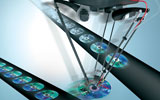
TwinCAT automation software now permits the integration of robots (delta kinematics, SCARA) as well as their interaction and synchronisation with existing motion control functions. This results in seamless integration into the overall control system and being able to dispense with additional robot CPUs. The PC-based controller from Beckhoff unites PLC, motion control and robotics all on one hardware and software platform – an important component to achieving leading edge ‘Scientific Automation.’
TwinCAT Kinematic Transformation software is the first step toward integrating robot control into the TwinCAT automation software suite. The PLC, motion control, HMI and robotic functions run on one powerful industrial PC CPU. This provides the user with a series of advantages:
* Eliminating the additional CPU required for robot control.
* Reduction in engineering costs – configuration, parameterisation and diagnostics in one system.
* TwinCAT, a well-known tool that adheres to global standards for configuration, programming and diagnostics.
* No friction losses due to the interaction of various CPUs for PLC, motion and robotics.
* Higher performance and accuracy due to direct interfaces – complex communication between CPUs no longer required.
TwinCAT Kinematic Transformation integrates itself transparently in the existing motion control world: robotic and motion control functions can be optimally synchronised using TwinCAT NC PTP (point-to-point axis positioning) or NC I (axis interpolation in three dimensions). All NC characteristics, such as ‘cam plate’ or ‘flying saw’ (synchronisation of a slave axis with a moving master axis) can be combined as desired on a common hardware and software platform.
TwinCAT supports various parallel and serial kinematics, such as those used for pick-and-place tasks. Regarding programming, the software is based on TwinCAT NC I and G-Code (DIN 66025). The target coordinates are programmed conveniently in the cartesian coordinate system. The Kinematic module takes care of conversion to the associated motor position (reverse transformation). In addition, the dynamic model for torque pre-control can be calculated.
The kinematic system can be selected conveniently in TwinCAT System Manager. The kinematic channel is used to parameterise the type (eg, delta), bar lengths and offsets. Mass and mass inertia values can be specified for dynamic pre-control. The ‘flying saw’ and ‘cam plate’ functions enable robot synchronisation with conveyor belts for picking or placing work-pieces, for example. These applications are met frequently in the material handling and packaging industries.
Network-capable remote relay system with flexible channel assignment Phoenix Contact
PLCs, DCSs & Controllers
Phoenix Contact has launched a modular PLC-Interface Ethernet Gateway remote relay system with up to 56 configurable I/O channels, multi-protocol support including Profinet Class C and S2 redundancy, and compatibility with established controller software for straightforward network integration.
Read more...Seven checks before replacing an obsolete industrial control component
PLCs, DCSs & Controllers
An obsolete control component rarely fails in isolation. Before ordering an exact spare, manufacturer successor or engineered alternative, maintenance and procurement teams should work through seven checks to define the problem properly and avoid a costly mismatch.
Read more...Economy drive system closes the drive gap in the entry-level segment Beckhoff Automation
Editor's Choice Motion Control & Drives
Beckhoff has launched an economy drive system pairing its new AX1000 servo drive and AM1000 servomotor with the AF1000 dual-axis variable frequency drive on a shared EtherCAT platform, targeting series machines and price-sensitive markets without sacrificing TwinCAT integration or functional safety.
Read more...Loop signature Part 2-6
PLCs, DCSs & Controllers
This instalment of the Loop Signature series introduces frequency plot theory as a foundation for understanding process dynamics, explaining Bode plots, dynamic gain, phase lag and their relationship to control loop tuning.
Read more...XPlanar aids innovation in laser processing Beckhoff Automation
Editor's Choice Motion Control & Drives
Aalborg University is among the first in the world to test Beckhoff’s XPlanar intelligent transport system in advanced laser processes, achieving micrometer-precise workpiece positioning and dramatically shorter lead times compared with traditional tool-based manufacturing.
Read more...The rise of software-defined brownfield automation Schneider Electric South Africa
PLCs, DCSs & Controllers
Schneider Electric’s EcoStruxure Automation Expert is enabling brownfield operators to modernise incrementally, decoupling control logic from hardware to bridge legacy equipment and future-ready operations without disrupting production.
Read more...Upgrading alarm systems for critical industries Omniflex Remote Monitoring Specialists
PLCs, DCSs & Controllers
Omniflex’s OMNI16R alarm annunciator platform provides a direct replacement for legacy CSA systems such as MPAS 90 and SA9100, enabling operators in oil and gas, nuclear and power generation to modernise alarm infrastructure without sacrificing the clarity required for safe operations.
Read more...XPlanar aids innovation in laser processing Beckhoff Automation
Fieldbus & Industrial Networking
Aalborg University is among the first in the world to test Beckhoff’s XPlanar intelligent transport system in advanced laser processes, opening the door to faster, tool-free production of metal parts.
Read more...How DCS can step off the hardware obsolescence treadmill Schneider Electric South Africa
PLCs, DCSs & Controllers
Schneider Electric argues that virtualising DCS environments breaks the cycle of hardware obsolescence, giving plant operators a smarter path to lifecycle modernisation without production disruption.
Read more...Loop signature Part 2-6
PLCs, DCSs & Controllers
The Loop Signature series turns to frequency plot theory, explaining Bode open-loop plots and how dynamic gain, phase lag and crossover frequency can be extracted from test data to inform more accurate control loop tuning.
While every effort has been made to ensure the accuracy of the information contained herein, the publisher and its agents cannot be held responsible for any errors contained, or any loss incurred as a result. Articles published do not necessarily reflect the views of the publishers. The editor reserves the right to alter or cut copy. Articles submitted are deemed to have been cleared for publication. Advertisements and company contact details are published as provided by the advertiser. Technews Publishing (Pty) Ltd cannot be held responsible for the accuracy or veracity of supplied material.










 printer friendly version