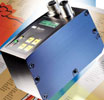
The new ZDDM 050T sheet sensor from Baumer has been designed to ensure high quality of bound print products in collating machines. For this task, a 60 x 80 mm image is taken of every sheet at a specified point in rapid sequence and this image is compared to a previously programmed reference image. The fully integrated image analysis system activates a simple switching output for sheet acceptance or rejection. Based on this information corrective actions can be initiated in the machine. The accept/reject signal is presented on a display together with additional sheet recognition information and can also be transmitted via Ethernet for remote monitoring and report generation.
The sheet sensor combines complex image recognition with the simplicity of a switching sensor
An intelligent teach-in process performed at the beginning of every print run ensures optimal recognition of the sheets. In run mode, up to 10 sheets per second are analysed at a speed of up to 3 m per second. The sheets, which may be printed either matt or gloss, may be between 110 and 500 mm in length and up to 5 mm thick. The sensor tolerates shifts in position of about 10 m along the x and y axes, as well as rotations of up to 3 degrees.
Thanks to its compact housing, 100 x 50 x 60 mm, the sensor can be mounted directly on the feeder. It is synchronised with the machine by means of the sheet start signal (external sensor), encoder pulses (CHA/CHB) or via an image trigger pulses from the control system. As the imaging optics, LED lighting, image analysis system and the interfaces (digital I/O and Ethernet) are integrated in the sensor, no additional equipment is necessary.
Market opportunity for sensors in humanoid robots
Sensors & Transducers
A new IDTechEx report forecasts the market for sensors in humanoid robots will exceed $6,59 billion by 2037, driven by perception sensors, force/torque sensors, encoders and inertial measurement units across a growing range of commercial robot platforms.
Read more...The wireless route to safer, more efficient mining operations Emerson Automation Solutions
Editor's Choice Sensors & Transducers
Modern wireless level measurement technologies are helping mining operations improve process control, increase safety and reduce installation costs. Emerson’s Rosemount 3408 wireless non-contacting radar level transmitter uses 80 GHz frequency-modulated continuous wave radar with HART communication to reach remote assets where cabling is impractical.
Read more...Telco sensors for harsh environments
Sensors & Transducers
Telco sensors are designed to operate where moisture, particulate contamination and surface fouling would disable conventional sensors, with a range including an adjustable five-metre infrared proximity sensor for harsh industrial environments.
Read more...The data-driven path to sustainable manufacturing ifm - South Africa
Editor's Choice Sensors & Transducers
Smart automation is closing the gap between operational efficiency and environmental responsibility, and the data to do it is already inside the plant. With ifm’s sensing and digitalisation technologies, manufacturers can turn machine intelligence into measurable sustainability gains.
Read more...Expanding visibility in mining operations Emerson Automation Solutions
Editor's Choice Sensors & Transducers
Advances in wireless communications, condition monitoring and sensing technologies are helping mining operators extend measurement into previously under-monitored areas, improving equipment reliability, process performance and water stewardship.
Read more...Fiber-optic amplifiers for precise object detection ifm - South Africa
Sensors & Transducers
The OCF fibre-optic amplifier detects even the smallest or most transparent objects in confined spaces, making proven fibre-optic technology easier and more user-friendly than before.
Read more...Distance sensor for confined spaces ifm - South Africa
Sensors & Transducers
The O6D100 from ifm has been designed as a powerful all-rounder for typical applications in object detection, distance measurement and positioning.
Read more...Optimise sludge treatment and reduce operational costs Endress+Hauser South Africa
Sensors & Transducers
Endress+Hauser’s inline measuring devices, the Proline Teqwave MW 300 and the Proline Teqwave MW 500, determine the total solids content of wastewater directly through microwave transmission.
Read more...Inclination sensors for motion control ifm - South Africa
Sensors & Transducers Motion Control & Drives
The JBC dynamic inclination sensor from ifm offers accurate angle measurement in the most demanding conditions, filtering out motion disturbances such as vibrations, shocks and vehicle dynamics to deliver reliable inclination values via IO-Link or programmable switch outputs.
While every effort has been made to ensure the accuracy of the information contained herein, the publisher and its agents cannot be held responsible for any errors contained, or any loss incurred as a result. Articles published do not necessarily reflect the views of the publishers. The editor reserves the right to alter or cut copy. Articles submitted are deemed to have been cleared for publication. Advertisements and company contact details are published as provided by the advertiser. Technews Publishing (Pty) Ltd cannot be held responsible for the accuracy or veracity of supplied material.










 printer friendly version