



In planning its new generation machines, Husky, a global supplier of injection moulding systems to the plastics industry, has embarked on an integral approach based on an industrial PC (IPC), fieldbus components and software from Beckhoff's product portfolio.
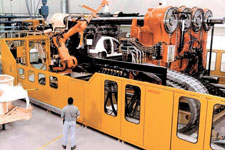
In order to provide the required clamp forces for injection moulding machines, manufacturers employ either hydraulic units or mechanically sophisticated, electrically driven clamp mechanisms. The screws of the injection units are driven by a hydraulic radial piston or servo motor. Servo motor drives are also used on the removal robots.
One industrial PC replaces four conventional controls
Two years ago, Husky decided to make plans for introducing a new PC-based generation of machine controls. Its new control concept replaces a hardware PLC, an injection controller, a clamp controller and a temperature controller with a single IPC. Machine signals are collected and transmitted by way of a Profibus master card and Beckhoff Bus Terminals connected to the fieldbus. The operator console is another standard Beckhoff product linked to the PC. Hardware has been reduced to the minimum, IPC, fieldbus and electronic terminal block, nothing more.
Modular software
Equally integrated, the software platform is based on IEC 61131-3 standards and has been designed as a software PLC in TwinCAT. This provides closed loop control of all hydraulic cylinders and also controls the robot sequences, with a TwinCAT NC software for numerical robot control. The key software components for controlling a Husky machine can be organised in four task areas:
* Hydraulics.
* Temperatures.
* Robotics.
* Visualisation.
Motion control of a hydraulically operated positioning axis is not a trivial job. Husky has many years of experience in closed loop control of hydraulically operated machine axes (typically at least eight per machine). In contrast to previous solutions, the individual controls are no longer 'black boxes' but can be adapted under the IEC 61131-3 standard by their own hydraulics and control specialists.
Temperature control with IEC 61131-3
A plastics injection moulding system can have more than 100 control zones for heating the machine as well as the mould and its hot runner manifold and nozzles. The temperature control function blocks, developed in cooperation by Husky and Beckhoff to IEC 61131-3 standards, provide functions such as self-tuning, adaptive power-up, smooth switch-over from manual to automatic mode and predefined response to hardware failures such as thermocouple breakage and open heater circuits. Adding a heating zone is the same as defining a variable.
Robots on SERCOS
Control of the electrical robot axes is programmed by using predefined function blocks for axial motion control, available in the TwinCAT NC library. As TwinCAT supports various different fieldbus systems, Husky selected SERCOS for the drives.
Visualisation
The fourth software component, visualisation, has been designed by Husky to run under Windows NT. The operating philosophy is focused on touch-screen operation combined with the softkeys of Beckhoff's Control Panel. Critical machine functions are initiated by means of softkeys. TwinCAT's software interface provides access to control parameters, alarm messages, time records, statistics, etc.
Benefits realised
Significant cost savings are derived from the use of a fieldbus system and eliminating specialised control hardware. The control solution can be adapted as required through the performance of the selected IPC. Overall control configuration has become more transparent for and is based on standard operating systems and software standards. This means that Husky has complete control of its injection moulding technology and intellectual property. TwinCAT provides a runtime and programming environment right at every machine. This opens the familiar possibilities of the PC world, such as high-capacity hard disk drives, teleservice by modem and Ethernet, links to further machines by serial interfaces or LAN, communication with scada systems, and use of external, Windows-compatible process optimisation software.
For the future Husky has recognised a need to focus on modular machine design and 'zero engineering' tools for simplified programming and flexible response to customer and market needs. Beckhoff TwinCAT has become a central pillar in this architecture.
| Tel: | +27 11 795 2898 |
| Email: | [email protected] |
| www: | www.beckhoff.com |
| Articles: | More information and articles about Beckhoff Automation |






© Technews Publishing (Pty) Ltd | All Rights Reserved
 printer friendly version