


Pneumatics & Hydraulics


Saving on compressed air consumption

June 2006 Pneumatics & Hydraulics

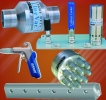
A simple solution to reduce costs and noise levels on compressed air blowoff operations is to use Exair air nozzles and jets. These nozzles and jets produce up to 25 times the air flow while using only a small amount of compressed air as the power source.

Air savings, compared to open copper tubes or pipe nipples commonly used for blowoff can be as high as 80%. Less compressed air means less noise. The typical noise reduction is 10 dBA. All nozzles and jets meet OSHA dead end requirements.

An open 6 mm copper tube, by contrast, ejects pure compressed air at up to 1,1 kilolitres per minute (the entire output of a 7,5 kW compressor). Annual energy costs can be exorbitant. Noise levels in excess of 100 dBA are commonly produced and when supply pressure exceeds 200 kPa, an open pipe, tube or drilled holes violate OSHA static pressure requirements.

The use of compressed air for blowoff in most facilities is a problem due to the energy costs, noise level and the potential danger to personnel who are exposed to high pressure air. Open air pipes, copper tubes and drilled pipes are a few of the common abusers. They consume tremendous amounts of energy and often produce noise levels over 100 dBA.

The best way to cut energy costs is through proper maintenance and use of the compressed air system. Leaks and dirty filters require maintenance on a regular basis. Energy savings can also be realised when replacing outdated compressor motors and controls with high efficiency models that often pay for themselves in a short period of time.

The most important factor to dramatically boost efficiency is proper use. Using engineered products like Exair's Super Air Nozzle can cut operating costs since it uses only a fraction of the compressed air of typical blowoffs. In addition, all of the air nozzles and jets can be cycled on and off with instantaneous response so compressed air is only used when needed.

High noise level is a common problem for many plants. Compressed air noise often exceeds 90 dBA resulting in hearing loss to those working in close proximity. Noisy blowoffs at 550 kPa that produce noise levels of 100 dBA can be reduced to only 74 dBA when using the Super Air Nozzles. At that pressure, it is still possible to obtain hard-hitting force without the high noise.

Air penetrating the skin

Air can be dangerous when the outlet pressure of a hole, hose or copper tube is higher than 200 kPa. In the event the opening is blocked by a hand or other body part, air may enter the blood stream through the skin, resulting in a serious injury. All of the air nozzles and jets manufactured by Exair have been designed for safety. All are safe to be supplied with higher pressure compressed air and meet OSHA standard CFR 1910.242(b).

Consider the following example where a Model 1102 Mini Super Air Nozzle replaces a 3,2 mm open pipe. The significant compressed air savings are easy to calculate. Payout for air nozzles and jets, including filter and installation cost is measured in weeks - not years as is the case for other cost reduction equipment.

Example

Existing blowoff is 3,2 mm open pipe at 550 kPa supply. Air consumption, from Table 1 is 1,98 kilolitres per minute.

Table 1. Air consumption for typical homemade blowoffs

Using a Model 1102 Mini Super Air Nozzle (also at 550 kPa supply), air consumption is 283 litres per minute. Therefore, air saved is 1,697 kilolitres per minute. For this example the blowoff is continuous. Further air savings can be achieved by cycling operation according to demand.




Share this article:
Share via emailShare via LinkedInPrint this page

Further reading:

CompAir introduces compressed air management solution
Pneumatics & Hydraulics
To maximise savings and extend the lifespan of compressed air systems, CompAir is launching the Compressed Air Management Solution powered by Ecoplant, an intelligent system in the cloud that represents the next level in operational management, and maintain the health

Read more...
Heavy impact, smart control
Axiom Hydraulics Editor's Choice Pneumatics & Hydraulics
Every now and then a project lands on your desk that’s equal parts heavy machinery and fine control - a tantalising mix for any engineer. A client approached Axiom Hydraulics with a project exactly like this.

Read more...
Making lines safer with smarter connection
Hydrasales Pneumatics & Hydraulics
Imagine connecting multiple hydraulic lines or a combination of hydraulic, electrical and grease lines with one single, confident movement. That’s the everyday convenience operators get from Faster’s MultiFaster multi-coupling systems.

Read more...
Achieving clean and dry compressed air
Artic Driers International Pneumatics & Hydraulics
Compressed air is an expensive source of motive power so it makes good sense to supply clean, dry compressed air to your distribution system.

Read more...
Navigating ISO standards in hydraulic cylinder manufacturing
Pneumatics & Hydraulics
For hydraulics professionals, understanding and leveraging ISO standards is a powerful way to ensure quality and gain a competitive edge. Here is a guide to the most critical ISO standards for hydraulic cylinder manufacturing, showing how to use them to your advantage.

Read more...
Hydraulic system upgrades to boost performance and save money
CT Hydraulics (Nqoba) Pneumatics & Hydraulics
Those working with hydraulic or pneumatic systems know that keeping your machinery running at peak performance balances productivity and cost. As systems age, they often become less efficient, requiring more energy and more frequent repairs. The good news is that you don’t always need to invest in an entirely new machine to solve these problems.

Read more...
Top 10 questions about pressure and temperature gauges
SA Gauge Pneumatics & Hydraulics
Some questions never go out of date, and in our industry, a few have been asked for decades. At SA Gauge, we hear them every week. Here are the ten questions we hear most often, and the practical answers that can save time, money and frustration.

Read more...
Gauge maintenance and calibration tips for shutdown or restart periods
SA Gauge Pneumatics & Hydraulics
As the year winds down, many plants across South Africa prepare for the annual shutdown. It’s also the perfect opportunity to give your pressure and temperature gauges the attention they deserve.

Read more...
Axial piston pump series for next-gen hydraulic applications
Pneumatics & Hydraulics
Moog has launched its new AXP Axial Piston Pump Series, a next-generation hydraulic solution engineered to deliver optimal performance, reliability and cost efficiency for industrial applications.

Read more...
The role of analogue gauges in a digital world
SA Gauge Editor's Choice Pneumatics & Hydraulics
With so much focus on digital systems, remote monitoring and automation, it’s easy to assume that traditional analogue gauges have become outdated. Yet if you step into almost any plant, mine or processing facility, you’ll still find them in daily use, quietly doing their job without fuss.

Read more...


While every effort has been made to ensure the accuracy of the information contained herein, the publisher and its agents cannot be held responsible for any errors contained, or any loss incurred as a result. Articles published do not necessarily reflect the views of the publishers. The editor reserves the right to alter or cut copy. Articles submitted are deemed to have been cleared for publication. Advertisements and company contact details are published as provided by the advertiser. Technews Publishing (Pty) Ltd cannot be held responsible for the accuracy or veracity of supplied material.


© Technews Publishing (Pty) Ltd | All Rights Reserved