Hydraulic system for UCT sled tester
January 2006
Pneumatics & Hydraulics
The University of Cape Town, Mechanical Engineering Department approached Hyflo for the design philosophy on a sled tester. Hyflo was to be responsible for the design and manufacture of the hydraulic and control system.
The system required a 300 kg sled to be decelerated from speeds of up to 17 m/s to rest in a controlled manner in a short period of time. Hyflo, in conjunction with system partners, Moog, decided that the best system for this task would be a servo-hydraulic system. This would comprise of a braking cylinder controlled by a high response servo valve. In addition to calculations being carried out for system design, dynamic simulations were carried out using Matlab/Simuling (R14,1) to assist and verify the component and control selections.
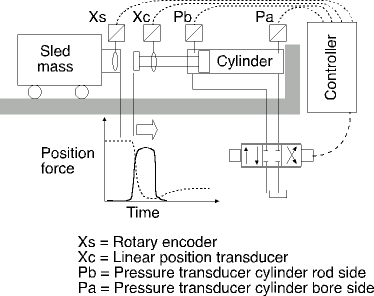
The selected hydraulic system employs a pressure compensated pump which delivers 40 l/min of high pressure oil to charge a bank of five accumulators. A separate accumulator is also charged to ensure constant control pressure for the servo valve is maintained during operation. Once the set pressure of 35 Mpa is reached, the pump will cut back displacement to zero. At this point, with the hydraulic cylinder extended, the system is ready for operation and in the 'default' position (See Figure 1).
Figure 1
To start the cycle, the sled moving at a maximum velocity of 17 m/s approaches the hydraulic cylinder with contact plate. At a predefined point, in position control via the servo valve, the hydraulic cylinder is pre-accelerated using the high flow available from the accumulator bank with a maximum flow of 4900 l/min entering the rod side of the cylinder and a maximum of 8000 l leaving the bore side. This predefined point is determined using a rotary encoder that is attached to a winch, which is in turn connected to the sled with the winch rope held in constant tension by a high speed brushless servo motor. This system produces position and velocity information on the oncoming sled. The pre-acceleration of the cylinder allows the cylinder speed to closely match the oncoming sled speed and thereby minimise the impact.
Once the sled and cylinder have connected, the braking sequence begins. This makes use of a closed loop control comprising of the rotary encoder on the sled, a linear position transducer on the cylinder and two pressure transducers on the rod and bore sides of the cylinder, which all transmit their data to a PLC which in turn controls the position of the cylinder via the servo valve.
The PLC ensures that all parameters are correct safely decelerates the sled from the 17 m/s to 0 m/s with an approximate deceleration of 57 g.
Further reading:
Pneumatic solutions for versatility, operational safety and efficiency
Pneumatics & Hydraulics
As an authorised partner of Festo, BMG combines access to globally recognised pneumatic technologies with local application expertise and technical support.
Read more...
Turning compressed air into a strategic energy advantage
Pneumatics & Hydraulics
Compressed air accounts for up to 80% of a system’s lifecycle costs, yet often remains overlooked in energy strategies. CompAir’s Energy Check provides a data-driven analysis of the complete compressed air network to identify energy savings of 20 to 30% or more.
Read more...
Air compressor secures premium meat company’s legacy
Pneumatics & Hydraulics
A tailored ELGi compressed air solution from Integrated Air Solutions is helping Tulisa Meat Market protect six decades of quality and consistency in its premium meat production.
Read more...
How laser cladding delivers 33% more life and maximum ROI in hydraulic cylinders
Pneumatics & Hydraulics
By utilising advanced laser cladding, Honingcraft can help clients achieve a 33% longer life from their components, ensuring they secure the maximum return on their investment.
Read more...
Identifying signs of hydraulic cylinder wear and tear
CT Hydraulics (Nqoba)
Pneumatics & Hydraulics
Recognising the early warning signs of hydraulic cylinder degradation is crucial for preventing costly downtime, ensuring operator safety and maximising the lifespan of your hydraulic systems.
Read more...
Integrated Air Solutions opens Pinetown branch
Pneumatics & Hydraulics
Integrated Air Solutions has opened a branch in Pinetown, bringing world-class diesel and electric air compressor services closer to customers in KwaZulu-Natal.
Read more...
Cartridge-style flowmeter
Axiom Hydraulics
Pneumatics & Hydraulics
Sun’s new cartridge-style flowmeter QMEH delivers precise, real-time flow measurements for demanding hydraulic applications. Using a custom-built, state-of-the-art sensor, the QMEH accurately detects flow and converts the electrical signal into a proportional flow rate.
Read more...
Robust sensors for pneumatic applications
ifm - South Africa
Pneumatics & Hydraulics
The pressure sensors from ifm have a G1/8 process connection, combined with a welded thin-film measuring cell. While offering an unbeatable price/performance ratio, this technology provides for high measuring accuracy in a very compact and robust housing.
Read more...
A guide to common hydraulic system contaminants
CT Hydraulics (Nqoba)
Pneumatics & Hydraulics
Every engineer, machine designer and maintenance professional understands that the heart of any reliable hydraulic system is its fluid. But the moment that fluid is compromised, your system’s life expectancy and your peace of mind drop dramatically.
Read more...
Compressed air piping design
Artic Driers International
Pneumatics & Hydraulics
When designing a compressed air pipeline, remember that size matters. The internal size of the pipe, along with the pressure and air volume, determine the velocity of the compressed air in the pipeline.
Read more...










 printer friendly version