Temposonics sensors operate on a magnetostrictive principle - which offers contactless, absolute, wear-free and accurate displacement measurement - desirable characteristics for mobile hydraulic applications.
The measurement principle combines several magneto-mechanic effects and performs the displacement measurement by accurate measurement of the travel time of an ultrasonic pulse through a solid body (the wave guide). Since there is no mechanical contact, there is essentially no wear, and the method of construction permits rugged designs with high operational life expectancies - even when used in conjunction with heavy-duty machinery subjected to shock and vibration. Harsh environmental conditions and the changes occurring in hydraulic liquid during operation do not affect the measurement accuracy.
Progress in the field of hydraulic control is largely due to the integration that has been happening in recent times between electronic and hydraulic systems. In order to reap the full benefit, adequate sensors are required. With their makers reporting fast measuring rate, high reproducibility and stable linearity throughout their working lifetime, Temposonics position sensors are well suited for dynamic control of mechanical systems. Applications that can benefit from the use of these sensors include almost anything that used linear hydraulic actuators to perform a job; from variable cutting and gripping device adjustment of wood harvesting machines through dynamic extension arm control for industrial mowing machines to the inclination control of high-speed trains.
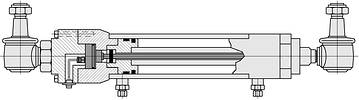
The sensor mechanics and electronics feature modular construction, with the sensor head housing all the electronics. Due to its small dimensions, the pressure-resistant wave-guide (35 MPa) is contained within the piston rod. The only moving part is the position magnet - which is mounted in the bottom of the piston. Its position is measured (without physical contact) and transmitted to the waveguide. Signal processing methods are used to minimise jitter and virtually eliminate signal overlapping and aliasing.
Advantages include:
* Linear absolute value measurement - no reference setting required.
* Contactless sensing - no wear.
* Minimum dimensions - ie, easy installation.
* Replaces potentiometers and inductive sensors.
* Linearly stable: no linearity error correction required.
* Direct analog signal output - ie, no conversion required.
* EMC immunity - ie, high measurement safety.
* Independent of hydraulic liquid - ie, no change of the measurement accuracy during operation.
Electrically operated, energy-efficient double diaphragm pumps Bearing Man Group t/a BMG
Pneumatics & Hydraulics
BMG has introduced the EVO series 210 electric double diaphragm pump range from ARO, offering lower energy consumption and quieter operation than air-operated alternatives, with access from one side for both diaphragms, and optional electronic leak detection for critical applications.
Read more...Integrated Air Solutions opens KwaZulu-Natal branch
Pneumatics & Hydraulics
Integrated Air Solutions has opened a KwaZulu-Natal branch in Pinetown, establishing a local turnkey compressed air partner for the province with equipment, installation, servicing, rapid emergency response and rental offerings under one roof.
Read more...Precision and durability in metal manufacturing and injection moulding Parker Hannifin - Sales Company South Africa
Pneumatics & Hydraulics
From 800 bar hydraulic circuits in metal presses to low-pressure cooling systems in injection moulding machines, Parker Hannifin’s fluid connector systems are engineered for the contrasting demands of high-pressure sealing, thermal resistance and rapid serviceability.
Read more...Turning compressed air into a strategic energy advantage
Pneumatics & Hydraulics
Compressed air accounts for up to 80% of a system’s lifecycle costs, yet often remains overlooked in energy strategies. CompAir’s Energy Check provides a data-driven analysis of the complete compressed air network to identify energy savings of 20 to 30% or more.
Read more...Air compressor secures premium meat company’s legacy
Pneumatics & Hydraulics
A tailored ELGi compressed air solution from Integrated Air Solutions is helping Tulisa Meat Market protect six decades of quality and consistency in its premium meat production.
Read more...Identifying signs of hydraulic cylinder wear and tear CT Hydraulics (Nqoba)
Pneumatics & Hydraulics
Recognising the early warning signs of hydraulic cylinder degradation is crucial for preventing costly downtime, ensuring operator safety and maximising the lifespan of your hydraulic systems.
Read more...Integrated Air Solutions opens Pinetown branch
Pneumatics & Hydraulics
Integrated Air Solutions has opened a branch in Pinetown, bringing world-class diesel and electric air compressor services closer to customers in KwaZulu-Natal.
While every effort has been made to ensure the accuracy of the information contained herein, the publisher and its agents cannot be held responsible for any errors contained, or any loss incurred as a result. Articles published do not necessarily reflect the views of the publishers. The editor reserves the right to alter or cut copy. Articles submitted are deemed to have been cleared for publication. Advertisements and company contact details are published as provided by the advertiser. Technews Publishing (Pty) Ltd cannot be held responsible for the accuracy or veracity of supplied material.










 printer friendly version