



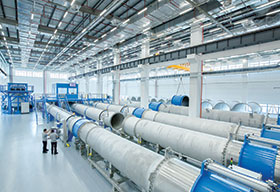
Endress+Hauser repeatedly raises the bar when it comes to products and services as is evident from the company’s calibration centres all around the world. The measurement technology specialist relies on globally proven, standardised procedures to optimise its customers’ processes and improve their productivity and competitive position – regardless of the measurement parameter.
Calibrating measurement instruments on a regular basis is key to ensuring that predefined tolerances are adhered to in quality-relevant processes. Using calibration, deviations can be highlighted at critical measurement points, which helps averts losses during production. The overall benefit is less wastage and superior product quality.
Endress+Hauser offers traceable, cost-effective and ISO 17025-compliant calibration services along the entire process, from onsite testing to fully accredited laboratory calibration. As a result, the company makes a significant contribution to quality assurance. A comprehensive calibration certificate, including a compliance declaration, verifies the accuracy of the measurement point and the process recording, and guarantees the reliability of the processes and the products.
Industry knowledge and manufacturer-independent calibration
With all industries facing increasingly stringent legal requirements, conforming to relevant local and international standards is an especially important factor. Thanks to in-depth industry knowledge and experience, Endress+Hauser can fulfil customer-specific regulatory and operational needs that cover efficiency, quality and accuracy. Utilising standard operating procedures (SOPs) and certified master measurement instruments, the company maintains a consistently high quality standard for both onsite and laboratory calibrations.
Production areas frequently have a high number of measurement points for quality assurance and metering applications, and, in many cases, the measurement instruments are not limited to one manufacturer. Endress+Hauser helps customers maintain an overview of the entire installed base and analyses all the instruments to determine the right calibration process, thus guaranteeing seamless and traceable calibrations of any measurement instrument, for maximum system availability.
Save time and effort by streamlined commissioning
Automation projects are under strong pressure to reduce costs from investment to start-up, and begin generating revenue as early as possible. Contractors and project leads typically follow KPIs based on time savings and cost reduction within a project, while comparing them to previous similar project experiences. Last minute changes in projects are common, e.g. adding new devices or changing configurations after the final order is placed, so it is important to be flexible and take an agile approach to managing these situations wherever possible. By using technology-enabled processes and smart DCS/PLC functions such as Device Templates, Pre-Configuration and Remote and Bulk Configuration, commissioning can be done faster and safer compared to conventional onsite processes. The result is drastically reduced commissioning time, risk and effort.
Expertise is the key to fast, smooth and solid plant start-up
Since commissioning is on the critical path for start-up and delays sometimes cost millions of Rands per day, customers are constantly searching for new ways to be more efficient during this phase.
Assuming an average time of 1,5 hours per device with conventional (device display, handheld or a service tool) commissioning, at a price of R1000/h, in a medium size project with 2000 devices, this task will take 3000 hours and cost R3 million. Taking the same project, but using Device Templates combined with a streamlined commissioning process, this task can be done in less than 500 hours at a cost of only R500 000. Typically, time savings result in 50-80% cost savings, mainly related to labour costs in projects with more than 200 devices and a good portion of intelligent devices.
In addition, most work can be completed more efficiently due to careful early planning, reducing the likelihood of any impact on the project’s critical path. Moreover, this approach also avoids the risk of working on construction sites, as most of the work is done offline in safe workshop environments. All configuration and integration tasks are discussed and tested before the final commissioning of the devices, eliminating concerns of compatibility with the control system.
With conventional commissioning, device diagnostics like NAMUR NE107 and Heartbeat Technology are sometimes not considered and therefore not configured which often leads to false alarms in the decentralised control system (DCS) or asset management system (AMS). This often forces the customer to ‘switch off’ this functionality in the host system. This makes it impossible to utilise Heartbeat Technology and to adopt a preventive maintenance concept using sensor data as a source of information. To enable best practices, the optimum configuration of each device is therefore mandatory.
Another advantage of Smart Commissioning is that the process is clear, proven and well-defined. Consistent and optimum device configuration, including alarming and advanced diagnostics, is comprehensively applied to the instrumentation installed base across the entire plant. As a result, there will be no unpleasant surprises due to DCS device integration issues or alarm flooding during the critical start-up phase. In addition, with this approach, the quality of work is independent of a sub-contractor’s (e.g. a field technician’s) qualifications.
The smart factor is in the commissioning process
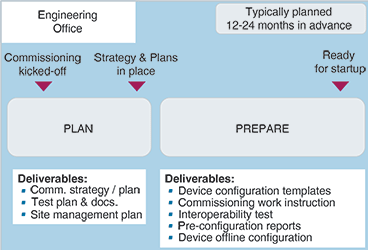
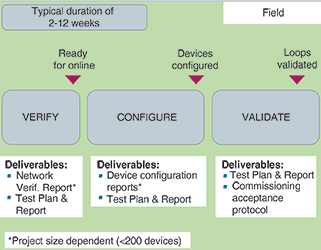
The essence of Smart Commissioning is to get involved as early as possible in the project discussions and make the best decisions at an early stage related to:
• Planning and preparing commissioning tasks in the engineering office.
• Efficiently performing commissioning in the field.
Figures 1a and b give an overview of the two main phases, as well as their associated deliverables.
Conclusion
Smart calibration and commissioning practices address the key customer concerns of meeting strict and shifting deadlines, as well as keeping tight control on budget. This combination enables faster and safer commissioning processes in comparison to conventional on-site methods and drastically reduces commissioning time, risk and effort. These value-added services are an integral part of Endress+Hauser South Africa’s extended project consulting and project execution services.
For more information contact Preston Reddy, Endress+Hauser, +27 (0)11 262 8000, [email protected], https://eh.digital/2HdcDSx
| Tel: | +27 11 262 8000 |
| Email: | [email protected] |
| www: | www.endress.com |
| Articles: | More information and articles about Endress+Hauser South Africa |






© Technews Publishing (Pty) Ltd | All Rights Reserved
 printer friendly version