



As information technology and automation technology continue to converge, cloud-based communication and data services are increasingly being used in industrial automation projects. Beyond the scope of conventional control tasks, applications such as big data, data mining and condition or power monitoring enable the implementation of superior, forward-looking automation solutions. New hardware and software products from Beckhoff for Industrie 4.0 and IoT ensure the simplest possible implementation of such advanced solutions.
Definition of business objectives for increasing the competitive edge
Industrie 4.0 and Internet of Things (IoT) applications do not start with just the underlying technology. In reality, the work begins much earlier than this. It is critically important when implementing IoT projects to examine the corporate business objectives, establishing the benefits to be gained from such projects. From an automation provider perspective, there are two distinct categories of customers: machine manufacturers and their end customers – in other words, the end users of the automated machines.
In the manufacturing sector there is an obvious interest in reducing in-house production costs, both through efficient and reliable production control and also by reducing the number of rejects produced. The traditional machine manufacturer pursues very similar objectives, and above all, is interested in reducing the cost of the machine while maintaining or even increasing production quality. Optimising the machine’s energy consumption and production cycles, as well as enabling predictive maintenance and fault diagnostics, can also be rewarding goals.
Collecting, aggregating and analysing process data
The process data used during production provides a foundation for creating added value and for achieving the above-mentioned business objectives. This includes the machine values that are recorded by a sensor and transmitted via a fieldbus to the PLC. This data can be analysed directly on the controller for monitoring the status of a system using the TwinCAT condition monitoring libraries integrated in the TwinCAT 3 automation software, thereby reducing downtime and maintenance costs.
However, where there are several distributed controllers in production areas, it may not be sufficient to analyse data from a single controller. The aggregated data from multiple or even all controllers in a production system or a specific machine type is often needed to perform sufficient data analysis and make an accurate analytical statement about the overall system.
Previous implementations focused on the use of a central server system within the machine or corporate network that was equipped with data memory, often in the form of a database system. This allowed analysis software to access the aggregated data directly in the database in order to perform corresponding evaluations.
Although such an approach to realise data aggregation and analysis in production facilities worked well, it presented a number of problems at the same time, since the required IT infrastructure had to be made available first. The fact that this gives rise to high hardware and software costs for the corresponding server system can be seen right away.
To complicate matters, the scalability of such a solution is very low. Ultimately the physical limits of the server system are reached at some point, be it the amount of memory available or the CPU power, or the performance and memory size required for analyses.
The path to the public cloud
Cloud-based communication and data services avoid these disadvantages by providing the user with an abstract view of the underlying hardware and software systems. Abstract in this context means that a user does not need to give any thought to the respective server system when using a service, rather, only the use of the respective services need be considered.
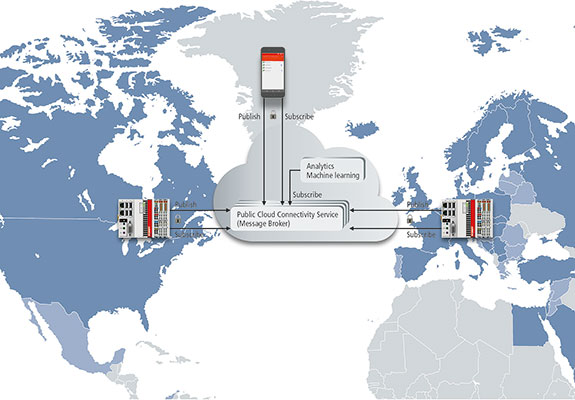
The public cloud service providers, such as Microsoft Azure or Amazon Web Services, for example, provide users with a range of services from their own data centres. This starts with virtual machines, where the actual user has control of the operating system and the applications installed on it, and stretches to abstracted communication and data services, which can be integrated by the user in an application. The latter, for example, also includes access to machine learning algorithms, which can make predictions and perform classifications regarding specific data states on the basis of certain machine and production information. The algorithms obtain the necessary contents with the aid of the communication services.
Such communication services are usually based on communication protocols, which in turn are based on the publish/subscribe principle. This offers definite advantages from the resulting decoupling of all applications that communicate with one another. On one hand, the various communication participants no longer need to know each other – in other words, any time-consuming disclosure of address information is reduced. On the other, data communication with the cloud service, via the message broker, involves a purely outgoing communication connection from the perspective of the terminal device – regardless of whether data is sent (publish) or received (subscribe). The advantages this offers for configuring the IT infrastructure are immediately clear: no incoming communication connections have to be configured, for example in firewalls or other network terminals. This significantly reduces IT infrastructure set-up time and maintenance costs.
Products for Industrie 4.0 and IoT
Beckhoff provides users with a wide variety of components for simple and standardised integration into cloud-based communication and data services. The IoT products within the TwinCAT 3 automation software offer varied functionalities for exchanging process data by means of standardised publish/subscribe-based communication protocols and for accessing special data and communication services of public cloud service providers. Corresponding services can be hosted in public cloud systems, such as Microsoft Azure or Amazon Web Services, but can be used just as effectively in private cloud applications.
If I/O signals are to be forwarded directly without a control program, then Beckhoff’s EK9160 IoT Bus Coupler allows I/O data to be parameterised on the device for sending to a cloud service. The bus coupler then independently carries out the sending of the digital or analog I/O values. An IoT coupling station consists of an EK9160 and a virtually limitless number of powerful and ultra-fast EtherCAT terminals. The data is sent in a user-friendly, standardised JSON format to the cloud service and can also be transmitted in encrypted form if required. Extended mechanisms, such as local buffering of I/O data in the case of an interrupted Internet connection, are provided here in the same way as a monitoring function for connected fieldbuses. The I/O signals can therefore not only be collected by means of EtherCAT, but also via other fieldbuses, such as CANopen or Profibus.
Analytics and machine learning
Once the data has been sent to a public or private cloud service, the next question is how it can continue to be processed. As previously mentioned, many public cloud providers offer various analytics and machine learning services that can be used for further examination of process data. Moreover, Beckhoff also has its own analytics platform for users to take advantage of, namely TwinCAT Analytics. This platform provides relevant mechanisms for data analysis, with all process-related machine data being recorded in a precise and cyclical manner. All machine processes can therefore be fully recorded as a result.
Depending on requirements, this data can either be stored for evaluation locally on the machine processor, or within a public or private cloud solution. TwinCAT Analytics uses TwinCAT IoT to connect to cloud solutions, ensuring seamless data communication. This provides the power to create new business ideas and models for both the machine manufacturer and the respective end customers.
Conclusion
Industrie 4.0 and IoT are on everyone’s minds. Likewise, these concepts are important when the realisation of innovative new business models is a requirement for the underlying infrastructure. This also drives the increased convergence of IT and automation technologies. Cloud-based data services can help implement such automation projects, as they save the machine manufacturer or end customer from having to provide the corresponding IT expertise.
With TwinCAT IoT and the EK9160 cloud bus coupler, Beckhoff provides customers with two new products for integrating such cloud-based data services quickly and easily into the control project. Additionally, TwinCAT Analytics enables the support of such projects using a powerful analytics platform, which facilitates comprehensive analysis of the recorded process data.
For more information contact Kenneth McPherson, Beckhoff Automation, +27 (0)11 795 2898, kennethm@beckhoff.com, www.beckhoff.co.za
| Tel: | +27 11 795 2898 |
| Email: | info@beckhoff.co.za |
| www: | www.beckhoff.com |
| Articles: | More information and articles about Beckhoff Automation |






© Technews Publishing (Pty) Ltd | All Rights Reserved
 printer friendly version