



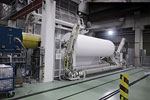
Condition monitoring is an important factor for any industry, yet not all condition monitoring measures are sufficiently applied to adequately control all machines and equipment. This is partly due to the fact that some companies have financial limitations that prevent wide scale condition monitoring… but when projecting long term, the financial loss after a system failure is significantly higher than the initial investment required for an online condition monitoring system.
Gain in the long term
SAPPI Germany successfully implemented the first condition monitoring measures in the early 1990s, and quickly discovered that comprehensive equipment monitoring is essential for competitive and profitable operation.
SAPPI Fine Paper Europe, is one of the largest papermaking companies globally and one of the company’s plants based in the small town of Ehingen in Germany, produces approximately 250 000 tonnes of paper per year while the group has an annual output of more than 2,7 million tonnes. Wood-free coated paper is mainly supplied to wholesalers and the bulk is utilised for the preparation of high gloss brochures for industrial advertising, artistic print calendars.
In an industry that demands consistency, on time delivery is often a deciding factor and equipment failure impacts negatively both on the manufacturer and the end user. Condition monitoring is essential in order to keep plant equipment operating smoothly – and according to SAPPI Fine Paper Europe technical manager, Burkhard Köhn, loss of production through machine failure cannot be made up as the plant runs round the clock, almost 365 days per year.
A case of 'when' – not 'if'
Paper making equipment presents a number of potential problem areas. A 200 m length of paper processing equipment contains a multitude of control and drive systems while large numbers of bearings and gears add to the risk of component failure on the production line.
As unplanned stoppages cost SAPPI €10 000 per hour, the ultimate goal is to prevent unnecessary machine failure. Realising that condition monitoring of high risk components plays a decisive role in safeguarding reliable functioning, SAPPI initially installed an offline measuring system and gradually moved to SKF online systems.
Maintaining a competitive edge
Operational reliability is also crucial to maintaining the competitive edge and with constantly increasing industry competition, Köhn believes that condition monitoring plays a decisive role in meeting the challenges of delivering consistently excellent products on time. A clear indication that SAPPI places high importance on plant maintenance to prevent unexpected failures, is the millions of Euros invested into maintenance systems. The plant is fitted with 385 sensors in different measuring positions to allow SAPPI’s foreman of preventative maintenance, Herman Huss, to retrieve sensor data via a computer. Huss explains that an alarm, triggered when a value exceeds a set limit (based on many years of experience), clearly identifies the location of a rolling bearing that is experiencing a tell-tale change in operating conditions.
Establishing the nature of the wear
Live measurements allow technicians to determine whether the damage on the rolling bearing is remaining constant or whether the condition is deteriorating. “This gives us the opportunity to calculate whether the bearing (with a quick application of additional lubricant) can be left to operate until the next scheduled maintenance date,” said Huss.
Huss and Köhn agree that although there will always be an element of risk, the plant still has the advantage as, based on the parameters measured, the problem component is located and identified and an exact report of reasons for plant downtime is produced. “Without condition monitoring it would be difficult to find one failed bearing. In our plant a planned bearing change requires two to four hours; without condition monitoring, it might well take eight hours,” claims Huss.
Condition monitoring allows bearing damage to be correctly evaluated. A bearing defect and consequent failure is considered normal in a bearing that has been used for several years while failure of a new bearing, demands a damage analysis to determine the cause and to optimise bearing choice.
Extending shutdown intervals
According to Köhn, the plant features online systems, Microlog data-loggers for manual measurements on the routes, vibration sensors fitted to the measuring positions and evaluation software to allow detailed viewing and analyses of data. Technicians can respond to changes quickly and systematically and monitor the plant to ensure shut down for scheduled maintenance at six weekly intervals. Condition monitoring made it possible to extend scheduled maintenance to intervals of six weeks instead of every two weeks in 1991.
Quantifying the success of the maintenance systems is the fact that since implementation of the plant’s offline and online measurements, 1000 instances of damage have been successfully identified ie, damage detected and diagnosed before the plant failed.
Higher production rates demand greater care
The risk for gearbox damage increases in tandem with increasing market demands and SAPPI’s production speed of 1120 metres per minute takes the gearbox to its limits more rapidly than planned. In order to achieve better control and reliability in planning, plans are on track to include this area in the condition monitoring programme. The objective is a state-of-the-art plant and equipment that allow identification and optimisation of shortcomings. SKF condition monitoring systems provide the tools for thorough analyses of all bearings in the manufacturing facilities. It is generally very comforting to know when everything is ‘in the green’, in the truest sense of the word – and which components are reaching the limit of their service life
For more information contact SKF South Africa, +27 (0)11 821 3500, samantha.joubert@skf.com, www.skf.co.za
| Tel: | +27 11 821 3500 |
| Fax: | +27 11 821 3501 |
| Email: | sales.za@skf.com |
| www: | www.skf.co.za |
| Articles: | More information and articles about SKF South Africa |






© Technews Publishing (Pty) Ltd | All Rights Reserved
 printer friendly version