The Motor Challenge Programme (The Programme) was launched by the European Commission in 2003 to aid industrial companies in improving the energy efficiency of their electric motor driven systems, which account for up to 30% of all electricity used in the European Union (EU). Practical experiences have shown that savings of between 30% and 50% are achievable on pump, compressor and fan systems through the use of energy-efficient design and selection methods.
The voluntary programme was developed to help to achieve the EU energy policy which aims to:
* Minimise environmental impact - in particular reduce CO2 emissions.
* Improve industry competitiveness of the trade bloc.
* Reduce dependence on imported energy sources.
Savings
Some examples quoted in the Programme's documentation show paybacks in the order of three to four months.
As at December 2007 there are 78 Motor Challenge Partners, with 34 having joined during 2007. The measures adopted by these new Motor Challenge partners in their projects have already resulted in annual electricity savings of more than 30 GWh.
Modules
The Programme issues guidelines in the form of modules to help partners document the status quo, establish project goals and record project outcomes. The modules also provide pointers in terms of where to look for potential savings.
The Drives Module is one such module. This requires challenge participants ('Partners') to:
* Inventory existing drive systems and components and system operation.
* Assess the applicability of possible energy savings methods.
* Present an action plan to the commission.
* Provide an annual report on progress of the action plan.
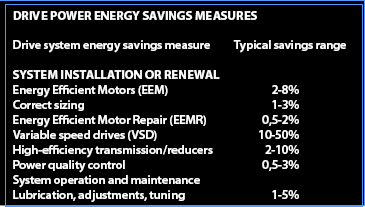
The Drives Module lists the following as factors influencing drive systems electricity consumption and shows the realisable energy savings potential of each. See Table 1.
Energy efficient motors
Energy efficient motors (EEMs), which are also called high efficiency motors (HEMs), offer 2%-6% better efficiency than standard motors and their use has many positive consequences including increased reliability, reduced downtime and improved power factor.
To help designers select appropriate drive components the European Commission:
Joint Research Centre (JRC) has developed a European motor system database, called EuroDEEM (EEM - energy efficient motors). This has data on more than 7200 motors from 29 major motor suppliers. A downloadable software tool allows users to select the most energy-efficient electric motor for a new installation or for a replacement, evaluating energy and financial savings.
Variable speed drives
When loads vary, the application of VSDs is beneficial. Based on a variety of case studies (VSDs for Electric Motor Systems: Aníbal T. De Almeida et al) a 35% average savings for pumps and fans and 15% average savings for compressors (air compressors, airconditioning and refrigeration), conveyors and other motors are achievable by using VSDs in place of fixed speed motors.
Andrew Ashton, editor, Motion Control Southern Africa
A smarter approach to simplifying motion architecture
Motion Control & Drives
n motion system design, the wiring and drive placement between motor and drive are often decided by default, yet they shape a machine’s cost, footprint and adaptability. Kollmorgen sets out how single-cable and decentralised architectures simplify the cabinet.
Read more...Robotic case packer achieves 99% uptime Rockwell Automation
Motion Control & Drives
DCC Automation designed a new robotic case packer for a nutrition supplement manufacturer using delta robots and a unified Rockwell Automation control platform, cutting changeover time from 45 minutes to 5 minutes, and achieving 99 to 99,5% uptime against the previous 10% per-shift downtime.
Read more...igus puts 3D-printed wear materials to the test igus
Motion Control & Drives
A new igus white paper compares its tribological iglidur 3D-printing materials directly with conventional POM, reporting lower wear, more stable friction and up to ten times longer service life in gear testing for customised, low-volume and replacement components.
Read more...SEW-EURODRIVE’s expanded local engineering capability SEW-EURODRIVE
Editor's Choice Motion Control & Drives
At Electra Mining Africa, SEW-EURODRIVE demonstrated how its expanded local engineering capability, digital technologies and lifecycle support strategy help customers improve reliability, energy efficiency and total cost of ownership across the full life of their drive assets.
Read more...Latest Danfoss automation drive Bearing Man Group t/a BMG
Motion Control & Drives
BMG has launched the Danfoss iC7-Automation enclosed variable speed drive range in South Africa, backed by significant local stockholding of 400 V models up to 710 kW, approved warranty workshops, and DrivePro digital asset management support.
Read more...Severe-duty workhorses powering mining
Motion Control & Drives
Mining machines such as rock crushers, pumps and conveyors need motors that combine high torque with robust enclosures, seals and cooling. WEG Africa explains how severe-duty motors deliver more than a decade of reliable performance in harsh conditions while meeting modern energy-efficiency standards.
Read more...Looking beyond the spec sheet when choosing motion architecture
Motion Control & Drives
When machine builders focus only on torque, speed and price, engineering time, integration effort and long-term maintainability get overlooked. Kollmorgen explains how thinking at the system level, not the component level, leads to better motion architecture choices.
Read more...From the editor's desk: Pushing engineering to the limit Technews Publishing
News
Among the many things robots can do, it’s a lot of fun to follow how fast they are. They go from the Boston Dynamics cheetah, which first reached a record-breaking speed of 45,5 km/h, to the robot Charlie ...
Read more...Economy drive system closes the drive gap in the entry-level segment Beckhoff Automation
Editor's Choice Motion Control & Drives
Beckhoff has launched an economy drive system pairing its new AX1000 servo drive and AM1000 servomotor with the AF1000 dual-axis variable frequency drive on a shared EtherCAT platform, targeting series machines and price-sensitive markets without sacrificing TwinCAT integration or functional safety.
While every effort has been made to ensure the accuracy of the information contained herein, the publisher and its agents cannot be held responsible for any errors contained, or any loss incurred as a result. Articles published do not necessarily reflect the views of the publishers. The editor reserves the right to alter or cut copy. Articles submitted are deemed to have been cleared for publication. Advertisements and company contact details are published as provided by the advertiser. Technews Publishing (Pty) Ltd cannot be held responsible for the accuracy or veracity of supplied material.












 printer friendly version