


Pneumatics & Hydraulics


Myths and truths: compressor efficiency and variable speed drives

October 2007 Pneumatics & Hydraulics

The myth: Variable speed drive compressors are more energy-efficient than traditional compressors that employ on/off control.

Analysis: With many industrial facilities often operating around the clock, plant-wide efficiency is paramount. The compressed air requirements on any given industrial site can be numerous and varied. Often, each application requires varying quantities of compressed air at different pressures, and at intermittent times. The resulting fluctuation in compressor load profile can complicate the task of selecting an appropriate compressor system.

In recent years, this quest for energy efficiency has seen an increase in the use of variable speed drive (VSD) compressors. It is often - and incorrectly - assumed that a VSD will always provide a more energy-efficient means of controlling the output of an air compressor than that of an on/off motor. This misconception is born from the popular belief that a variable speed rotary screw air end displays the same performance characteristics as a variable speed fan. There is, however, a fundamental difference between the two - the efficiency of a rotary screw air end is affected by changes in the speed of the apex of the rotary screw (tip), while the efficiency of a rotating fan blade remains essentially constant, regardless of the rotational speed of the fan (see Figure 1).
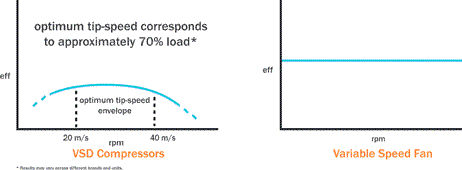
Figure 1. The efficiency of a rotary screw air end is affected by changes in the speed of the apex of the rotary screw (tip), while the efficiency of a rotating fan blade remains essentially constant, regardless of the rotational speed of the fan

This difference stands to reason, given that the rotary screw air end is a far more complex device than a simple fan. A rotary screw air end transforms the volume, temperature and pressure of incoming air, whereas a fan merely moves the air from one side of the fan blade to the other.

VSD compressors, by design, have an optimum tip speed 'envelope' within which they operate most efficiently. The optimum efficiency 'envelope' is usually bound by tip speeds of 20 m/s (at the low end) and 40 m/s (at the high end). A tip speed of less than 20 m/s results in air escaping back through the tip, while tip speeds greater than 40 m/s creates turbulent and inefficient compression.

Unfortunately, VSD compressors are designed to span the entire tip speed range corresponding to 0 to 100% compressor load. As a result, VSD compressors cannot operate within this optimum tip speed 'envelope' across the entire capacity range of the compressor. Manufacturers of VSD compressors predominantly size the air end to operate with an optimum tip speed corresponding to 70% load. When compressor loads reach above or below 85%, the tip speed is in turn adjusted above or below the optimum, and the VSD compressor's efficiency drops away.

As a result, compressors employing VSDs are more efficient than conventional on/off motor-driven compressors through approximately 50% of their capacity range - outside this '50%' envelope they are far less efficient. The manufacturer determines where this '50%' envelope lies. If the compressed air load regularly occurs outside this range, then other compressor options would be best suited to the application in place of a VSD compressor.

A variable output compressor (VOC) represents an ideal solution to maximising the efficiency of compressed air usage on the plant floor. The VOC is able to address changes in compressed air demand without changing the tip speed, making it one of the most energy-efficient compressed air solutions available. By controlling the delivery of air to the rotary screw air-end, the effective rotor length and compression volume is modified, enabling the delivery of compressed air at the selected capacity and pressure (see Figure 2). The VOC operates at an optimum tip speed across the entire load range (0-100%) and does not change throughout the output capacity range.
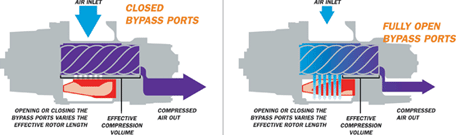
Figure 2
Figure 2

Conclusion: Before spending capital on a VSD compressor, careful analysis of the compressed air requirements of the application is crucial. It may cost more to run a VSD compressor. VSD compressors are only a more efficient compressor option in a limited number of applications. Conventional on/off load compressors are often still a more cost-effective solution.

A rotary screw air end has an optimum tip speed envelope that can be breached by a VSD. When compressor loads frequently reach levels that demand rotor speeds outside of the optimum tip speed envelop efficiency decreases and energy and money is wasted.

The ‘Compressor Myths and Truths’ series is supplied by Champion Compressors, an Australian-based designer and manufacturer of industrial rotary screw air compressors especially designed for harsh environments.




Share this article:
Share via emailShare via LinkedInPrint this page

Further reading:

CompAir introduces compressed air management solution
Pneumatics & Hydraulics
To maximise savings and extend the lifespan of compressed air systems, CompAir is launching the Compressed Air Management Solution powered by Ecoplant, an intelligent system in the cloud that represents the next level in operational management, and maintain the health

Read more...
Heavy impact, smart control
Axiom Hydraulics Editor's Choice Pneumatics & Hydraulics
Every now and then a project lands on your desk that’s equal parts heavy machinery and fine control - a tantalising mix for any engineer. A client approached Axiom Hydraulics with a project exactly like this.

Read more...
Making lines safer with smarter connection
Hydrasales Pneumatics & Hydraulics
Imagine connecting multiple hydraulic lines or a combination of hydraulic, electrical and grease lines with one single, confident movement. That’s the everyday convenience operators get from Faster’s MultiFaster multi-coupling systems.

Read more...
Achieving clean and dry compressed air
Artic Driers International Pneumatics & Hydraulics
Compressed air is an expensive source of motive power so it makes good sense to supply clean, dry compressed air to your distribution system.

Read more...
Navigating ISO standards in hydraulic cylinder manufacturing
Pneumatics & Hydraulics
For hydraulics professionals, understanding and leveraging ISO standards is a powerful way to ensure quality and gain a competitive edge. Here is a guide to the most critical ISO standards for hydraulic cylinder manufacturing, showing how to use them to your advantage.

Read more...
Hydraulic system upgrades to boost performance and save money
CT Hydraulics (Nqoba) Pneumatics & Hydraulics
Those working with hydraulic or pneumatic systems know that keeping your machinery running at peak performance balances productivity and cost. As systems age, they often become less efficient, requiring more energy and more frequent repairs. The good news is that you don’t always need to invest in an entirely new machine to solve these problems.

Read more...
Top 10 questions about pressure and temperature gauges
SA Gauge Pneumatics & Hydraulics
Some questions never go out of date, and in our industry, a few have been asked for decades. At SA Gauge, we hear them every week. Here are the ten questions we hear most often, and the practical answers that can save time, money and frustration.

Read more...
Gauge maintenance and calibration tips for shutdown or restart periods
SA Gauge Pneumatics & Hydraulics
As the year winds down, many plants across South Africa prepare for the annual shutdown. It’s also the perfect opportunity to give your pressure and temperature gauges the attention they deserve.

Read more...
Axial piston pump series for next-gen hydraulic applications
Pneumatics & Hydraulics
Moog has launched its new AXP Axial Piston Pump Series, a next-generation hydraulic solution engineered to deliver optimal performance, reliability and cost efficiency for industrial applications.

Read more...
The role of analogue gauges in a digital world
SA Gauge Editor's Choice Pneumatics & Hydraulics
With so much focus on digital systems, remote monitoring and automation, it’s easy to assume that traditional analogue gauges have become outdated. Yet if you step into almost any plant, mine or processing facility, you’ll still find them in daily use, quietly doing their job without fuss.

Read more...


While every effort has been made to ensure the accuracy of the information contained herein, the publisher and its agents cannot be held responsible for any errors contained, or any loss incurred as a result. Articles published do not necessarily reflect the views of the publishers. The editor reserves the right to alter or cut copy. Articles submitted are deemed to have been cleared for publication. Advertisements and company contact details are published as provided by the advertiser. Technews Publishing (Pty) Ltd cannot be held responsible for the accuracy or veracity of supplied material.


© Technews Publishing (Pty) Ltd | All Rights Reserved